

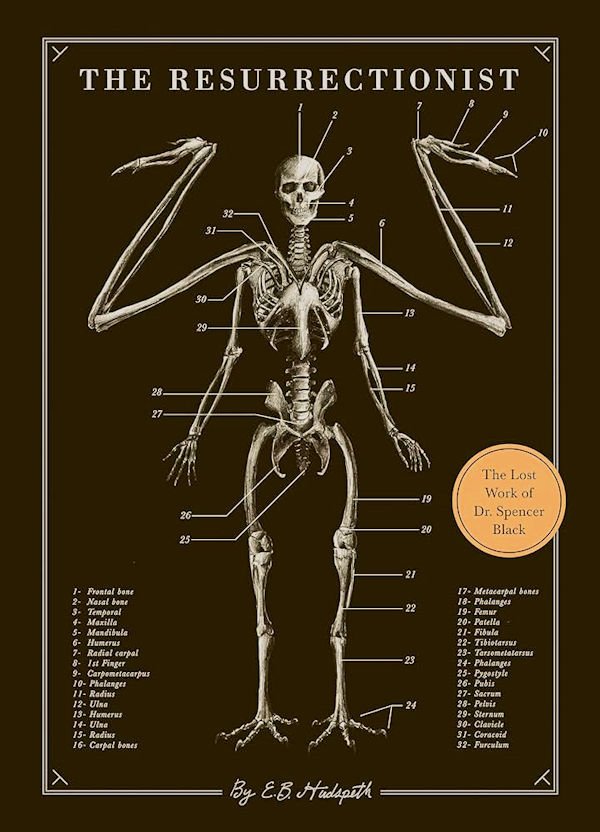
Philadelphia, the late 1870s. A city of gas lamps, cobblestone streets, and horse-drawn carriages—and home to the controversial surgeon Dr. Spencer Black. The son of a grave robber, young Dr. Black studies at Philadelphia’s esteemed Academy of Medicine, where he develops an unconventional hypothesis: What if the world’s most celebrated mythological beasts—mermaids, minotaurs, and satyrs—were in fact the evolutionary ancestors of humankind?
There is a specific kind of book I will always pick up: fictional non-fiction. Give me a fabricated academic, a lost manuscript, a forged field guide, and I am completely gone. The Resurrectionist by E. B. Hudspeth is exactly that kind of book, and it has lodged itself somewhere permanent in my brain.
The premise is gloriously unhinged in the best possible way. Dr. Spencer Black, surgeon and son of a grave robber, becomes convinced that mythological creatures—sphinxes, sirens, centaurs—were not legend but evolutionary ancestors of humanity. What follows is a portrait of a man sliding from gifted to obsessed to lost, and the line between genius and madness feels thin as it so often is.
My only complaint is I wanted more. More length, yes, but also more depth. The descent from brilliant surgeon to carnival showman to whatever he became at the end deserves more room to breathe. I wanted to feel each step of that unravelling in more detail, not just watch it happen at a distance. If we got a bit more depth here, this would have been a *perfect* read for me.
The second half is the The Codex Extinct Animalia: full anatomical plates of mythological creatures, rendered with the dry precision of a genuine medical textbook. They are stunning. Meticulously detailed, completely committed to the bit, and absolutely the work of someone with a very specific and wonderful obsession.
But here is the thing. The art gets its meaning from the story. Without Dr. Black’s biography, the Codex is beautiful curiosity. With it, every plate becomes a document of a brilliant mind coming apart at the seams. That reframing is everything.
If you love fictional non-fiction, scholarly characters going gloriously off the rails, or just something that feels genuinely unlike anything else on your shelf, this one is worth your time.

