

The goblins have killed all of our horses and most of our men.
They have enslaved our cities, burned our fields, and still they wage war.
Now, our daughters take up arms.
Galva?Galvicha to her three brothers, two of whom the goblins will kill?has defied her family’s wishes and joined the army’s untested new unit, the Raven Knights. They march toward a once-beautiful city overrun by the goblin horde, accompanied by scores of giant war corvids. Made with the darkest magics, these fearsome black birds may hold the key to stopping the goblins in their war to make cattle of mankind.
The road to victory is bloody, and goblins are clever and merciless. The Raven Knights can take nothing for granted?not the bonds of family, nor the wisdom of their leaders, nor their own safety against the dangerous war birds at their side. But some hopes are worth any risk.
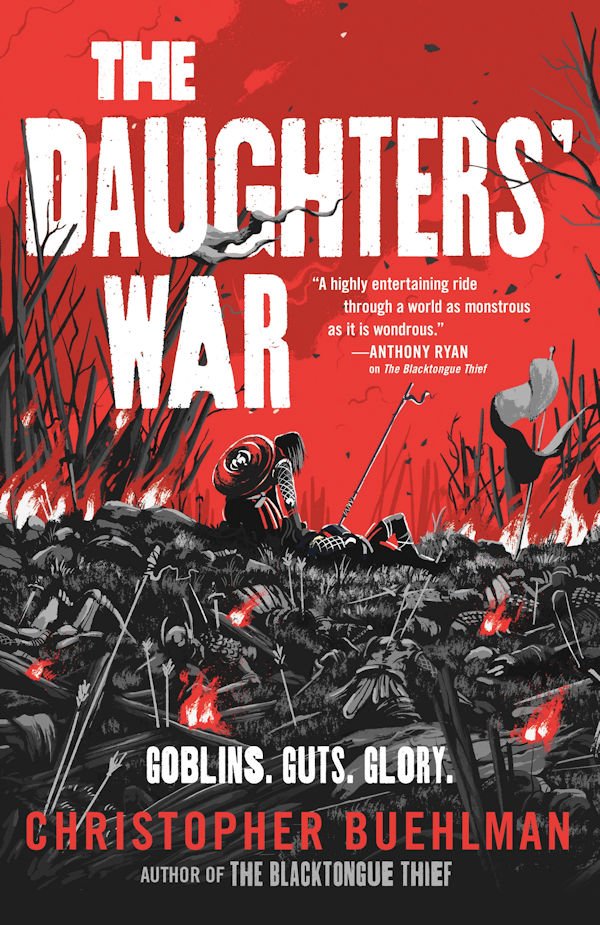
Set before Christopher Buehlman’s first novel, The Blacktongue Thief, The Daughters’ War is a harrowing prequel following Galva. Born into the powerful Dom Braga family, she forgoes her birthright to experience the brutal reality of war at the front, in the killing grounds. She joins the Knight Ravens, an all-female unit forged as a unique weapon against the goblins. Warriors who fight not only with blades, but alongside magically imbued war birds known as corvids. Enormous, intelligent, and created to kill.
We follow Galva as she traverses a continent under the constant threat of war. It’s harsh, grounded, and deeply harrowing. I felt a persistent sense of dread throughout; the atmosphere Buehlman creates feels exactly as I would expect from a world besieged by such relentless and overwhelming conflict. This isn’t a story about the war itself, but an eyewitness account of the terror, survival, and desperation that surround it.
The narrative is told almost entirely through Galva’s perspective, with occasional interludes in the form of journal entries from her younger brother, Amiel. More sensitive and introspective, he serves as a contrast to Galva’s often harsh and resolute voice, offering a more romanticised view of the war.
I did find the opening somewhat slow, and I didn’t immediately warm to Galva as a protagonist. At first, she felt slightly one-dimensional, but this may be what ultimately made her arc more compelling. As the story progresses, the characters deepen, and I found myself increasingly invested—almost as if I had become part of her journey.
Buehlman provides little exposition, forcing the reader to find their footing in a world already deep in conflict. You’re thrown violently into a war featuring one of the most disturbing depictions of goblins in modern fantasy. The Biters are not comic sidekicks, but grotesque creatures drawn from folklore. A true medieval nightmare. They treat humans (known as kynd) like cattle. Animals to be caged, butchered, and consumed. Their complete disregard for sentience is deeply unsettling. They linger as a constant oppressive threat, forcing Galva to draw on every ounce of courage and resolve.
Despite the horror and relentless conflict, there is an emotional depth that grounds the story. This, I think is what elevates it beyond the ordinary: The relationships. Through these interactions, we experience Galva’s emotions in their rawest form. Unconditional love, fierce pride, deep pity, and bitter hate. We watch an otherwise hardened character soften through her exchanges with her brothers, her bond with her corvids, and her exploration of her sexuality. It feels believable. Her evolution is not fantastical, but deeply human, making it easy to connect with her on a personal level.
The pacing in this book is exceptional. Where some fantasy leans into constant escalation, epic battles, relentless action, and rapid reveals, Buehlman takes a more measured approach. He carefully inserts quieter moments where everything slows, allowing the reader to reflect and fully absorb the intensity of what surrounds them. This balance prevents fatigue and gives greater weight to both the action and the stillness. These quieter scenes also reveal Galva’s more empathetic side, making her journey all the more compelling.
Brutality is where the novel truly shines, particularly on the battlefield. The combat scenes are visceral enough to make even seasoned grimdark readers wince. They’re not overly technical or weighed down by strategy. Instead, they focus on sheer carnage and vivid detail, creating something both gripping and disturbingly authentic.
However, it would be impossible to review this book without mentioning one of its greatest strengths: the corvids. These magically engineered war birds, related to crows, are humanity’s last hope against the Biters. Formidable in every sense, they anchor Galva’s story through a deeply intense and protective bond. They represent both hope and uncertainty, something that runs throughout Galva’s journey. With each chapter, she faces new and unknown challenges, and it is this fear of the unknown that resonates so strongly. It’s something we all recognise.
The ending to this story is a true high point, building to a peak of intensity, violence, and emotion. In its final moments, you’re exposed to raw extremes. From absolute terror to pure elation. I found myself completely absorbed, unable to put the book down as it surged toward a deeply satisfying conclusion.
As a prequel to The Blacktongue Thief, its objective is to build a compelling foundation for Galva, to give her actions and temperament greater weight and meaning. In my opinion, she is more than worthy of her own narrative. It would be interesting to see how this new depth to her character would add to a re-read of The Blacktongue Thief.
The Daughters’ War isn’t just a grimdark fantasy tinged with horror; it’s a complex story of resilience, personal discovery, and companionship. It drags you into the blood-soaked mire of the battlefield, leaves you trembling at the presence of the Biters, and pulls at your emotions through the bonds between family, companions, and lovers.
But perhaps Galva puts it best, “Short life, bloody hand.” It’s less a warning than a promise. One forged in war and survival. A promise to yourself, to others, and to your enemies. It echoes the very heart of Buehlman’s work. Brutal, unflinching, and quietly devastating. It leaves an impression that is difficult to shake. And for those who are caught up on the series, we’ve not long to wait until the next book. The Thrice-Bound Fool is releasing in October later this year.

