

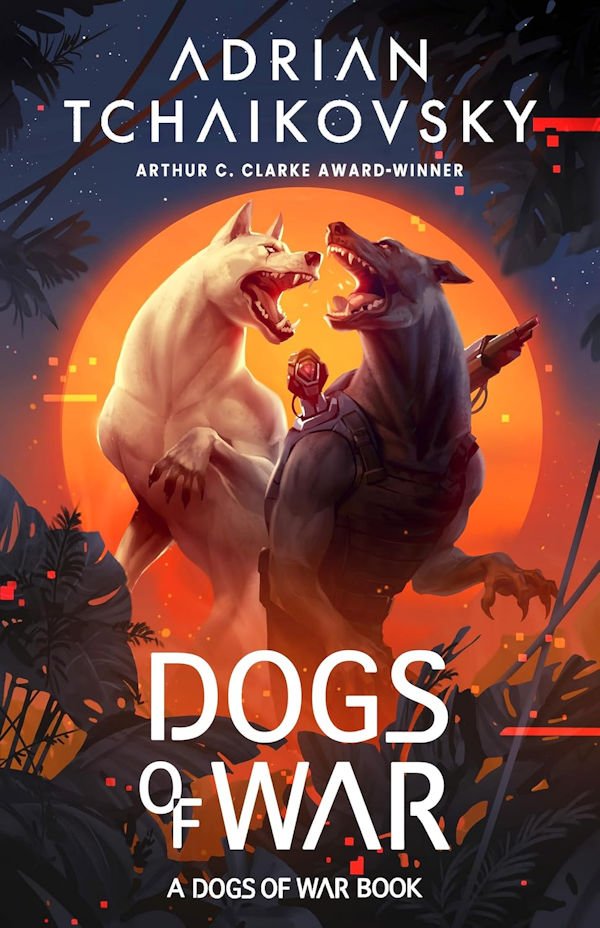
My name is Rex. I am a good dog.
Rex is also seven foot tall at the shoulder, bulletproof, bristling with heavy calibre weaponry and his voice resonates with subsonics especially designed to instil fear. With Dragon, Honey, and Bees, he’s part of a Multiform Assault Pack operating in the lawless anarchy of Campeche, south-eastern Mexico.
Rex is a genetically engineered Bioform, a deadly weapon in a dirty war. He has the intelligence to carry out his orders and feedback implants to reward him when he does. All he wants to be is a Good Dog. And to do that he must do exactly what Master says and Master says he’s got to kill a lot of enemies.
But who, exactly, are the enemies? What happens when Master is tried as a war criminal? What rights does the Geneva Convention grant weapons? Do Rex and his fellow Bioforms even have a right to exist? And what happens when Rex slips his leash?
My name is Chris. I am a reviewer. I write book reviews. I want the people who read my reviews to like them. That will mean they want to read more of my reviews, and that means I am a good reviewer, and the editor will be pleased. They might even say, “Good Boy.” Hearing that makes me happy. My name is Chris.
If you find this kind of narrative voice amusing, as I did, I recommend reading this book, because that’s how the majority of Dogs of War by Adrian Tchaikovsky reads. Trust me, it’s endearing as heck.
The story follows Rex, a genetically engineered dog bioweapon (or bioform in the book), as he navigates the warzones of a future Earth. At first, his point of view comes across as clunky, but it really shows the kind of thinking instilled by his creators and handler (A.K.A. his “master”). Throughout the book, Rex’s point of view (POV) is interspersed with those of human characters: spies, lawyers, and even other bioforms. Considering how unique Rex is, his voice actually becomes a style you look forward to returning to. Whenever there were other characters’ POV chapters, I found myself anticipating Rex’s chapters to see what trouble he was getting into and how that experience would further shape his perspective on his role in society, as his character develops so much both artificially through sci-fi plot devices and naturally through his curiosity and relationships.
The book explores what war could look like in the future should the ethics around genetic engineering and animal rights fail to such an extreme for the sake of avoiding human casualties. Bioforms have been created in response to military robots’ code going rogue, causing them to malfunction and be deemed unreliable, an allusion to our present AI and drone technology, perhaps? Dogs were the best choice, after all, no other animal shares the cross-species positive brain chemistry dogs and humans do. This is reinforced with biofeedback, which chemically encourages obedience in a very Skinner-like positive reinforcement. Although there are similar experiments done on other animals, bears, lizards, and even a hive of bees, these all have outstanding consequences, which become all the more interesting when in a team with Rex.
Despite the horrific things Rex and his team initially do, his voice reveals how innocent he is as he follows orders from the corrupt military contractor and the main antagonist, Murray. Rex sees Murray as his ‘master,’ and the questioning of his orders and his struggles to break free of him and the biofeedback chip’s influence make up a large part of his story arc.
Rex’s evolving responses to his own behavior and to his interactions with the other humans he encounters reveal how external influences contaminate and exacerbate his rebellious impulses. He doesn’t want to be a bad dog, but when the communication between him and his master is cut, he gets his first taste of autonomy, which changes everything. Eventually, he becomes a leader of other bioforms, but his old master still attempts to control him. Seeing Rex’s inner struggle and how Murray influences him makes you want to reach into the book and whisk Rex away from the difficult situations he finds himself in.
Who wouldn’t feel bad for a dog being shot at in a war zone? He didn’t choose to be there. His childlike, black-and-white manner of thinking makes the later portions of the story all the more tragic, as he is dragged through a political whirlwind of court cases to prove that he and bioforms like him are intelligent creatures, not merely weapons.
The way the humans in the book respond to Rex and his pack is confronting, particularly those who see them as nothing but murderous monsters, but that’s another reason I enjoyed Rex’s POV in this book. You are given the perspective of a monster who is sensitive and intelligent, and who doesn’t really want to be a monster, but has been manipulated into becoming one on a biological level. How humans react to these “monsters” is just as telling. You could probably look back at all the people you’ve ever met in your life and be able to identify someone who fits into each human role in the story. All of their reactions and responses feel genuine, which is why the characters who reach out and try to come to know Rex feel so much more courageous and kind.
This book is not a cozy read; it is a pessimistic look at the future of humans through the eyes of a creature who doesn’t fit in but desperately wants to. This gives it a lens of hope, particularly regarding how even the most messed-up futures can be redirected onto a more promising path by the courage of a few, and that message isn’t something I take for granted these days.

