

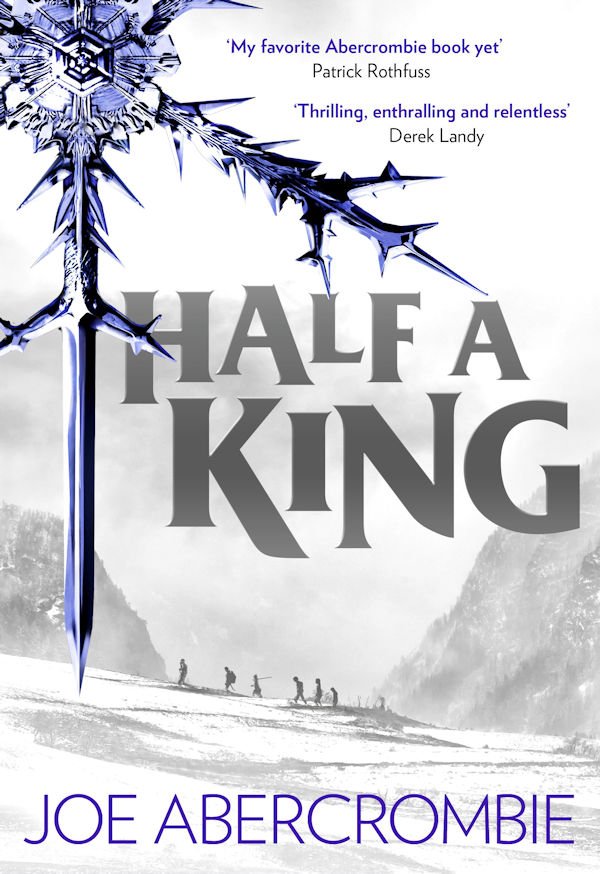
Imagine if Half a King had been published without the letters ‘YA’ anywhere near the cover. Just a new novel by Joe Abercrombie, author of The First Law, arriving with a maimed prince, a brutal world of raiders and slave ships, and a story about revenge, survival, and the uneasy weight of power.
Would readers see it differently?
It’s a strange question, but one that sits quietly behind almost every discussion of Abercrombie’s Shattered Sea trilogy because when Half a King was released in 2014, the thing most people noticed wasn’t the story itself.
For an author famous for some of fantasy’s bleakest cynicism and most morally compromised characters, the shift seemed unexpected and for some fans it was intriguing, but for others it was a warning sign. Yet over a decade later, the question is still worth asking: not whether Half a King is YA, but whether that label has obscured what the book actually is.
For many adult fantasy readers, the YA tag suggests certain familiar tropes: a simple plot, clear morality, romance-forward storytelling, and young protagonists’ journeys shaped around a coming-of-age narrative. The world may be dangerous, but the storytelling often feels safe. In contrast, Lord Grimdark’s First Law novels thrived on moral ambiguity, political cruelty, and the uncomfortable truth that power rarely belongs to the virtuous. Readers expecting more of Abercrombie’s razor-sharp worldview might reasonably wonder whether a YA series would blunt the Sharp Ends of The Blade Itself. It’s an understandable assumption but misses what Half a King does.
At the centre of the story stands Prince Yarvi, born with a crippled hand and destined for the ministry rather than the throne—another of Abercrombie’s complicated outsiders whose story begins in failure and somehow still earns our loyalty. What follows is not a heroic quest so much as a harsh education.
Yarvi’s greatest advantage is not strength but intellect. Where other fantasy heroes win battles through physical prowess, Yarvi survives through observation, patience, and calculation. His story becomes one of humility and adaptation. That premise alone already pushes against many YA conventions. The book may be accessible in style and pace, but the themes are unmistakably Abercrombie’s. Trust is fragile, revenge is rarely clean, and good intentions lead to terrible consequences.
The tone carries a familiar edge of dark humour as well. Abercrombie’s dialogue retains the dry wit and quiet cynicism that defined his earlier work. Characters clash, schemes unfold, and victories often come at uncomfortable cost. In other words, Half a King may be shorter and more streamlined than The Blade Itself, but it still feels written by the same author.
In fact, the structure of Half a King may feel quietly familiar to readers of Abercrombie’s other work. Strip away the YA label and the novel follows a pattern he clearly enjoys: a band of unlikely companions travelling across a hostile world while political forces shift behind the scenes. It is a structure that echoes parts of The Blade Itself and appears again, in a different form, in The Devils. They are all stories where misfits, outcasts, and reluctant heroes are pushed together by circumstance and forced to survive through uneasy alliances.
The details change, of course. Half a King is far more tightly focused on Yarvi himself, and the journey is smaller in scale than Abercrombie’s sprawling adult epics, but the bones of the narrative remain recognisable: damaged protagonists, shifting loyalties, dark humour, a world that rewards cunning more than heroism, and an oddly recurrent hatred of elves! Seen this way, the novel doesn’t represent a departure from Abercrombie’s style so much as a reframing of it.
The Shattered Sea trilogy replaces the sprawling political webs of The First Law with a tighter narrative focused primarily on Yarvi’s transformation. The plot is leaner and moves quickly, driven by clear stakes and sharp reversals rather than layers of intrigue and misdirection. For some readers this simplicity could be a disappointment. Abercrombie built his reputation on complex ensembles and deeply tangled plots, and Half a King doesn’t attempt the same breadth. But that narrower focus also brings its own strengths.
Freed from the weight of multiple viewpoints and sprawling geopolitics, the novel becomes a character study. Yarvi’s growth from uncertain prince to calculating survivor unfolds with satisfying clarity, with each setback forcing him to rethink what leadership, loyalty, and strength actually mean. It’s a classic coming-of-age arc but filtered through Abercrombie’s trademark scepticism about the nature of heroism.
Even so, Half a King often sits slightly outside the core of Abercrombie’s reputation. Part of this is expectation. Readers approaching the novel hoping for another grimdark epic may find the story comparatively straightforward. The pacing is faster, the cast smaller, and the narrative more focused on a single protagonist. In many ways, it is similar to the reception of The Devils.
Another factor is simply familiarity. Abercrombie’s later return to adult fantasy with the Age of Madness trilogy reinforced what many readers loved most about his writing: expansive worlds, dense politics, and a broad range of morally complicated characters. Against those works, Half a King inevitably feels lighter. Yet that difference doesn’t necessarily make it lesser. It simply means the book is trying to achieve something slightly different.
Seen from another angle, the YA structure sharpens the storytelling. The tighter focus gives the novel momentum. The coming-of-age framework aligns naturally with Yarvi’s transformation, and his journey from reluctant prince to strategic thinker fits comfortably within the emotional clarity that YA narratives often emphasise.
At the same time, Abercrombie never abandons the darker instincts that define his writing. The world remains harsh, alliances remain fragile, and even moments of triumph carry complicated consequences. Rather than diluting Abercrombie’s voice, the format forces it into a more concentrated form.
Which brings us back to that opening question. If Half a King had been released without the YA label, it might well be discussed differently today. Readers might simply see it as a leaner Abercrombie novel. Instead, the marketing category placed it in a slightly awkward middle ground between audiences; it was too grim for some YA readers, too labelled for some adult fantasy fans. Yet the book itself remains an engaging and cleverly constructed story. And perhaps that’s the quiet irony at the heart of Half a King. The very label designed to broaden its audience may also have discouraged some of the readers who would enjoy it most.
Half a King may not reach the sprawling ambition of Abercrombie’s most celebrated work, but it succeeds on its own terms: a sharp, fast-paced story driven by a clever and compelling protagonist. It is still recognisably Abercrombie. Just focused through a different lens. Readers willing to look past the label may discover the distance between YA fantasy and grimdark isn’t quite as wide as they once thought.

