

A bargain with a fortune beast guarantees luck, but the price is a future devoured.
Reed’s luck has run out. After causing the deaths of his fellow fortune weavers, he spends twelve years searching for atonement. His luck turns when he finally finds what he desires: a fortune beast who can teach him to fix his mistake.
But all knowledge comes at a cost.
The ancient beast offers him a bargain: the power he needs to weave a fortune construct that can resurrect the dead. In return, all he must do is listen to the story of Daryifel the Eighty-Seventh.
Intrigued, Reed agrees. Yet he quickly realizes that Daryifel’s story is no simple tale, and he finds himself trapped to the fortune beast’s bidding. Attempting to protect the future by unweaving the errors of the past, Reed must face a dangerous truth:
A bargain with a fortune beast cannot be so easily broken.
If your land and your people were dying, how far would you go to get the future you wanted? Would you steal somebody else’s luck to ensure your own?
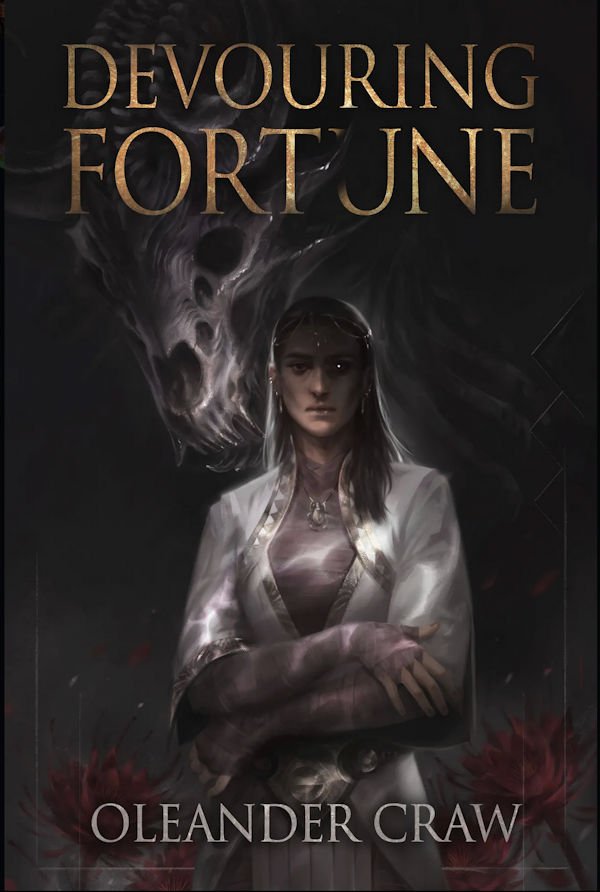
Devouring Fortune by Oleander Craw is the story of two characters in different times with the same problem: their worlds are gradually succumbing to an environmental disaster, which is slowly poisoning the land and all the living things on it. To save his people, Reed tracks down a Fortune Beast with the power to delay the Calamity. But before the Beast will help Reed, he asks Reed to listen to a story about an ambitious priestess of Fortune offered a similar bargain by Fortune herself. Reed and Daryifel, the priestess, are driven characters who take big chances to achieve their goals, and this makes for an absorbing read as their stories twine together ever closer and we discover everything that Reed and Daryifel believe in may not be what it seems.
First of all, let me say I was offered an ARC of this novel, and this is my honest review: Devouring Fortune is one of the best indie novels I’ve read, period. For a debut, it’s an incredibly mature book. The prose is strong, the plotting is tight, and the conflict is believable and never lets up. But my favorite aspect of Devouring Fortune is the world.
I feel like saying, “I’m a fan of worldbuilding,” immediately conjures an image of giant epic fantasy: thousands of years of “lore” (I had an editor tell me once I should add more lore to a book, and I’m still not exactly sure what she meant), hard magic systems, wikis stuffed with esoteric knowledge, painstakingly and lovingly maintained by their authors. To be clear, I’m not saying there’s anything wrong with that (I wish I had started a wiki myself), but Devouring Fortune is not that sort of book. It’s also not the worldbuilding-lite that has become popular in romantasy, where worldbuilding is kept to a bare minimum in order to focus on the characters’ relationship. This is a third thing, my favorite thing, where the world and the characters and the story all meld together. If you changed the world of this story, the story would collapse, and the characters would all be different people. In fact, you couldn’t even conceive the story outside of this world.
In keeping with its two storylines, Devouring Fortune features two separate settings: Reed’s, where forests survive but are in danger, and Daryifel’s world, which is made up almost entirely of salt.
As an anthropology nerd, I love how salt isn’t just the seasoning of the book, it’s the foundation of Daryifel’s world. The settings are described so well you can almost taste them. Daryifel is a priestess of Fortune, living in a crumbling temple surrounded by salt marsh. Her job is to lead pilgrims through a salt cave system, called the Underluck, for a chance to drink water tainted by the bones of a Fortune Beast in the hopes of gaining the future they want.
Salt, bones, and fortune structure everything about the way Daryifel’s people view their world. They make up all their metaphors and form their worldview. A lot of books, even those with intricate, original worlds, basically plunk modern characters down into them. But not here. It’s completely clear these characters come not only from a different place, but a different culture. An alien world, but one the writer is letting us into.
I also liked the story’s treatment of fortune. Epic fantasy is full of prophecies that seem to negate free will; sometimes it seems like humans are just warring against the inevitable, and in that case, why even try? Devouring Fortune portrays its characters in a fight of free will to control a destructive destiny they believe can be changed. In this case, there is no fate, only human love, hate, and ambition, all of them battling each other (often within the same character) to determine the future. I liked this a lot. The stakes are save-the-world, as in many epic fantasies, but Craw reins the plot in tight, so the story won’t get out of hand.
If I had one ask, it would be that the characters were allowed to expand a little, to show us a few more dimensions rather than just those that directly relate to the story. But that’s more an observation than a criticism. This isn’t the kind of book with lingering character asides. I wouldn’t say the book is fast-paced—there’s a lot of worldbuilding to absorb (never in a confusing way) and the twin stories necessarily slow the pace a bit—but it does drive on relentlessly from the start to the climax. The characters have goals, and they are determined to reach them—even if reaching those goals means they need to do some pretty questionable things.
Reed and Daryifel are unapologetically ambitious and complicated, and I appreciated that, especially in the context of Fortune’s queer normative world: Reed is transmasc & Daryifel is involved in a sapphic relationship with a palace guard. Too often female and queer characters are held to higher standards of behavior than straight male characters: morally gray female characters are “cold” and “bitchy” and queer characters seem to have to perform in an endless parade of trauma. Not to mention the pressure for these characters to always make correct decisions, or to fit into the limited story roles usually provided for them.
In Devouring Fortune, all the characters just are. They are ruthless and ambitious. They want to do the right thing, but sometimes they do the wrong thing. They grieve and get angry and want to love and be loved. In short, they get to be human.
I liked that both protagonists were allowed to bear a lot of emotional weight, but I have to admit, secretly my favorite character was the rogue, Yashen. I loved his interactions with Daryi, and I ate up every scene he appeared in. Honestly, I think his inclusion in the story allowed Reed and Daryifel to bear the heaviness without it seeming like too much, because Yashen provided some necessary lightness and relief before we dove down into the darkness again.
In summary, if it hasn’t been clear, I loved this book. It’s easily the best book I’ve read this year, trad or indie, and I hope we see a lot more from Craw in the future. If you’re in the mood for a character-driven dark science fantasy standalone that absolutely breathes its world, definitely put this one on your TBR!
The Kickstarter for Devouring Fortune launches this Friday, June 8th! You can check out the campaign and read the first three chapters here! You can also learn more about the book and its author by following them on Instagram, Threads, and Bluesky.

