
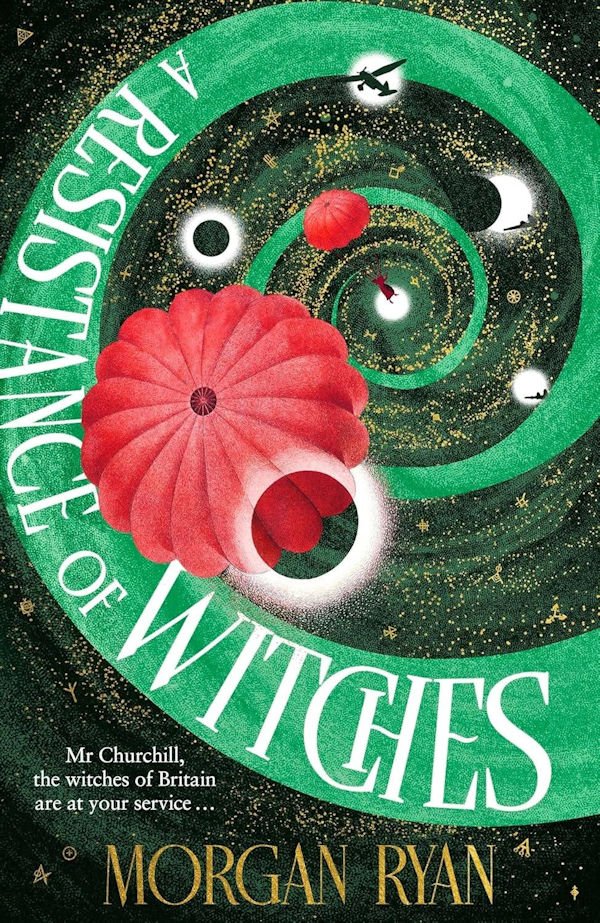
Stubborn, plainspoken, and from an unimpressive family, Lydia Polk never expected to be accepted into the Royal Academy of Witches. Now, with Hitler’s army rampaging across Europe, the witches of Britain have joined the war effort, and Lydia is key to the cause: she must use her magic to track down magical relics before Hitler and his sycophants can.
Then a Nazi witch infiltrates the Academy with heart-breaking consequences, leaving the coven shaken, exposed, and divided. The elder British witches have no interest in further loss of coven life in service of a government that has forced them into hiding for generations. But with the discovery of the Grimorium Bellum, an ancient book that leaves a trail of death and destruction wherever it goes, Lydia knows her mission has never been more urgent.
Alone and woefully outnumbered, Lydia makes her way to the heart of occupied France, where she finds allies in Rebecca Gagne, a fierce French resistance fighter with a secret, and Henry Boudreaux, a handsome Haitian American art historian with a little magic of his own. Together, they traverse the country, stalked by the natural and supernatural alike, in search of the grimoire.
But, as Lydia soon discovers, finding the book is only half the battle, the Grimorium Bellum itself has a dark agenda. Lydia must subdue it before the witches of the Third Reich can use it—but she’ll have to survive the book herself first.
Content Warning for this Book: All of the following was gently and elegantly done by my standards, but there is violence, gore, torture, allusions to sexual assault, and curse words in a surprising number of languages.
English witches helping to save the world from Hitler? Sign me up!
The novel opens with a secret witch academy in the heart of London, giving strong Terry Pratchett’s Tiffany Aching series meets Indiana Jones and Raiders of the Lost Ark vibes. However, it soon becomes clear it’s more of a spy novel meets Lord of the Rings situation. The book centers around a quest to keep the Nazi’s from claiming a dangerous artifact, but the artifact is more of a One Ring than an Ark of the Covenant. Author Morgan Ryan is going for seductive, vicious evil rather than mass invulnerability.
A Resistance of Witches is written in the third person, which made a nice change as first person seems increasingly popular in fantasy (perhaps augmented by the rise of Romantasy) and I’ve read a lot of it lately. The writing is straightforward, the goal clearly to tell a story the author is excited to tell, not to mix action with extended poetic descriptions and mood setting. Which is not to say A Resistance of Witches doesn’t have its moments (more and more so as the book goes on).
As a child, Rebecca would lie awake in the early morning hours, listening to the birds calling to one another, and would feel a sense of hope and wonder cracking open like an egg inside her chest. – Rebecca
The story is told from three points of view, Lydia’s, our witch; Rebecca’s, a French resistance fighter; and Henry’s, an art historian with secrets. This is worth knowing going in, because the second two points of view don’t start until chapter nine, after which the book branches quickly and consistently into being told from the perspectives of all three characters. One at a time, however. There’s no head-hopping here.
The setting is, you guessed it, Europe during World War II (1939-1945), and mostly takes place in Nazi occupied France. This, in fact, is one of the highlights of the book, as Ryan gives us a fantastic glimpse into the perils of being a resistance fighter and/or member of a non-Aryan group in a country under Nazi control. This, in turn, is held up against how witches are treated by pretty much everyone.
“[The witches had] made themselves ordinary in exchange for their safety.”
The historical persecution of witches, juxtaposed with the persecution of non-Aryans by the Nazi’s, is an interesting point on which to balance the plot. Longstanding hatred of and mistrust for witches drives the villains of the story, giving them, from their point of view, justifications for their actions that are disconcertingly apropos to some aspects of today’s world.
“Each and every witch in this sisterhood understands firsthand the tragedy that follows a life lived in the shadows. I understand it too. And I will do everything in my power to restore us to our former glory, if doing so means that not one more witch need suffer that fate ever again.”
Aside from being anti-Nazi, this quick-moving story has some solid feminist streaks. Which is, frankly, to be expected when the central character is a witch.
[Lydia] “You talk as if we were still in the Middle Ages. The world has changed, Vivian.”
“Has it?” Vivian’s tone was mocking. “Show me a world that does not hate a powerful woman, and I’ll show you a world without men.”
Interestingly, and compellingly, this book is also very pro art, a stance you don’t often see in fantasy novels. Not, I doubt, because fantasy authors aren’t all for artistic expression, but rather because it’s not a topic that’s usually a natural fit, as it is here.
“[Any art] that doesn’t align with [Hitler’s] world view, anything that isn’t Aryan enough for them, they have a name for it, they call it Entartete Kunst. Degenerate art…How can art be degenerate?”
A Resistance of Witches is a fast-paced debut novel with a clean, clear storyline and great historical detail, and comes to a satisfying conclusion. There are some twists, but the main focus is on the quest and historical details. The good guys are good, the bad guys are bad, and there were a few moments that made me cry, but perhaps I’m a bit sentimental. The three main characters are interesting, and all three learn more about who they are over the course of the book, though mostly near the end.
What did I like?
A Resistance of Witches is anti-Nazi (hopefully not that controversial of a stance…), pro-women, pro-marginalized/persecuted groups, anti-racist, pro-art, and, while not aggressively so, pro-LGBTQIA+.
There is a great deal of love in this book, and not simply mother to daughter, as one might expect when it comes to covens. That abounds, to be certain, but there is also the love of a mother for her son, and of children for parents. Of siblings for one another. There is generational love, and love found both between those related in traditional senses, and for chosen families. There is also a small amount of romantic love, but that is tangential to the main quest. Related, but not the focus.
This is not to say these relationships are put on a pedestal or shown as perfect. They’re nuanced and believable, and evolve as the story progresses.
He felt…The tangled, frustrating, complicated love she felt for her mother, like trying to unknot a mass of string that refuses to be anything other than a mess.
What didn’t I enjoy as much?
For me, the book was a touch too fast paced. I enjoy a nice flowery description that sets the tone. They exist, mind you, as mentioned above. I don’t mean to imply the novel is devoid of description and tone. Only that I, personally, prefer more.
There are a fair number of extra words and sometimes words used, perhaps, too often in too little space. So, if you’re the sort of reader who dissects the pros as you read (no criticism…we all enjoy ingesting books in our own way…goats will even eat them), this may not be the novel for you. But if you’re in it for the story, don’t be dissuaded.
There are perhaps some small plot indentations (plot holes is too large a phrase). Most of them may fall into the category of, ‘I don’t know that much about witches.’ So, in that aspect, the author may have needed to spoon feed me a bit more information about how magic works. For example, I completely missed things that needed to happen ‘on the solstice’ must happen before sunset.
As I said, that’s a me issue.
My only real complaint is the lack of humor. I know, witches and Nazi. Doesn’t sound like a comedy, does it? So, again, that’s on me as a reader and not a condemnation of the novel in any way.
Final Thoughts
Overall, if you’re up for an adventure-filled read, full of a great deal of witchcraft, villains we can all get behind hating, a smidgeon of voodoo (you’ll just have to read to find out about that), strong female leads (but a great male lead as well), and an epic quest (truly, the fate of the world is at stake), this is the book for you. Especially if you enjoy an author who is sympathetic to the plight of others (as I do), and well-done glimpses into another time.
Men have power the moment they enter the world. Women have to make their own.

