

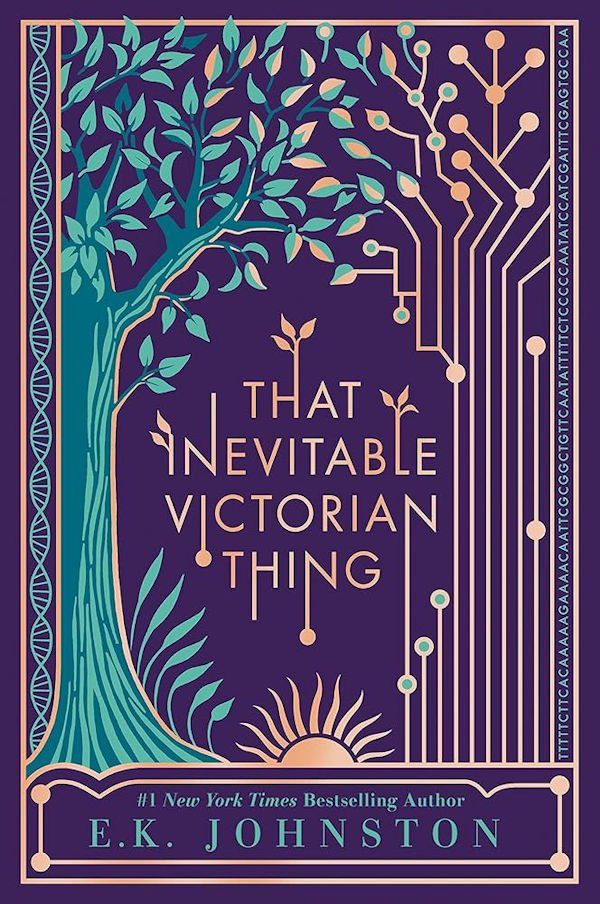
Victoria-Margaret is the crown princess of the empire, a direct descendant of Victoria I, the queen who changed the course of history two centuries earlier.
The imperial practice of genetically arranged matchmaking will soon guide Margaret into a politically advantageous marriage like her mother before her, but before she does her duty, she’ll have one summer incognito in a far corner of empire.
In Toronto, she meets Helena Marcus, daughter of one of the empire’s greatest placement geneticists, and August Callaghan, the heir apparent to a powerful shipping firm currently besieged by American pirates. In a summer of high-society debutante balls, politically charged tea parties, and romantic country dances, Margaret, Helena, and August discover they share an unusual bond and maybe a one in a million chance to have what they want and to change the world in the process —just like the first Queen Victoria.
I’m still not entirely sure how I feel about That Inevitable Victorian Thing. It’s a book that took me quite a while to get into. Nearly the first third felt slow, with little happening plot-wise. It also took some time for me to connect with the characters. But once I found my footing, I genuinely enjoyed spending time with them and seeing how their relationships developed.
The alternate history premise is bold: a future where the British Empire never fell, but instead made the right decisions. Valuing diversity, embracing intermarriage, and building a peaceful, inclusive society. Colonization still happened, but in this version of history, it led to a utopia (mostly) free from racism and hate for anything queer or otherwise different. It’s a bit jarring at first, but the author addresses this directly in the afterword. Johnston makes it clear this isn’t an attempt to erase or excuse the very real harms of colonialism, but rather an imaginative exploration of what could have been, if we had centered inclusion, respect, and joy instead of domination.
On one hand, it’s refreshing to spend time in a world without hate. In the current climate, it felt like a much-needed mental break. On the other hand, something about it still felt a little off. Cultural elements like saris, hijabs, and other global traditions are visible, but the societal structure still leans heavily British. The monarchy remains intact, debutante balls still happen, and despite the diversity on the surface, the power structures haven’t shifted all that much. That contradiction gave me pause.
The queer representation in the book is both lovely and slightly uneven. In this society, queerness is normalized, so there’s no bigotry, and even the church is now following “God” who is an AI-based computer, offering a matchmaking service that pairs people based on genetic compatibility. That setup includes manual overrides for things the computer can’t detect, like being trans, Two-Spirit, or intersex. Those identities are fully respected and accommodated, which is great in theory. But it also raises some strange questions: if this society is so informed and inclusive, why would a character discovering they are intersex be so shocked, so unaware that this was even a possibility? That moment felt discordant in a world that otherwise claims deep awareness and acceptance of identity diversity.
There’s also some thematic tension around queerness and tradition. Being queer is no big deal, unless you’re a royal, where producing heirs is still a core expectation. The story seems to want to challenge that idea, but it doesn’t go quite far enough in questioning whether the monarchy’s outdated values can truly coexist with queer liberation.
That said, I really appreciated the variety of LGBTQIA+ representation: there’s a sweet sapphic romance, an intersex character, bi characters, possibly a polyamorous dynamic, and more. The normalization of all these identities is one of the book’s strengths, even if some moments didn’t quite land for me.
My biggest complaint is the ending, which felt rushed and overly tidy. Problems that were set up as potentially complex were resolved in just a few pages, some with little to no explanation. Others through major decisions handed down by other characters, without discussion or compromise. The characters accept life-altering changes far too easily, with no sign of inner conflict or emotional processing. I wanted more: more time to wrestle with the implications, more space to explore how those resolutions might play out.
That Inevitable Victorian Thing is far from a perfect read, but it’s an intriguing and unique one. It presents a hopeful, inclusive future that’s rare in fiction, especially one where queerness and cultural diversity are both celebrated. While some aspects felt underdeveloped or too idealized, I still appreciated the time I spent in this world. It gave me things to think about, characters to root for, and a glimpse of what could be, if we centered empathy, inclusion, and love.

