
A little bit of sin is good for the soul.
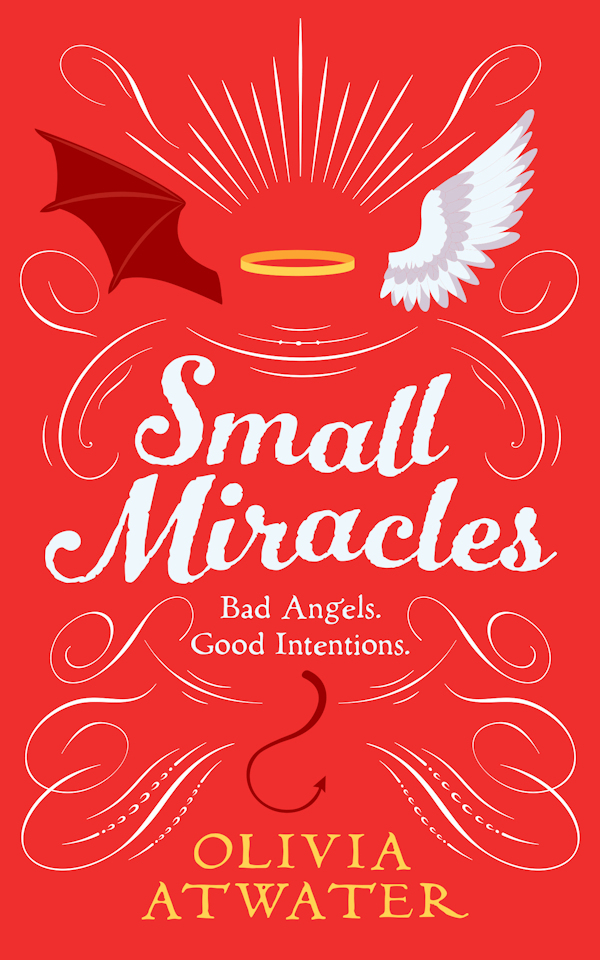
Gadriel, the fallen angel of petty temptations, has a bit of a gambling debt. Fortunately, her angelic bookie is happy to let her pay off her debts by doing what she does best: All Gadriel has to do is tempt miserably sinless mortal Holly Harker to do a few nice things for herself.
What should be a cakewalk of a job soon runs into several roadblocks, however, as Miss Harker politely refuses every attempt at temptation from Gadriel the woman, Gadriel the man, and Gadriel the adorable fluffy kitten. When even chocolate fails to move Gadriel’s target, the ex-guardian angel begins to suspect she’s been conned. But Gadriel still remembers her previous job. And where petty temptations fail, small miracles might yet prevail.
The SPFBO Champions’ League rolls on! Ten champions enter, only one can wear the ultimate crown, but honestly, when the books are this good, we readers are the real winners.
So without much further ado, here’s our thoughts on Small Miracles:
Yaniv
I consumed this book as audio read by Rafe Beckley.
I’ll start out by stating that the narration by Beckley was stellar and made this story a pleasure to consume. I will definitely be looking out for more of his narrations.
In this wholesome fantasy book, which is also a SPFBO finalist, the fallen angel of petty temptation is given one simple mission: make a lady by the name of Holly Harker commit a few small sins to make her life a bit more interesting. Sounds innocent enough, right? However, often simple things become complex, as life gets in the way.
It turns out that tempting our dear goodsouled Holly requires much more than a bit of fun or chocolate, as she’s struggling with some family drama as well as a very mundane existence. It also involves fighting a serious calamity and some of the worst math/history test questions anybody has ever encountered. In addition, while I usually prefer much darker tones in the stories I consume, this book expertly juggled true moments of sadness and regret, as well as loyalty, sweets and genuine humor.
I took a break from reading tomes to read this and one other extremely popular cozy book. While this may be a salty opinion, although this book featured less coffee, I felt it was stronger and more wholesome than the other, while not requiring as much worldbuilding. I also thought the book did a good job of tackling themes such as remorse and trauma in a way that was relatable without being overly dramatic or falling into cliché.
I highly recommend this book and will keep my eye out for more of Atwater’s works!
Patrick
Small Miracles is often pitched as being like Terry Pratchett, particularly Pratchett’s Good Omens, probably because of the extensive footnotes and the setup of the rival angel and fallen angel. However, it reads much more like a Connie Willis story than a Pratchett one (this is no bad thing; Connie Willis has won eleven Hugo awards and seven Nebula awards), although it is cosier than most of Willis’s work. It is, in general, a story of decent people trying to do their best, in particular, Gadriel, the Fallen Angel of Petty Temptations, Holly Harker, the woman the angel is sent to tempt, and Ella, Holly’s niece. Each of them is trying to get by in difficult circumstances and at times making a mess of it.
Overall, this is a charming story, with lots of chocolate and likeable characters, and I’ve enjoyed seeing cosy fantasy make an increasing impact in SPFBO, a contest that tended to favour epic fantasy and grimdark fantasy at its outset.
I’ve been meaning to say since we started reviewing the champions of SPFBO that all ten champions are fantastic novels, and trying to rank them in order is a nearly impossible task. They are all very, very good. It does mean that to do so requires a little more nit-picking than I would generally engage in, but almost every one of these books deserved to win its contest.
That said, I had a few issues with this book, some of which are personal preference, some of which are less so. In the former case, I have to admit I am not a fan of footnotes in fiction. I haven’t read any books where I think they add to the story since Terry Pratchett. In general, I find they interfere with the flow and are rarely worth the diversion, and that was my experience here. Eventually, I stopped reading the footnotes and started to enjoy the book a lot more.
My other issue comes with the setting. Small Miracles is set in an approximately contemporary period in London. Unfortunately, too many of the details didn’t quite ring true, and this was particularly so in the parts of the book set in a school. British schools just don’t work like that. A lot of the details were either things that haven’t been true for British schools for decades or are things that happen in North American schools but not British schools. Maybe it’s just because I’m a former teacher and because I have kids currently in schools that this stood out so much. If you’re not in the same situation, that may not be an issue.
Despite these minor reservations, this is a warm, charming, entertaining book that will appeal to people who like cosy fantasy or who enjoy Connie Willis’s lighter works.
Julia
Small Miracles by Olivia Atwater was a complete delight from beginning to end. This book deserves a standing ovation from my bookshelf. I picked it up meaning to just sample a chapter, and suddenly the evening was gone. I only stopped at night because the alarm clock was already glaring at me, and even than it was hard!
At first I thought it might simply be a lighthearted read. The opening felt almost too easy, deceptively so, and I wondered if it would end up as nothing more than a depthless popcorn story. What surprised me was how quickly the characters worked their way into my heart anyway. The odd collection of people, and of course the fallen angel with a sweet tooth, became impossible not to care about. By the time I reached the final page, it felt like I was saying goodbye to friends.
The story is funny, warm, and filled with that wonderful sense of found family. Friendships form, love begins to bloom, and yet it never tips into being overly sentimental. The humour keeps everything bright and sharp. In fact, the tone reminded me a lot of Terry Pratchett: witty, a little ridiculous in the best way, and often sneaking up on you with a line of truth.
Gadriel, the sugar-obsessed angel, was a real highlight for me. Their straightforward, almost literal way of speaking made me smile again and again. At times they reminded me of Discworld’s Death, who could conjure a grin even while, or rather by, delivering the most matter-of-fact observations.
What I loved most was the balance. Beneath all the joy and laughter, Atwater does not shy away from heavier themes. There are moments of grief, loneliness, and simply feeling overwhelmed by life. These are handled with care, which makes the lighter moments all the more meaningful.
I also want to mention how the book plays with ideas of gender. Angels are not tied to human definitions, and when they appear on earth, they shift from one presentation to another as they wish. The way people simply accept this in stride gave me a warm glow. It felt both humorous and quietly affirming.
Small Miracles is a funny, tender, and uplifting tale about friendship, love, and the everyday magic that makes life worth living. A book I’d hand to anyone who needs a smile.
Kerry
“This is the book I didn’t know I needed as it was the balm for a terribly bad personal year.
“I also loved the footnotes and the humour within them; it takes a good author to do these well … I must admit to some muffled laughter and nose snorting giggles on the morning commute whilst reading them.
“[My] profound thanks to Olivia Atwater for the pure joy this book bought me and enforced my belief in the power of chocolate.” – from my original review of Small Miracles for SPFBO #8
I have reread Small Miracles twice more since that initial read and my thoughts have remained the same. It still is a cosy read when you want something short and comforting when real life makes you want to scream or cry. Whilst it is not a book with high stakes, it does contain those real, slice of life problems that at the time personally feel like it’s the end of your world; e.g. if you’re an adult your teenage kid hates you, your job sucks, and your social life is more extinct than the dodo and someone is STEALING YOUR CHOCOLATE. If you’re a young adult, your supposed BFF is a bitch, school sucks the Kumara, and the adults in your life don’t understand anything.
However, this is just the icing on the top, there’s a density to the cake underneath because this book also deals with death, how we perceive loss, and the expectations society puts on us on how we are supposed to respond to a deceased person, especially if they’re family. There is also some generational trauma and the issues that come with familial addiction. I thought all these were dealt with extremely well and the humour used never detracted from the impacts these issues have on people.
I loved how positively gender queer this book is, there is no judgement at all with regard to anyone’s sexuality or appearance. Gadriel appears as a different gender more often than he changes his vest and there’s a wonderful teacher (though not a favourite of the students) who gets the most “…terrifying vengeance of a very angry lesbian atheist.”
I read the footnotes altogether at the end of each chapter; flicking back and forth between the book and each footnote often disrupts the flow/pacing of the book but there’s a number of footnotes that still make me LOL, such as, “The Rococo art movement has convinced far too many people that the cherubim are harmless, baby-faced children with wings. In fact, they are powerful, eldritch angels whose genders involve far more wheels, eyes, and extra faces than even Ezekiel could accurately describe. As a rule, no one ever wants to involve the cherubim.”
Or, “You needn’t feel bad for the chihuahua. Just as God created the platypus out of spare parts, Lucifer created the original chihuahua out of spare spite. There may be many greater evils in this world, but one would be hard-pressed to find a more concentrated form of evil than the average chihuahua.”
I do however think this book should come with a CW: do not read this book at 3am whilst suffering from insomnia and then discover there is NO chocolate in the house, in any form!!
Adawia
This one’s quite the page-turner—my desperation to know how each situation was going to play out, to know what happens next, was tempered by my desire to absorb this story with absolute deliberation. The temperance is worth it.
One of my favourite aspects of this book is how deftly Atwater manages the gender switching. I can’t put my finger on why or how it works, but I was never confused or unsure nor did I forget the characters’ gender at any given time (this may not make much sense here, but it will when you read the book).
Small Miracles is a mostly feel-good story, with a cool, unique approach to angels and demons, good vs evil, temptation and forbearance. It explores grief and indifference and family relationships and friendships in a way that is meaningful without being too heavy. It’s fun and clever and completely engrossing. If you like Justin Lee Anderson’s Carpet Diem (which I love) I think you’ll definitely enjoy Small Miracles. Plus, there are statistics, so If you enjoy reading LitRPG, you may also enjoy this (technically it’s a running tally, with a little explanation on how the ‘points’ system works, but still).
While I thoroughly enjoyed this story, there’s one thread involving the three young girls I wish had played out a little differently—I just feel the way that bit went wasn’t quite ideal (for my liking anyway).
[Mild Spoiler: I would have liked to see a little more distribution of culpability regarding the animosity shared between the girls, particularly given—at one point—all three were being ‘whispered’ to. I don’t feel like Ella’s actions were horrid enough to warrant the treatment she received from her friends, yet some of her friends’ responses were awful enough to justify Ella’s reactions.]
This is a quick, easy read with enough complexity and humour to maintain engagement and enjoyment throughout.
Our ranking now stands at:
- The Thief Who Pulled On Trouble’s Braids by Michael McClung (champions’ review/original review)
- Murder at Spindle Manor by Morgan Stang (champions’ review/original review)
- Small Miracles by Olivia Atwater (original review)
You can see the full score sheet for all the other blogs judging the contest here.

