

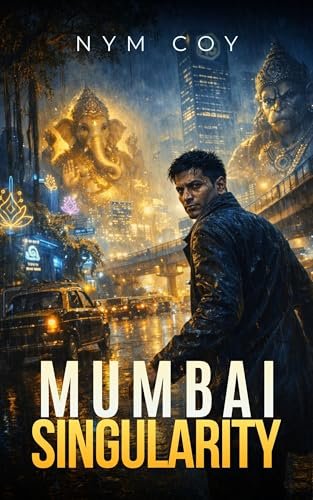
Inspector Krishna Mehta’s mesh antenna is broken. In a Mumbai where augmented reality overlays every surface, his glitching connection strands him in the raw city underneath.
That’s when he sees the marks.
Faint rainbow shimmers on people’s foreheads, invisible to everyone else. When the marked start dying from catastrophic brain haemorrhages, Krishna follows the pattern to a hospital shrine, a corporate conspiracy, and uploaded human consciousness running on networked minds.
Someone is hijacking the gods themselves. And the deeper Krishna investigates, the more he realises the conspiracy doesn’t just threaten Mumbai’s deities.
It’s already inside his partner’s head.
This was a really interesting reading experience for me, mainly because it sits in a cultural and narrative space that I don’t often get read from, so I jumped on the chance for an ARC. The Mumbai setting and the cultural texture were a huge highlight. The everyday details, from language to food to domestic life, made the world feel lived in and grounded, even when the story moved into much bigger mythic territory.
I appreciated that the book doesn’t stop to explain every cultural reference. The words and customs are just part of the world and you learn them through context or look them up if you want to. Western medieval fantasy often expects you to know terms like armour pieces without explanation, so it was refreshing to see the same trust given here. Reading this felt like travelling somewhere new. I wouldn’t bring Weißwurst to Italy and expect the menu to change for me, and I don’t expect books set in other cultures to translate everything for me either. I’m there to experience a different world, not have it reshaped around me or my expectations.
The tension between “is this actually divine” or “is this something technological or projected” worked especially well for me. That ambiguity stayed compelling for a long time. The blend of tech, conspiracy, and myth concepts felt ambitious and genuinely different from the usual genre baseline.
Beyond the cultural and mythic elements, the main character’s voice was very engaging. He is pragmatic, grounded, and approaches even very strange situations in a practical way, which made him easy to follow through the escalating plot. I also appreciated the portrayal of disability, both physical and in how he connects to the mesh, even if I personally wasn’t fully sold on the later divine healing element. Some of the side characters felt especially strong, particularly his mother, who comes across as very real in how she looks out for him and wants him to have stability and support. The dynamic with his former colleague turned private investigator added another grounded and supportive relationship layer to the story.
The story itself moves from grounded investigation into tech conspiracy and eventually mythic scale conflict. I enjoyed how the investigation grows through layered reveals, starting with small strange details and expanding into something much bigger. The mix of augmented reality, corporate power, and questions about consciousness and divinity kept the stakes feeling both personal and large scale.
Some of the mythology driven developments felt unfamiliar to me, simply because I don’t have much personal experience with Hindu mythology. They didn’t feel random or decorative though, they felt grounded in a real storytelling tradition. The shift into more mythic territory later in the book was clearly purposeful, but it did take me a bit to adjust to. By the end I found myself mentally tilting my head a little, not because it was bad, just because it was working on a different narrative logic than I’m most used to.
On a purely personal level, the relatively quick shift toward a mythic multi-consort dynamic and large extended family structure took a moment for my brain to process. There’s nothing wrong with a different lifestyle or culture like this, it just took me a bit to settle into the story as it moved toward restored balance. The domestic peace feels very in line with mythic storytelling traditions. If you mostly grew up with Western classical myth and epic traditions, this kind of structure and ending might feel different at first, but it is clearly consistent within its own mythic framework.
Overall, this felt like stepping into a different storytelling tradition and letting it unfold in its own voice. The mix of grounded character work, big concept ideas, and mythic scale left a strong impression on me. This is the kind of book that reminds you how different fantasy can be, and how wide and varied the genre really is once you step outside the usual narrative spaces.

