

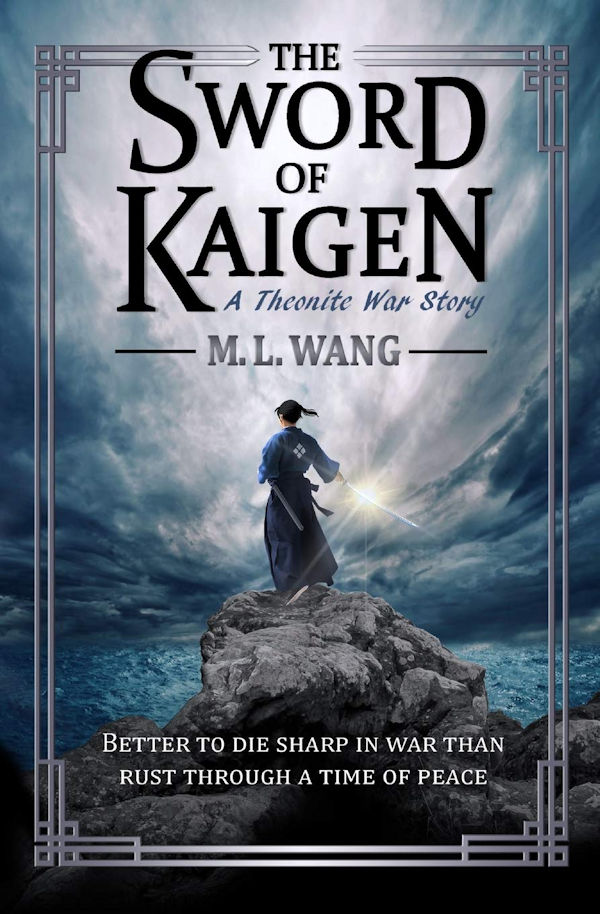
A mother struggling to repress her violent past, a son struggling to grasp his violent future, a father blind to the danger that threatens them all.
When the winds of war reach their peninsula, will the Matsuda family have the strength to defend their empire? Or will they tear each other apart before the true enemies even reach their shores?
High on a mountainside at the edge of the Kaigenese Empire live the most powerful warriors in the world, superhumans capable of raising the sea and wielding blades of ice. For hundreds of years, the fighters of the Kusanagi Peninsula have held the Empire’s enemies at bay, earning their frozen spit of land the name ‘The Sword of Kaigen.’
Born into Kusanagi’s legendary Matsuda family, fourteen-year-old Mamoru has always known his purpose: to master his family’s fighting techniques and defend his homeland. But when an outsider arrives and pulls back the curtain on Kaigen’s alleged age of peace, Mamoru realizes he might not have much time to become the fighter he was bred to be. Worse, the empire he was bred to defend may stand on a foundation of lies.
Misaki told herself she left the passions of her youth behind when she married into the Matsuda house. Determined to be a good housewife and mother, she hid away her sword, along with everything from her days as a fighter in a faraway country. But with her growing son asking questions about the outside world, the threat of an impending invasion looming across the sea, and her frigid husband grating on her nerves, Misaki finds the fighter in her clawing its way back to the surface.
Every so often, a book comes back into our group discussions long after the first read, the kind of story that leaves an impression on most of us even as a few have mixed feelings. The Sword of Kaigen is one of those books. Returning to it now, with fresh eyes and years of reading behind us, we found much of its emotional weight and power still resonates across the team, even if not everyone connects with it in the same way. It’s rare for a story to spark this much conversation on reread, and rarer still for it to hold so much meaning for so many of us.
Julia
This was my third time reading The Sword of Kaigen by M. L. Wang, and somehow, each revisit only deepens my connection to it. The first time I picked it up, it was with high hopes, having heard such powerful praise. But I’ll admit something I didn’t expect: I almost didn’t finish it. The beginning felt dense and disorienting. I struggled to find my footing in the snow-covered village of Takayubi. I even came close to putting it down for good.
But then something shifted. Somewhere along the way, quietly, gradually, the story got its hooks in me. By the time I reached the final stretch, I was spellbound. It’s one of those rare books that transforms as you read it, and then transforms you in turn.
On rereads, everything that once felt like a hurdle became part of the magic. I remember struggling with the long action scenes the first time around. They were beautifully written but, at times, felt just a touch too extended, so much so the tension began to fray. But rereading with emotional investment already intact changed everything. Suddenly, those battles were alive with meaning. I felt what was at stake. I cared. And even knowing the outcome, I found myself breathless, white-knuckled, unwilling to look away.
The same transformation happened with the worldbuilding. The terminology, the linguistic flourishes, the cultural layers, which had initially kept me at arm’s length. I was thinking too hard, stumbling over unfamiliar words and phrases. It was like being pulled out of the narrative every so often, just to reorient myself. But on reread, those elements became a strength. With the foundation already laid, I could finally appreciate how textured and immersive the world really is. The vocabulary no longer distracted; it enriched.
I even remember being thrown by the formatting. So much italicized text, for inner thoughts and foreign words alike. It didn’t flow smoothly at first, like it kept me from falling fully into the voice of the story. But now, it doesn’t even register. The style just is, and I don’t question it. Like a song that once seemed strange but later feels like something you’ve always known.
The flashbacks, too, originally felt like odd detours, disrupting the pacing at moments when I was just beginning to get my bearings. But now, knowing where the story is headed, I see them for what they are, perfectly timed revelations, rich with emotion and resonance. They don’t interrupt, they deepen. They change how you see everything that came before and everything still to come.
And once the final third of the book hits, everything else falls away. The narrative becomes something electric. I remember sitting there, stunned, feeling like the air had been knocked out of me. It wasn’t so much the plot. It was the raw humanity of it. The way Wang writes about love, loss, duty, and regret with such painful honesty. That stretch took my experience from “I like this” to “I love this,” and every reread has only reinforced that feeling.
The setting remains one of the most vivid I’ve encountered. Takayubi is a small place, but it’s drawn with such care that it feels like an entire world. The snow, the silence, the weight of tradition pressing in on its people, it’s all so real, so alive. And despite the story’s narrow geography, the emotional and historical scale is vast. Through memory and myth, Wang shows us an entire empire, a lineage of warriors, a world shaped by choices made long before these characters were born.
And the characters… Some reached me right away; others took time. But now, I love them all. Misaki in particular stays with me. Her journey, as a mother and a woman trying to reclaim her identity in the wake of sacrifice, is one of the most powerful character arcs I’ve read. Her pain feels real. Her strength feels earned. And Mamoru, well, I don’t think I’ll ever be able to talk about him without getting emotional.
What truly sets this book apart, though, are its themes. It’s a fantasy novel, yes, with elemental powers and jaw-dropping battle. However at its core, The Sword of Kaigen is about family. About loss. About the things we inherit and the ones we choose to let go. It’s about how people live in the quiet moments after everything’s gone wrong, and how, somehow, they go on. The emotional maturity of the writing, especially around motherhood and identity, is astonishing. When I found out how young the author was when she wrote it, I was floored. There’s a depth here that most writers take decades to reach.
Coming back to this story for the third time, I felt none of the friction I’d once experienced. Everything that had thrown me, the vocabulary, the formatting, the structure, now felt entirely natural. I didn’t just understand the story better. I understood why it had been told the way it was. And that kind of realization is rare. This isn’t a book that gives itself to you all at once. It unfolds. It asks you to be patient. It asks you to trust it. And if you do, it rewards you with something unforgettable.
If you’re reading The Sword of Kaigen for the first time and finding the start a bit daunting, hold on. Keep going. I promise, it’s worth it. The snow clears. And by the end, it might just become one of the books that stays with you forever.
All the stars. Every single one.
Yaniv
Looking back at my review from almost five years ago to the date, two major things stick out:
1. This was probably one of the first indie Asian-inspired adult fantasy series that started this trend, though nowadays we’re seeing so much more of it, which is a good thing in my mind.
2. While this book does some very unconventional things (such as give you the peak drama in the middle and then something different in the end), I still think it’s an excellent work of fantasy and highly recommend it, if you can stomach a bunch of emotional heartbreak.
Five years ago, this book won SPFBO #5, so I had BIG expectations coming in. And boy, they were met if not surpassed.
When a foreigner from the north named Kwang comes to the fierce mountain village known as Takayubi, and starts telling Mamoru Matsuda what he knows about the empire is wrong, Mamoru is angry with him. However, both boys have no idea what is coming their way.
Soooo much happened in these 600+ pages. So much love, anguish, conflict, brutality, friendship, strength and more.
The main characters Misaki (what a woman) and Takeru (ice man anyone?) were refreshingly both younger and older, but almost always real and believable. The relationship between M+D (to avoid spoilers) left me barely breathing.
All of the characters were tremendous and well sculpted, whether they were Matsudas or others. They had painfully real experiences that brought me at times to tears in both good and bad ways (this is RARE, but as I said, the book shook me).
When I thought the plot was over it wasn’t, and the traditions and the worldbuilding were fantastic and great to discover (not just feudal Europe, which is nice but can get tiresome).
If you like Asian-inspired books, read this. If you like action-filled reads side by side with regular life, read this. If you like kick ass authors and diversity in your SFF, read this. I have read the author’s other adult work and found it at least as good if not better.
Some people might say it’s a slow burn read. While I do understand their opinion, the vast majority felt very strong and related to me, and I believe in giving a book a chance.
5 stars from me and it’s easily one of the best standalone adult genre books I’ve ever read.
Go Get It, and kudos for your awesome work, M. L. Wang!!!
Patrick
The Sword of Kaigen is probably the one to beat in this contest. It has the joint highest score of all the champions and is probably the most beloved. It’s easy to see why. It is the best written of the books here, and it produces strong emotional attachments to the characters and their journeys.
I did have issues with some of the character stories and parts of the structure. At several points, particularly toward the end, I couldn’t shake the feeling that there was another novel I needed to have read or to read to see why I should care about what had happened to Robin, the main character from Misaki’s back story, who reappears at the end. But if there is, the rules of SPFBO require us to judge this book by itself anyway.
My main issue, though, came down to a simple fact: I am not the right reader for this book. I can appreciate all of the things it does very well, but each time I put it down, I had to really fight to make myself pick it up and keep reading. Were I not reading it for the contest, I would have DNFed it a dozen times. That’s always going to be the downside of a contest like this, we read and judge books where we are not the right reader, and while we try to be as objective as possible, there really is no such thing as an objective judgement of art.
If you are the right reader, you will absolutely love this. If you start and find you are not, you’re unlikely to grow into it, and you will just become frustrated.
Kerry
I originally read The Sword of Kaigen when it was in SPFBO #5 and I had mixed feelings about it then. Parts of it I loved and were deeply affected by but the rest of it felt like a chore and it was almost a DNF.
Five SPFBOs later I did a reread and my original thoughts haven’t changed.
I did enjoy the friendship that developed between the three female main characters, the opening of Mamoru’s eyes to the outside world and propaganda he’s lived with all his life, the magic driven by the mountain, and of course the incredible battle scenes. Also, on a personal level, being a mother who has lost two children, I had so much empathy and shared grief for certain characters.
Where it falls down for me are predominantly the parts with Robin in it. For me, these feel like someone different has written these chapters and I didn’t care at all for his character.
It may also be a case of not really clicking with Wang’s writing style. I tried reading her recent novel, and like The Sword of Kaigen, the subject matter is something I enjoy in books, but that ended up as a DNF.
Adawia
I wept, a lot.
I’ve not been quite so moved by a book in a very long time. It’s beautiful and stirring and thoroughly gut-wrenching. Wang takes a whispering blade and aims it straight at my heart in this completely engrossing tale. For an unputdownable story, I actually had to put it down a few times, to catch my breath and dry my eyes. Some of the injustices truly broke my heart.
Like the world in which they reside, the characters are complex, intriguing, and beautifully nuanced. Each one adding a thread to the unique tapestry that makes The Sword of Kaigen so compelling. The dialogue, the relationships, and general interactions between characters are extremely well done, I felt like I was able to connect with each of them in, at least, a small way (although I did struggle to connect with Robin). I could understand their struggles, their motivations, their sorrow and their joy. And while I acknowledge that neither Takeru nor Misaki would be likely to win any spouse of the year awards (or parent of the year for that matter), I do comprehend each’s capacity to feel and express their feelings based on where they have come from and what they have experienced in their respective lives. The way they come to understand and accept each other in the second half of the book is an extraordinary literary feat that doesn’t feel forced or unnatural for their personalities. Any frustration I may have harboured for them dissipated once I properly understood their coping mechanisms and felt their regret, tragic as it was. I also felt a little shift in my response to their personalities when I realised I probably shouldn’t be attributing or expecting entirely human reactions and emotions from them, they have the blood of gods flowing through them after all.
Highly emotional and action-packed, the fight scenes are amazingly well choreographed and detailed. I have to make an effort to imagine scenes while I read (I used to believe this was normal until I discovered I have mild aphantasia), but The Sword of Kaigen is one of those books that is so vivid and visceral, imagining certain scenes is actually a little easier than is typical for me. Excellently done.
After my first reading of this book, I actually felt the shift in tone in the last quarter (or so) of the book let it down a little. It didn’t quite fit the preceding story, and began to feel more like a setup for a potential sequel as opposed to a natural, logical ending for this book. That said, I oddly appreciated the ending a little better upon reading the story recently, for the second time. I still feel there’s a shift in the tone of the story, but I really don’t mind it so much now.
This sweeping tale will appeal to a huge audience. It very much is the type of book that easily lends itself for discussion, it practically screams to be talked about. I can imagine discussions with friends about favourite and least favourite characters and scenes. A truly fantastic story, I absolutely love it.
[Reviewer’s Note: ‘Foreign’ words are used quite extensively, but the context makes the plot and purpose easy to comprehend and follow, there is also an extensive glossary and character list in the back of the book to assist in that area.]
Our ranking now stands at:
- The Thief Who Pulled On Trouble’s Braids by Michael McClung (champions’ review/original review)
- The Lost War by Justin Lee Anderson (champions’ review/original review)
- The Sword of Kaigen by M. L. Wang (original review)
- By Blood, by Salt by J. L. Odom (champions’ review/original review)
- Murder at Spindle Manor by Morgan Stang (champions’ review/original review)
- Small Miracles by Olivia Atwater (champions’ review/original review)
- The Grey Bastards by Jonathan French (champions’ review/original review)
- Where Loyalties Lie by Rob J. Hayes (champions’ review/original review)
You can see the full score sheet for all the other blogs judging the contest here.

