

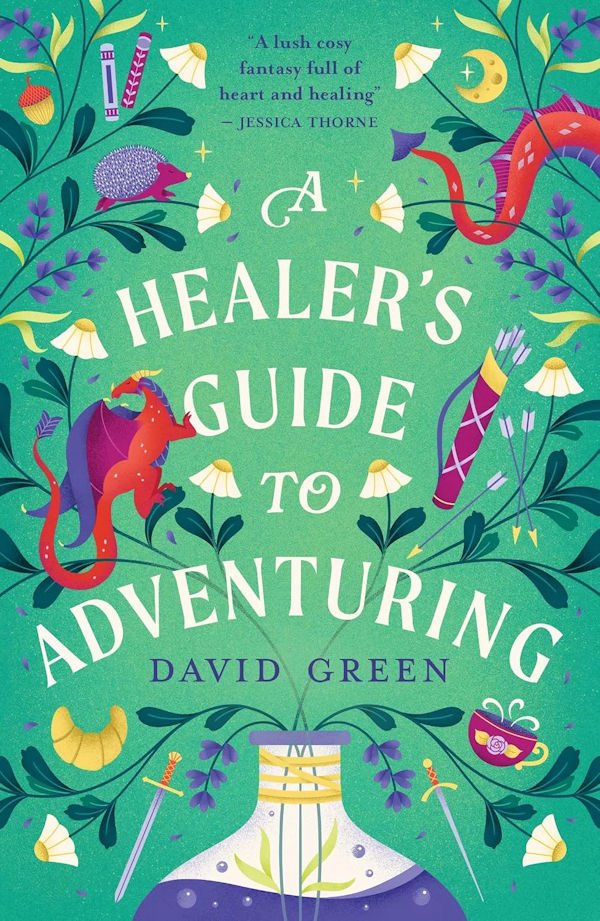
Tanwin never wanted to be an Adventurer. After surviving a disastrous campaign that left her scarred in ways no potion could heal, she abandons Lanriel’s glory-seeking Adventurers’ Guild and opens an apothecary instead.
Soon Tanwin spends her days helping battle-scarred heroes confront the emotional wounds no one else will treat, one steaming cup of tea at a time.
Until Lanriel’s most fearsome warrior arrives begging for help.
Fang-Ripper’s son is missing. A dragon is involved. And somehow Tanwin finds herself trekking into the dangerous Wilds with a handful of unlikely companions, a curious moondrill in her pocket, and absolutely no desire to become part of anyone’s heroic quest.
But as ancient grudges resurface and war threatens to ignite between dragons and humans, Tanwin discovers that monsters are rarely who the stories claim they are.
And when the elf who has captured Tanwin’s heart is called back into peril, the peaceful life she has built begins to unravel.
When I shared the cover, I promised to devour this book before my tea went cold. Quest complete. I breezed through it in no time, and yes, the hedgehog did distract me a little. His name is Rundy, and he’s actually a moondrill. He isn’t crucial to the plot. He’s more of a sweet extra, though a useful one, since he helps show emotions, especially for some of the neurodivergent characters. Mostly, though, he is cute as hell.
The story is cosy. The world it’s set in is not. In Lanriel, your birth order decides your life. Firstborns live in a golden cage, a bit like royalty or mafia families of old. They don’t get to choose their own path. Every decision serves the family, right down to who they marry, and whether they even like their spouse never comes up. Second-borns get handed a sword and pushed out the door to become Adventurers, ready or not. Glory is for the big names who slay dragons. Most of them are just cannon fodder, coming home short a few teammates, a few fingers, a few toes. The lucky ones only carry the nightmares.
Tanwin was always meant to heal, not to fight. She studied healing and has the heart for it. But she’s a second-born, so one day the call came anyway. Her first campaign went worse than anyone could have imagined, and she came home alone. Her entire team was gone. So she did what nobody in Lanriel does. She said no. She turned her back on the Guild and on her family’s expectations, knowing full well it would bring shame on the whole house. Instead she opened an apothecary. By day she sells potions. Behind closed doors, she becomes her world’s first therapist, helping Adventurers with the wounds no potion can reach.
Those sessions were my favourite part, and every single one landed for me. Reading them felt like a balm, gentle and soothing. Every character carries their own tangle of troubles, friend and foe alike. I loved brushing away the surface and following those feelings down to their hidden root. Because you can water the grass all you like. If the roots are rotting underneath, nothing will grow. Tanwin knows that. She doesn’t give up at the first sign of resistance. She simply tells her clients the first session is the hardest, and it gets easier from there. It’s so spot on. You can tell Green knows his way around therapy and honest self-reflection. Tanwin sums up her method best:
‘The only way I know. By talking the pain out of your soul and into the world, where the Winds of the Fates can blow it away like the steam from a hot cup of tea.’
I especially loved the conversations about letting go of vengeance, about choosing to look forward instead of clutching the hate of the past. My only complaint? I wanted more. I expected the sessions to take up more of the book, so I was a little sad when the quest elbowed them into the background.
Because before long, Tanwin is trekking into the Wilds with a motley crew of battered souls. There’s Fang-Ripper, the warrior famous for slaying the dragon queen’s son, who might secretly prefer to be soft. There’s Olan, a dwarf who no longer trusts his own choices and lets his dice make them for him. There’s Neelan, a mage who sniffs smelling salts to keep his magic on a short leash. And there’s Cora, an elf hungry to learn about her people and their past.
Tanwin never tries to change any of them. She helps them, and she lets them keep their quirks. As they slowly learn to trust themselves again, their problems don’t vanish in a puff of magic. They shrink from walls into hurdles, and their real personalities start to peek through. The healing doesn’t only flow one way, either. Tanwin gets nearly as much from her companions as they get from her. After all, every Mind-Mage needs a Mind-Mage of her own. There isn’t one yet, but friends will do for now. And all it took was talking.
But the people who came to her weren’t in need of fixing. They weren’t defective.
They were people. People who needed help, self-compassion and love. Kindness too, from themselves and others.
The healing feels true to life, too. Progress is never a straight line. A character can be doing well one day, stumble back the next, and find their feet again the day after. Green captures that back and forth beautifully. Bit by bit, the group learns to live without their crutches and without violence. They learn to forgive each other, the world and, most importantly, themselves.
Compared to Green’s Greton’s Marvellous Maps series, starting with Magic, Maps, and Mischief, this book leans much harder into romance. Greton is asexual, which suits my personal taste, and the romance there is barely two shakes of the salt shaker. Here it isn’t the main ingredient, but it is definitely a strong flavour. Think cosy with romance, not romance with cosy.
Tanwin and Cora worked well for me as a couple. They were friends first, just a little stuck and not quite brave enough. Once things finally clicked, it moved fast, but it felt earned, because they’d had years to build trust. Their quiet moments are lovely:
‘Do you listen to my heartbeat often?’
‘Yes. It’s how I know when you need me.’
‘I always need you.’
What didn’t work for me was the one sex scene. It isn’t super graphic, but it’s far more detailed than I needed. I’d always pick a fade to black, and the wording in these scenes makes me cringe, here and in nine out of ten books I read. I don’t mind erotica and pick it up now and then, but fantasy is what I love. It’s a bit like brussels sprouts and chocolate. When I’m really hungry, a plate of sprouts can hit the spot. Chocolate, though, I’ll always love. And throwing sprouts in when I’m craving dessert doesn’t help. It just ruins both. That’s the only reason I didn’t enjoy this one quite as much as Greton’s adventures.
The quest itself is fine. It’s really the window dressing for the emotional journey, and some of it wraps up a little too easily. It carries the feel of the book rather than being the hook, and it never pretends otherwise.
A Healer’s Guide to Adventuring is a hot cup of tea for battered souls. Come for the dragon, stay for the therapy, and leave a little kinder to yourself.

