

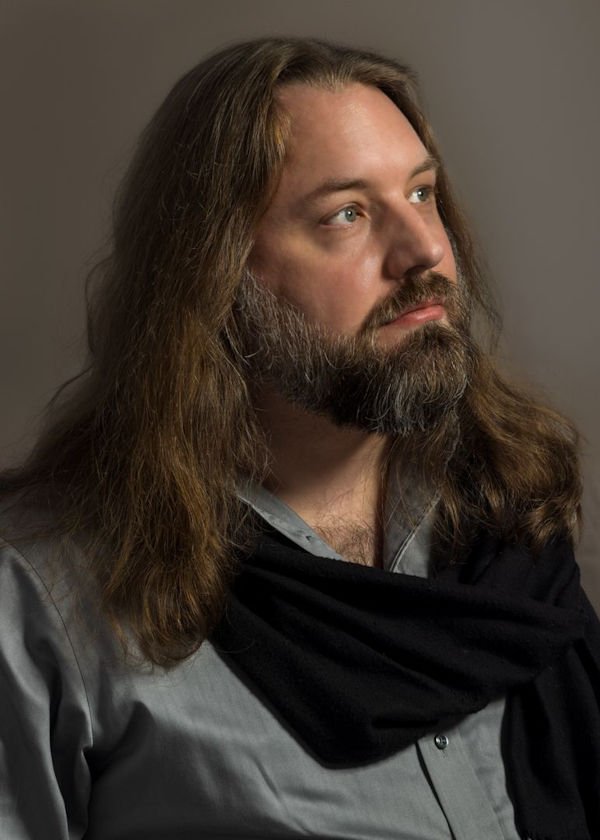
I had the distinct pleasure to sit and chat with Scott Lynch this past weekend at ReaderCon, a small writing-centric fantasy/sci-fi convention just north of Boston, MA. ReaderCon is a wonderful little event, one of those quaint little cons that’s still small enough to fit into a hotel lobby, and it boasted a truly wonderful offering of panels and readings on a variety of topics ranging from classic Greek mythology to social activism in speculative fiction. It also boasted an air-conditioning system rivaling the sub-arctic, which left half the attendees bundled up into sweaters despite the summer heat outside, but few seemed deterred by this. Scott was kind enough to take an hour out of his busy day to discuss what he’s currently up to, his recent foray into acting, and—yes, because I know you’re wondering—the status of The Thorn of Emberlain.
I met Scott once before, at a WorldCon in London twelve years ago. At that time, I chatted with Scott as just a fan, rather than on a professional level. The Republic of Thieves had been released just one year before, and he was still riding high on that success. The man I sat down with on Friday was drastically different from the confident young man I met then. He’s still a very deep thinker, a man who has clearly analyzed and turned situations and topics over in his mind a million times before putting them to words. A man with a quick wit, as is evident to anyone who’s read his books, and a man who drops expletives as often as I do. (Let this serve as your warning, gentle reader, that I shan’t be editing out any F-bombs in this interview. If you’re a fan of the Gentleman Bastards, I assure you that you’ve already read worse.) But he was also a man carrying a great burden. He seemed careworn, his eyes belying the smile he wore so easily. And we delve into some of the reasons for that in this conversation.
I will say, as a gentle trigger warning, we do discuss depression and anxiety at length towards the end of this interview. But Scott talks about his struggles in a way I believe may be healing to some; to know and understand that we don’t carry these burdens alone.
LYNDSEY: Hello, Scott. I am talking to you today from Fantasy-Faction. So, the first thing I’d like to ask you about is the Free Fiction Archive you mentioned in your Substack awhile back. So, for any of our readers who may not follow your news feed, what is your free fiction archive?
SCOTT: I’ve reached a point where I’ve got about, I don’t know, ten or eleven published short stories and the vast majority of them have been either printed or reprinted online. If you really, really wanted to, you could hunt them down in the far corners of the internet. They’re on various podcast sites, a couple on Uncanny, et cetera, et cetera. So, you could do that. But I figured I might as well just create a centralized clearing house where people can find almost all of my stuff. Nice and easy, under one banner, one place.
And part of it… How can I put this? Trying to be honest without sounding totally commercially mercenary. I don’t make my money screwing it ¢30 at a time out of people by charging for short stories. That’s gatekeeping to the maximum possible financial exclusiveness. There’s no artistic or social or even financial good in that for anybody. So, I might as well just also offer the free versions because people are either going to pay for them or they’re going to pirate them. And if they’re just going to pirate them, I might as well make it easy for them.
I have a lot of friends, and I have a lot of peers, some of whom have vast back catalogues of fiction. And some of them are really eager to just kind of spill it out into the world, and some of them keep them under lock and key. Like, “I can’t. I can’t let them out.” And at some point, you really ought to consider just… letting them out. Because a story that’s sitting in a vault, even an electronic vault, not doing anything, is doing you no good, it’s doing readers no good, it’s doing the world no good. So, yeah, that’s the whole idea behind the free fiction archive.
LYNDSEY: And also, you know… Give people a little bit for free, and then maybe they’ll come back?
SCOTT: You know, it’s not completely insane. Like my agent doesn’t have to drag me off and beat me in a backroom. It gets people to come look at the website. It reminds people, I’m alive. It makes people say, “Gosh, what a swell guy. I think I’ll buy everything else he ever publishes without question!” (laughs)
Maybe that’s a bit extreme, but, you know, people are welcome to have that reaction if they want. But yeah, it’s just I feel if you’re going to have a give and take between writer and reader, there’s got to be some give in the give and take.
LYNDSEY: There’s another aspect here, too. With the internet being what it is, people feel like they have a closer relationship with the authors they’re fans of. We didn’t really have that thirty, forty years ago. Look at Matt Dinniman, and how closely related he is with his fans right now. Look at Brandon Sanderson, having all those talks with fans on Reddit and so forth. Giving your short fiction away for free is one of those little things you can do to foster a closer relationship, and those little things are what sets you apart. Building those relationships with your fans, in this day and age, is a really smart choice, business speaking.
SCOTT: Yeah, at the beginning of your career, you kind of have to make this decision. You can decide whether you’re going to make yourself part of the equation, whether you encourage that sort of para-sociality. And, you know, you’ve got to learn, usually the hard way, where to draw the boundaries. Which have to exist. You can take yourself completely out of that and you can be like Greg Egan, an Australian hard science fiction writer who famously does very few appearances, interviews, et cetera, et cetera, just lets the fiction speak for itself. You can do the whole John Twelve Hawks thing. You know, like, “I live off the grid. I live under an alias,” whether that’s real or not. And if you’re not gonna do that, then you’ve got to decide how you’re gonna handle yourself in public and what you’re gonna offer.
And I guess the way I always try to describe it is, it’s best for everybody if what you see is real, but it’s also edited. I’m not going to make Instagram posts like, “Wow, I’ve got explosive diarrhea today.” I might allude to it on Bluesky or something, but I’m not going to show you every single aspect of my life. “Filling in a lot of insurance forms today, sitting in the doctor’s office…” We show you the “good parts” version.
LYNDSEY: Like most people do on social media, famous or not.
SCOTT: Well, there’s an extreme version of that where it’s like, “I’m a TikTok author. I’m making my 14th video of myself dancing today! My entire life is I get up and I answer email for an hour and then I bake a cake and then I count my money because that’s the magic author lifestyle.” That’s not the author lifestyle.
LYNDSEY: Oh, I guess it is for some people, but… Must be nice.
SCOTT: Yeah, definitely. So, you try not to lie about it. You know?
LYNDSEY: So, talking about the boundaries you have to put up as a public figure, actually leads interestingly into the next subject I want to talk to you about. What we’re talking about here is acting, right? When you are acting, you are taking parts of yourself and deciding which parts to blow up, which parts to minimize, which to show an audience. And you have been stepping into acting recently with The Tower of the Wizard. Would you like to talk a little bit about what the Tower of the Wizard is? I have your write up here, but…
- THE TOWER OF THE WIZARD is his special adaptation of the novelette “The Fall and Rise of the House of the Wizard Malkuril;” a unique one-man performance reading, live and never to be recorded or duplicated! Enjoy an epic fantasy tale of sorcery, time, ambition, disaster, and tea… a tale with secret elements added to each performance, never to be shared elsewhere!
SCOTT: Oh, okay. So, The Tower of the Wizard is my live performance adaptation of “The Fall and Rise of the House of the Wizard Malkuril,” which is a short story I wrote for one of Gardner Dozois’s collections a few years back.
[Interviewer’s Note: You can find The Book of Magic: A Collection of Stories, an anthology of short stories, here.]
And it’s a performance reading. In that I am reading the text live. I’m fascinated by the 19th century notion of going to an author’s reading, especially if they were a relatively big name like Charles Dickens. You know, Dickens didn’t make a lot of his money later in his life off his actual publishing. He made it on his speaking tours. And he would read from his various manuscripts for, like, four hours, and pack three-thousand people. So, I’m just weirdly fascinated by the thought of this.
Also, this is before movies, before video games. Listening to a guy talk was really all you had. That was the only form of entertainment available. I’m just fascinated by people going nuts and doing the equivalent of holding up lighters and ripping their hair out like, “Oh my God, it’s Chucky Dick live in person! I can’t believe it! He’s doing a Christmas Carol!” It’s like seeing your favorite band and going, “Are they doing their greatest hits or…? Oh my God, they’re doing a whole album playthrough! Deep cuts!” So, it struck me as fascinating. I explained a little on my website that early in the pandemic, having one of those flights of despondency that sometimes strike even those of us who are very sensible and well adjusted—
LYNDSEY: (laughs) I laugh because I also am very sensible and well adjusted, yes. Yes.
SCOTT: That’s why we’re in this industry/career/genre.
LYNDSEY: Not neurospicy at all! No, no, no.
SCOTT: I was having thoughts about, what do we have to offer as writers, as authors? What can we do that machines can never replace? What can we do that companies can never squeeze out of us? What is irreducible? What is something that only we can do? And that something is the uncertainty and the excitement of a live performance.
I’m also very interested in stage magic. And whenever Bear and I go down to New York City, I usually try to hunt down a new show or something for us, and back in 2018, shortly before its run ended, we saw a show by a guy named Derek DelGaudio called In and of Itself, which is technically a magic show, but is also so much more than that. It was a meditation on identity. It was a spoken word performance. It was a, “is he lying or not” autobiographical puzzle as well as some of the most incredible stage illusions you could ever hope to see.
And just that sense of playfulness, that sense of excitement, that sense of tension, that you get only when you see something live… The possibility that you’re gonna see a great performance, the possibility that you’re gonna see someone fall on their face. They’re both weirdly, equally exciting. And the sense that there’s no take backs, that it has to be without a net in some fashion. It’s also really fascinating. So, I started noodling around with this plan to, like… who’s doing this these days? Where are the readers-out-loud?
I have a lot of peers and friends and colleagues I think would be absolutely great at this if they would devote themselves to it a little bit more. I’m not being a jerk. There are some writers who read very well, and there are some writers who should really practice it more. And then there are some writers who should never read at all.
And it’s not a requirement of your job. It’s not a bad thing. But imagine the richness if we were doing it more, if we were better at it. I love what we do at conventions. I love our impromptu, ongoing devotion to readings in science fiction and fantasy. We do it in conference rooms, we do it in meeting rooms. We do it in the backrooms of acoustically poor bookstores. But I began to wonder, how much cooler could this be if it was in an actual theatrical environment? If there were actual lighting, actual acoustics. If people were actually focused on what was going on here and I didn’t have to leave in five minutes because the next three people are coming in. Again, this is not to shit on that culture because that culture is awesome. It’s just a step aside to do something different.
LYNDSEY: It’s taking it to the next level. Like, we’ve done this at the volume of five. Now, what if we take it to twenty?
SCOTT: Yeah, exactly. And part of it is just fun for me. Part of it has been the process of trying to figure out if this is something I really, really want to keep doing. I’ve done it twice now in Massachusetts and in Seattle, and I hope to continue later this year. And so, a big part of the first two sessions, as it were, was deciding, is this really a thing you want to keep doing on a logistical ongoing basis? Or was this just a random urge you’re now done with?
And I do want to keep doing it. I do want to keep getting better at it. And the selfish part of it is that, like I said, I want to draw other people out of their shells as well. I had a couple of friends of mine in the audience for a couple of these, and a couple of them came away saying, now I have ideas. I really want to do this. And I want to keep pushing them because I want to see what they’re going to come up with.
LYNDSEY: Do you have any training in improvisational theatre?
SCOTT: Uh, I LARPed [live action role-playing] for eight years.
LYNDSEY: So, no formal training.
SCOTT: No, no, no. I would never have called myself an actual actor. I had one… I tried out for declamation, which would have been a gateway into theater when I was in high school, and had a really unsatisfactory encounter with the theater teacher. I discovered I would have been a theater kid about twenty years late. It’s like, oh, wait a minute.
LYNDSEY: “If only I had a better teacher,” yeah.
SCOTT: We bounced hard off each other, and I did not want to go back and put myself under that person’s constant attention. But then a couple of years later, I fell into live action roleplaying. Which was where an awful lot of us were in that group in high school, because we started when we were seventeen, eighteen…
That’s where a lot of us learned how to speak in public, how to make arguments, how to declaim, et cetera, et cetera. And so, for the last two years or so, I’ve just been trying to practice voice and reading performance, and, I’m probably never going to be a full and proper actor, but I can certainly work off a tablet very well. You know, I’m confident enough to charge money, but I’m not going to be winning any awards anytime soon.
LYNDSEY: Well, if people are coming back, then that means they enjoy it.
SCOTT: Hopefully, yes. Yeah, I can admit I’m like, I’m a $15 or a $20 ticket. I’m not a $100 ticket.
LYNDSEY: I understand that all too well. I work for ren faires [Renaissance Fairs]. We are “put a dollar in the hat” type performers.
SCOTT: So, partly it’s excitement for me, partly it’s very selfish, and partly it’s just, I love the spark. I love the sets when everything is firing, the audience is attentive. And they’re attentive to the fact that I could really fuck it up at any given second, but it feels the same.
LYNDSEY: I have an interesting take on this, as both a writer and an actress, and wonder if you’ve also noticed the difference in energy. Writing is a very solitary thing. You do get feedback from the audience, but it’s not immediate. It’s not as you’re putting the words on paper, unless you have somebody reading over your shoulder. Theatre is immediate feedback. You’re getting that energy back, and it’s feeding one off the other, the audience’s energy heightening (or dampening) your performance. I don’t know if you’ve also had that experience.
SCOTT: Oh, yeah.
LYNDSEY: And it creates a different energy than the energy you can create sitting alone typing on a computer, which is really, really fascinating.
SCOTT: It’s also been interesting because of how I conceive of myself when I’m sitting at my keyboard. Some writers are hermetically sealed off from the universe. They need that to do their functioning. Whereas I think of myself as performing for an audience even when I’m all by myself. I have that particular delusion. (chuckles)
I sometimes describe myself as the world’s slowest-motion song and dance man. I dance one keystroke at a time. And my wife hates that comparison, because that’s not how she mentally operates at all. And all that’s done for her is, you know, thirty-five-ish novels and one-hundred-twenty-ish short stories, so what does she know about anything?
LYNDSEY: (laughs) Oh, is that all? Pfft. Amateur. Come on.
SCOTT: So, I think of myself like that, even when I’m sitting by myself, and I try not to let this be too crazy and delusional. I saw a cartoon thirty years ago or so by a comic book artist of my acquaintance, who drew a little autobiographical story of his neurosis about cartooning. He imagined himself sitting in his drawing board in front of fifty-thousand people in a gigantic stadium on close cam. And every time he drew a really good line, the audience would cheer.
And his girlfriend is like, “That’s fucking crazy. You’re going to drive yourself crazy. Do you think like that?”
And he’s like, “I know. But I can’t not be that way. I have to think like that.”
And I sympathize with that viewpoint. Like I don’t, I don’t necessarily feel like I’m in a fishbowl or I have an audience, but there’s a part of my brain that is always writing and working for an audience. So, transplanting my behind-the-keyboard self to a stage is not that severe of a surgery compared to many of my beloved peers and colleagues. I think a little bit differently.
Spoken word performance… It has this connotation of… “Jesus Christ, what have I gotten into? Why am I here listening to this stuff?” But when you hear really good spoken word performance, someone who knows what the fuck they’re doing… Have you ever a movie called Plunkett & Macleane?
LYNDSEY: I’ve heard of it, but I haven’t seen it.
SCOTT: It’s hard to get a hold of. Surprising, ‘cause it’s totally awesome. And it’s one of those things where it’s like… It’s so great, we’re gonna hide it from streaming forever, and the only way you can get it is… Lithuanian bootleg DVDs. (laughs) But it’s a tale of gentlemen highwaymen in the late 18th century.
LYNDSEY: (dryly) I wonder why that would possibly appeal to you.
SCOTT: (laughs) Right? And there’s a scene where one of them is going to be hung on the gallows at Tyburn. And they got a performance artist named Murray Lachlan Young to do a declamation. So, whilst Macleane is being taken to his hanging and being given a last quaff of ale, this equivalent of an 18th century standup comedian/newscaster is telling his story to the crowd.
“It brings no pleasure to my heart to stand and deliver the sorrowful tale of the man who stands in the rattling carts.” And he tells the story of why he’s there, and how he’s gonna dangle, and how awful it’s gonna be, and works the crowd up and sends him on his way. And that performance, the timber and gallows tree spoken word piece he does, has always stuck in my brain and worked its way, not just into my fiction, but into these performance readings.
There’s a point in The Tower of the Wizard performance where I start not reading from the tablet. When the story is at its most climactic moment, I throw the tablet aside and I just declaim straight to the audience, and I walk up and down, and I point at people. And I think it hits really well, but that is the extent of my memorizational abilities.
I don’t have the ability to squeeze an entire script into my head. But the silver lining of that is I’ve started studying things I paid no attention to when I was a lot younger, like the whole concept of the memory palace. And I discovered, oh my God, there are actual craft techniques of memorization that are centuries old, that people were using prior to Shakespeare?! I find this fascinating and as I get older and… okay, I’ve reached forty-eight. So obviously, you know, I’m about to teeter over into senility.
LYNDSEY: (laughs and offers a fist bump of solidarity)
SCOTT: But you can only get so far on brute strength and adrenaline. At some point you’ve got to make strategies for keeping your brain in order.
LYNDSEY: For those of us who are on the neurospicy side, sometimes memorization is just not a thing that comes easily, if at all.
SCOTT: Yeah. Mhm. And it’s like… no one knew when NASA started doing various space research programs, that out of going to space, we would also get Tang, or Velcro or all these other subsidiary technologies that turn out to be fairly useful. So, the program of getting up in front of people and potentially making a fool of myself is paying some dividends elsewhere. Even if I don’t carry it on forever, I’d like to keep at it for a little bit.
LYNDSEY: Is it mostly scripted, or are you incorporating some improvisational stuff?
SCOTT: I will improvise. The script itself is the story. And into that, I will do gestural things. I will use timing and cadence. I will pause. I will hold. I will let certain jokes sit. I will let certain jokes stampede. So those are practiced, but not noted. Like if I was directing somebody else, of course I would have to scribble notes like, do this, do that, do that. But it’s just me.
In the future, that may change because I have a sense that I want to evolve toward a certain style of performance. There are a couple things I want to try that are not necessarily just reading a story, but an actual performance, and the mechanisms, they’re not complete yet. Like, I kind of know what effect I want to achieve, and all I lack is a means of getting there. I really don’t know what I’m doing yet. I just have a vague shape of what it looks like.
LYNDSEY: Do you have any plans for your next one?
SCOTT: After The Tower of the Wizard, which is gonna have five or six total performances… I have some notion of telling the story of… this is so vague, it’s so completely unformed, but… I have this notion of something between a spoken word performance, a reading, a bit of card trickery, and mentalism. I’ll be telling the story of a bunch of thieves in a demi monde, or a loose cast of characters in this sort of shadow world of crime and nightclubs, in which the order the story is told is determined by the draw of a deck of cards. With every performance someone will be removed, someone will be added. So, the story is told in a different fashion every way, and it features different people every time it’s told. And I think there’s solid gold there. I just haven’t mined all the way down. I don’t know what the mechanism is gonna be, but it would be a more original, still structured, still reading performance, but a little bit also more of a flourishing trick than what I’m doing right now.
LYNDSEY: That sounds awesome.
SCOTT: Until like, I actually try it out, and it sucks. But you know, that’s…
LYNDSEY: That’s part of theatre. I have a friend in the ren faire circuit who does this show called Shakespeare Approves. He was my director for a few years, and he said, “The first thousand shows that you do are gonna be shit.” Same thing with writing.
SCOTT: I have discovered… I’ve relearned the hard way personally. It’s like, oh, wait a minute. This is why people do this. This is why they have an usher as well as someone taking tickets! I’ve learned so many basic logistic lessons that impresarios have known for five-thousand years. So at least I had that going for me. You have to remind yourself that you’re gonna fuck it up.
LYNDSEY: Yeah, and it’s okay.
SCOTT: You play a professional sport, you’re gonna have a bad day. You’re gonna have a lot of bad days. In front of a lot of people who are gonna see everything about your bad days on video forever. You write a lot of stories, you write a lot of books… occasionally, you’re going to write one that just doesn’t land where you wanted it to. You’re gonna write one that dies, that just doesn’t find the audience you expected. And occasionally, you’re gonna get up on stage and you’re gonna make a fucking fool of yourself. The recovery process from that… It’s a useful, healthy mental exercise. I tell myself, even when I’m in the midst of it, like, “Oh, God, I wish a hole would open up and swallow me right now.” But recovery is healthy. Learning to roll with the punches that are self-inflicted is very healthy
LYNDSEY: So, you mentioned through your Substack that it took you about eleven years of serious effort to get to your published state, and nobody ever really wants to talk to you about those eleven years. They all just want to know about, you know…
SCOTT: Yes. Yes, yes. People love the “I sold my book” stories, but they really like to elide everything that comes before them.
LYNDSEY: Exactly. So, I feel this conversation we have just had about trying and failing and learning really leads well into, if you had to give advice to somebody who was in those eleven years, who is still learning and trying and figuring things out as they go, what would your advice be?
SCOTT: My advice would be to understand that it sucks, and I say this with all sympathy. I was there, and it did suck, and it’s easy for me to say, because I sold my first novel twenty-ish years ago now, and was published twenty years ago last month.
LYNDSEY: Happy book birthday!
SCOTT: Thank you. I have difficulty believing it. People will come up and be like, “Yeah, I read your book in high school,” and I’m like, “Last year?” and they’re like, “No, fifteen years ago.”
Ugh… Drinking from the false grail, withering into dust…
There is this thing called the long tail effect, which is much discussed and sometimes derided, because basically, the only problem with the long tail effect is you have to stick around long enough for it to work. If you stick around, and you put out work, and you make contacts, and you keep to schedules, and you build… I don’t mean to use such corporate-y bullshit, but, I mean, the concepts are valid. You’re building a brand. You and your work are a brand. You know, like keeping your contracts, being a decent person. These are all part of your brand. (with wry humor:) For some of us, our brand is not delivering a novel for thirteen years. But some people, their brand is on time every time, every year in an hour.
LYNDSEY: Brandon Sanderson. Stephen King.
SCOTT: Yeah. I mean, it’s an unfortunate truth, and this is only partly a segue, because this is also something I would absolutely fucking tell anybody who’s getting started, and would shake into myself, if I could go back in time twenty odd years. Keeping to a schedule is one of the primary elements. of building awareness, building a brand, and maintaining it. Whatever that fucking schedule is, when you say something is gonna come out, getting it out, and doing so regularly.
When I was studying as a teenager, I thought I was gonna be a comic book self-publisher. The number one determinant of whether your book would still be alive in a couple of months was, are you on schedule? Or are you perpetually slipping? Are you always three months behind, which becomes four, which becomes five? Get the music out, get the stories out, keep the schedule. Note that the people who do that… That is, in and of itself, a builder of opportunities for people to see you, to find you, to discover you.
I was reading an interview with a guy who worked for a marketer. And back in the day, back in the 1950s, one of their guys was tasked by the New York Philharmonic, to basically, like… “Our sales are tanking. We are doing very, very poorly,” and the one and only thing, apparently, that this guy did for them is he told them:
“Here’s what you do. At the beginning of your season, publish a full-page ad in the New York Times providing the schedule for every single concert you’re gonna have. From the beginning of the season to the end. Show everybody exactly when they can come, at any given time, all year, so they can look at it in one place, at one time, and not need to think about it after that.”
And bookings immediately went up, 40, 50, 60%. And then, you know, they got a famous conductor and the renaissance was complete. But being on schedule, letting people know when you’re gonna be, and actually being there.
LYNDSEY: So, also, figuring out what that schedule feasibly can be for you. If you know you’re a slower writer, don’t promise something once a year. Promise something that works for you and your style.
SCOTT: Yes, and you know, I mean, Brandon puts out a very high volume of stuff, and the thing that doesn’t happen with his operation is, “Oops, this is gonna be four months late. Oops, this is gonna be six months later.” There’s not a lot of slide in that schedule. Most everything he does or his people do, comes off on time. And this is a massive benefit for all concerned. If you don’t have an operation like his, I sympathize.
I understand it would have been a big help if my Depression and Anxiety were better controlled on a much earlier date, because they were actively interfering with my life and my career. I understand. There are reasons for failing, but they should not become excuses. And if you want to live long, you gotta keep a schedule. You gotta do something. You gotta be regular in some fashion. I cannot emphasize it enough.
And take it from me; someone who has been stung by this. Even though I’ve been fortunate enough to enjoy relatively great success, I have still been stung by my inability to keep to a schedule. Absolutely. And I’m not just talking financially; I mean, disappointing people, frustrating the people I work with, frustrating the people I’m contracted with. No one wants to be the guy who causes a hold up for all the people in the production cycle, who have to keep schedules, who have regular jobs, who have, you know, criteria they have to meet.
LYNDSEY: That’s a lot of pressure.
SCOTT: I’ve been that guy. I caused those problems, and I don’t appreciate it. I do regret it. So, avoid that if you can. But it’s part and parcel of the most important thing I could tell you, which is that you must stay in the game. That is the only truly important thing. If you want to give time the ability to do its thing, if you want the network effect and the long tail effect to work to your benefit, you’ve got to stay alive. You’ve gotta stay in the game.
Some people—and this is totally cool—some people only have a couple stories in them. You know, Cameron Reed writes a novel about once every twenty-five years, and they’re awesome because they’re Cameron Reed. So, if you want to just do what you want whenever you can let it out into the world, that is cool. But that is not going to be a commercially sustainable way of living if you want to do this on a more full-time basis. You must keep people aware of your existence. You must keep something out there. You must keep something out there regularly, if you can help it at all. That is the most important thing in the world. And it’s easy to say, like, this is something you should know when you’re starting out. But you’re gonna be working on this for five years, ten years, fifteen years, twenty years, you’re going to have to carry this burden forward and keep it up. The industry is strange. Media is strange, and algorithmically controlled media is the strangest thing of all.
LYNDSEY: Especially now.
SCOTT: I mean, it’s very easy to say, “Gosh, why don’t I just pay more money, take up more ads. Why don’t my publishers put me on billboards?”
LYNDSEY: “Why can’t I get a hold on BookTok?”
SCOTT: Yeah, and you’ve got to understand. The information playing field is not level. It is not fair. Once upon a time, years ago, Twitter was a relatively fair and open thing. If something was good, you’d get thirty-five thousand retweets and thirty-five thousand likes. And it just spread organically. And the imposition of algorithms upon that changed it entirely.
Nothing changed functionally back when I was still using my Twitter account. What I was posting, the nature of what I was posting, the quality of what I was posting… Except one day I’d get five-thousand retweets, and one day I’d get six. That’s nothing I do. That’s something somebody else did. And that’s what we’re all struggling with, is the fact that we blast ourselves out into the world. We shout as loud as we can, but the markets for that information, they’re not fair. There are fingers on all the scales, and dancing around that is difficult and time consuming.
But you still got to do it. Plug it.
LYNDSEY: Keep casting your line, because otherwise you’re never gonna catch any fish.
SCOTT: Yeah, you’ve also got to do it smartly. You’ve got to remember that just dumping money into the hands of the people who’ve made things like this is not necessarily the way to solve things. Like, yes, you can take out ads on the exact same services that have algorithmic-ed you out of existence to begin with. But this is an entirely separate conversation in and of itself.
So, the most important takeaway is just to remember it’s not a fair game. It’s not a fair game for anybody. There’s no magical point at which you reach the other side, and all of a sudden, it’s like, oh, now your advertisements land, and now your publishers spend a lot of money on you. And now everything is going to be perfect. I guarantee people who want to be published writers get together on mailing lists and groups, and so on and so forth, and they bitch and moan about “Oh, how is it that the successes are the only ones who get all the money? And if only I had some of that, I could be a success too.” Well, those of us who are published sit on mailing lists of our own in support groups of our own. And we say the exact same shit to each other back and forth on a daily basis. “Oh, my God, everything sucks. Oh, if only I could get real money, you know, if only someone would throw some resources behind me. I could be a big success, like I deserve.”
The nature of the conversation never changes. The grass is never greener on the other side. It’s not fair for anybody. So, you just, you just gotta recognize, you’re fighting in an unfair environment. It’s never gonna be fair. So, what are you gonna do about it? You’ve got to find more intelligent ways to fight. You’ve got to find unfair ways to fight, and you’ve got to do things that drive a personal connection and a lasting brand connection with people.
LYNDSEY: Like a Free Fiction Archive.
SCOTT: Like free fiction, like reading live in front of them, like reminding them you are a real person and a performing artist. And, you know, you just hope there’ll be some reciprocal goodwill. It’s the only way to stay sane as a human being, to do these things, but also, it’s a valid commercial approach. It’s, in many ways, the only valid commercial approach. Our humanity is special. And, you know, not to get too fucking crass, but it’s also a selling point.
LYNDSEY: And if you want to be a success in the industry, if you actually want to sell things, if you want to make this into a living, then you have to look at it from the business perspective.
SCOTT: I’m sorry it is the way it is. I’m sorry it is so hard. I’m sorry it is so difficult. But the fact is it has always been hard. It has always been difficult. The publishing industry goes through a sea change, roughly every five years or so. Significant changes are happening continuously around us.
The industry I entered, when I sold my first manuscript in 2004 in large part no longer exists. I mean, a lot of the people who were there have moved on. They’re in different places or have left the industry entirely. Some of them have passed away. Some of the writers I came up with, or, you know, burst onto the scene with, have moved on entirely or become swept up, but in the shadows. But also logistically, Amazon was not what it was when I sold my first novel. Ebooks were not what they were when I sold my first novel. Audiobooks were not what they were. So, the notion that once upon a time, there was a pristine and magic time when money fell from the sky, and publishers really supported authors… it’s never been the case.
Every age of publishing has its own fresh set of brand-new problems. Sometimes we solve an old one, but then we add two new problems on top of it. It’s a weird industry, it’s an unfair industry, and the world has made it even weirder.
Publishing, movies and TV, games, media have always sort of worked in sync. There’s been a lot of synergy between these three. And the last ten years, for some fucking reason, all the geniuses who control almost all of the money have spent most of their time destroying that synergy and ripping up these previously functional engines of media interaction and information awareness. The environment in which Game of Thrones became a breakout TV success and then a massive subsidiary licensing success just doesn’t exist anymore. Ten years is all it took to wipe that off the face of the map.
LYNDSEY: Although, it’ll be interesting to see what happens with Dungeon Crawler Carl, ‘cause it almost seems as though that’s heading in a similar direction with its massive cult following and the recent TV acquisition.
SCOTT: I don’t blame Matt one bit for trying to get as much stuff out there as he can. throw everything against the wall to see whatever sticks.
This is not a native quote to me. This is a TV writer on Bluesky, who was being very erudite about this the other day. And he said that once upon a time, what you would do is you’d produce half a year’s worth of episodes of a given TV series, striving to get to one hundred, which was the magic syndication point. Then it would go into syndication. And if it went into syndication, that was like a free advertisement for the first run show itself. They would feed on each other and the ratings on both would go up and everybody would make more money.
And these days, what you’ve got is, especially with streaming, you don’t get twenty-two-episode seasons. You might get eight if you’re lucky. You might get seven to ten and you don’t know until a couple months before you start filming. And they’ll all more or less go on at once. And they basically have to hit like a blockbuster movie. They’ve got to land a big audience, or you won’t get a season two.
LYNDSEY: Like Wheel of Time.
SCOTT: Yeah, Wheel of Time! As far as I’m concerned, that was ridiculous, because the first season was kind of a hot mess. The second season was pretty improved, and the third season was fucking awesome.
LYNDSEY: Yeah, it was great.
SCOTT: And it really was, and like, they shit canned it just as it was coming into its own and was about to land gigantically. As I’ve said before, it’s like somebody canceled Star Trek: The Next Generation right after Riker says, “Fire!” at the end of season three, and they never complete the Borg storyline. And it feels so short-sighted.
Like, yes, I know this is an expensive thing to produce. Do you remember just a few years ago, you would do all kinds of subsidiary licensing deals and release DVD sets and do all kinds of other things to recoup your investment? It drives me crazy sometimes because it’s like, I’m a long-haired freak who sits up at night listening to heavy metal music and writing my little stories. Why do I sound like the only committed capitalist in the fucking room? Do you guys want to make money with your TV shows anymore?
And I, being in development hell at the moment, on Gentlemen Bastards related projects, am in that boat as well. The nature of what is on offer and what is potentially going to be made has changed from the last big cycle of potential developments in 2018, 2019, to what we think we might be able to get in 2026. And it hasn’t changed for the better for the most part.
LYNDSEY: So, we have probably about fifteen minutes left.
SCOTT: Okay, I’m sorry. I don’t mean to rant endlessly.
LYNDSEY: No, no, no. It’s perfectly fine. I want to be respectful of your time because I’m sure you’re very busy…
SCOTT: I’m a significant tangent fucker, so if you give me a chance, I will just run off.
LYNDSEY: (laughs) I’m about the most extroverted person in the world, so, I feel you. Okay, so. Talk to me about The Thorn of Emberlain.
SCOTT: Be more specific. What do you want to know? I’m happy to talk about it.
LYNDSEY: So, I know you’ve got some shorter stories that are coming out to bridge the gap between books three and four. Is that right?
SCOTT: Yes.
LYNDSEY: Tell me a little bit about those, if you don’t mind.
SCOTT: Okay, so I have owed three novellas to subterranean press for a truly embarrassing length of time. And originally, back in the day, they had no fixed conception. It was just “write three novellas.” And then I decided, you know, what if at least one of them was sort of a prequel to The Lies of Locke Lamora? Then I kind of had a moment of sanity and realized I’m fairly disenchanted with the notion of like, if you’re going to do a prequel as far as I’m concerned, it needs to reveal something that was previously unknown. It needs to be surprising. It needs to enhance the story. It’s very, very, very difficult to do a truly good and awe inspiring and transformational prequel. And I realized I did not have an idea worthy of that. It was just an incident.
But then I thought, okay, wait a minute, I can repurpose the incident and basically turn it into the story that comes between The Republic of Thieves and The Thorn of Emberlain. And as I’ve always said, as I’ve always promised, and as I’ve always adhered to, you don’t need to read these novellas to understand the events of the main sequence books. I really detest lengthy fantasy and science fiction series where it’s like, and in order to understand who these characters are and what’s going on, you need to read the subsidiary novel and the side, et cetera, et cetera.
LYNDSEY: (cough) Sanderson (cough, laughs) He’s doing something interesting and different, but yes.
SCOTT: Yeah, I freely admit that, like, David Weber’s Honor Harrington books are a guilty pleasure of mine. Yeah. But I don’t read the side novels because there’s like nineteen books in the main sequence. And then there’s side trilogies cowritten or written entirely by other authors. And it’s like, I don’t want to. I want the main sequence of story. There are conceivably times and places where I would read those side stories, but I don’t appreciate that I need to know who the fuck these people are to continue reading the main sequence.
LYNDSEY: It’s the comic book effect, right? “Oh, I want to read about Green Lantern. Oh, okay, well, in order to read about Green Lantern, first you have to read this from Justice League, and then you have to read this and this and this…”
SCOTT: This month, the Green Lantern story is told in eight different places!
LYNDSEY: Exactly. It’s so frustrating.
SCOTT: Ironically, if they had been less essential to the main plotline, I might have read those side books. But I resented the fact that they weren’t. So, I’m absolutely determined these books I’m working on will enhance and enrich the experience, and maybe supply a couple of answers, but there’s absolutely nothing in there that is like, “Oh, well, in order to understand that…”
I hate that when you go to see a movie, too. Like, oh, yeah, there’s a comic book that came up beforehand…
No, this is a solved problem. Be better at writing. That’s how you fix this.
So, I’m determined not to inflict that on people. The novellas are referred to as the Road to Emberlain Trilogy. They are titled More Than Fools Fill Graves, The Mad Baron’s Mechanical Attic, and The Choir of Knives.
LYNDSEY: Very cool titles.
SCOTT: They’re basically a travelogue blending into misadventure that leads immediately into The Thorn of Emberlain. But also, the prologue to The Thorn of Emberlain describes a little bit of what Locke and Jean have been up to, and what their scam is and how they came into it. So, nothing is hidden. You know everything you need to know. It’s just that if you want to read more of me, there’s more of me.
LYNDSEY: (pause) So. How is The Thorn of Emberlain going right now?
SCOTT: I wish I could be at home working on it right now. Thorn is… Thorn is okay. I finished a draft in 2019 I thought I was pretty happy with at that time. But actually, it wasn’t so hot. And I had a couple ideas afterward, during the long, dark, soul-searching times of the pandemic. I had a couple thoughts about what the series needed and what I wanted to do and what I was no longer interested in exploring, and what I was really genuinely interested in providing. And it turned out that Thorn, in particular, needed a major overhaul in a couple of places. So, it is now in a place where I’m much happier with all the character work, and I’m much happier with how everything fits together.
Another thing that happened over the course of the pandemic is I watched a TV series called Succession, which provided a lot of hints and sort of affirmed my choices. “Ah, yes, yes. This is how you write an interesting power struggle.” Less about armies meeting on the battlefield and more about people in smoke filled rooms being really bitchy to each other. Like, these are all the parts of Game of Thrones, everyone remembers. You know, like… cool battle, cool fight, whatever. But like…
LYNDSEY: “Tell Cersei it was me.”
SCOTT: Yeah, exactly. Bring the Queen of Thorns back! Please bring Tyrion Lannister. You know, like, have these people just talk to each other for half an hour. And that is the truly interesting, memorable part. So, Thorn has steadily evolved from the focus of, “this war is battles” to “the focus of this war is why the hell are people fighting it and the arguments they are having.” And I feel this approach has really, really paid off for me, and I think it’ll be for the reader as well.
But now I’m still just in a place where I perennially have like twenty thousand to twenty-five thousand words to stitch together, and finish the ending off and make sure it all hangs together. My wife and my editors and my first readers will have a crack at it and will be able to say, “You know, yes, this makes sense,” or “No, this is really stupid,” but it’s almost in a place where I’m happy with it. Generally speaking, I think everything that’s been done to it in the last couple of years is a major improvement.
LYNDSEY: So, the foundation is secure.
SCOTT: A lot. We’re not gonna open… And I’m grievously aware—and my wife helps with this—helps with my awareness that, you know, there is that mentality of like, “Gosh, if the book keeps getting better the longer, I don’t turn it in, all I have to do is wait until I’m fucking ninety-five and this will be a masterpiece!” And I recognize at some point, this must end. You must shit or get off the pot.
LYNDSEY: Thank you, Kevin Smith.
SCOTT: (chuckles) And… I’m reaching a point where I want this process to be done. I want this book to be in. I want to be the bearded fantasist who’s handed in his book. I have enjoyed the power and the privilege of being an extremely dithering, bearded white male fantasist, but I am so ready to move on. I’m so ready for the next phase, and I’ve been very, very fortunate and very blessed over the years, like during the pandemic, my readership went up. And again, that’s the network effect. That’s people giving the book to other people who give the book to other people.
BookTok, passing it around and getting excited about it. Like, “Oh my God, did you see this book this old man wrote twenty years ago? It’s actually pretty okay.” Barnes & Noble chose it as their pick of the month for science fiction and fantasy a year ago, and it got back onto the USA Today bestseller lists.
It didn’t do that when it was first released. It was just ludicrous. So, the demand for the series is still there. I see the reprint numbers; people enjoy it, but… I can’t… (sighs) there will be a point at which people get tired of never having a new book.
LYNDSEY: You know, as somebody who spends a lot of time in fandom circles, there is definitely a common occurrence where someone will say, “Well what about that Scott Lynch guy? He’s just the same as Rothfuss and GRRM.” But others will come to your defense like, “No, no, no. He had some stuff going on in his life, and he was open, and he was honest about it,” and I feel people in general give you a lot more grace because you are open, and you are honest about your struggles.
SCOTT: As I’ve said before, I accidentally started being open and honest about my Depression back in the day. I did a radio interview over in the UK back in 2010 and the guy asked the question directly, like, “Where have you been?” And I just… I had that horrible realization that if I dance around this subject, I’m going to be dancing around it for the rest of my life. And it was easier just to say, “Well, it turns out I’m a serious clinical depressive, and it helped destroy my marriage, so I got divorced too. And that’s where I’ve been for a couple of years.” And the guy was like, “I’m sorry.” I was like, “You know what? Actually, that felt a lot better than I thought it was gonna.”
So again, this is one of those things where you do have to set boundaries. And as I’ve said, I’ve learned a couple hard ways that there are some boundaries you don’t even approach.
I don’t talk about what medications I’m on, for example. I don’t invite a vote on every aspect of my life. My actual medical treatment is between me and my family and my doctors—the internet doesn’t get to click a box and choose, “Should Scott take his drug this week?” But generally speaking, being honest about it has been nothing but beneficial. Gives me a chance to actually talk about it and not feel like I have to conceal something. It has helped me really confront the fact that, yeah, it has caused problems in my life.
Back in my first marriage, my ex-wife and I had a really bad habit of just telling ourselves, “Oh, artists are like this. They are supposed to be a little bit weird and a little bit eccentric.” But there’s a difference between a little bit eccentric and totally fucking dysfunctional; incapable of answering his email for six weeks at a time. This is eccentric, that is out of control. That’s a problem. And you can do things about that. So, one of the things I’ve had to deal with that has been a silver lining is this: realizing that admitting you have an illness and it affects you lets you realize, oh, it has been affecting me. And I’ve been trying to obfuscate or push aside that fact rather than dealing with it.
And also… When you go through a divorce, you think you are the first person on earth who has ever done it. You would never judge anyone around you who went through a divorce for any reason, but when it happens to you, you’re like, “I am a crystalline solid of human failure. I have invented failure.” And then you look around after a couple of months, and you’re like, “Wait a minute. Half the fucking population has been divorced!”
And it’s much the same with Depression and Anxiety. You’re like, (puts on a dramatic mannerism) “I have a horrendous malady, which I must hide from the light of day!” And then a couple months later, you’re like, “Wait a minute. Every single fucking person I know is like this.”
LYNDSEY: Yeah. Approximately seven-eighths of my friend’s list…
SCOTT: It was an incredibly helpful moment for me. My former editor, the guy who bought Lies of Locke Lamora originally, back when I was completely dysfunctional and very newly diagnosed as depressive, he called my house and said, “Scott, if you can’t talk to me, then we can’t have a business relationship, because obviously it implies you don’t trust my judgment.” And that wounded me deeply enough that I was able to call them back and say, like, “Look, man, it’s not that. I’ve been talking to a psychiatrist. I’ve just done intake and I think I have some news that may be relevant to all our lives.”
And he said two things that were immensely helpful. “First off, good. Not good in the sense you’re depressed, Scott, but good in the sense that you know, and now I know. And now we know you’re not just fucking around with us, that you are dealing with a medical issue. We’ll delay the books as long as we need to. We’ll do whatever we need to, to help you in the situation. Now that we know you’re not just being an asshole, now that you’ve talked to us and you can communicate.” And the second thing he said was, “Do you think you’re the first depressive author I’ve ever had? Do you think you’re the tenth? Welcome to a commonplace condition for people who are in this situation.” And I was like, oh, I guess that does actually make an awful lot of sense.
So, you know, being honest about it has been… liberating can be a very problematic term to use, but it’s true. Being honest about it has been nothing but a constant weight off my chest. And it also lets people come out and say, “Hey, it was me too.”
Pardon me. This is the emotional part of the thing, where I need to get control of myself.
I’ve had a lot of people come out and say, “I’m glad you and other writers talk about this openly, because I thought it was just me. Then I noticed everyone I read talks about it.” And it’s like, you know what, everyone you read thought it was just them until they realized it was all their friends as well. So, it’s a mutually supporting thing.
So, what I tried to do is… just be honest about my issues, be honest about the fact that I’m trying really, really fucking hard to work past them and through them and replace them with a system of living that works. And the last couple of years have been really exciting in that respect. I’ve been a lot more communicative. I’ve been a lot more productive. And I’ve been out in public a lot more, and as long as I mind my medication and continue to do sensible things, that’s gonna continue. But I also do try to remind people that I’m alive. I’m still here. I’m working on it. Believe me, I’m working on it.
I don’t feel bad if my work takes as long as it takes. I do feel bad when it starts to take too long. And I think with Thorn, we have finally reached too long, so I am desperately working to bring that to an end.
There was a guy I met at ArmadilloCon in 2009 who came up to me and said, “I really liked your first two books. I’m seventy-nine and I hope I get to finish the series.” And it’s like, statistically speaking, I have probably already failed that guy. And I don’t think about everyone I’ve disappointed, but I do think about him an awful lot. So, you know, sometimes with people on the internet, it’s like, do you think you could say anything to me that would hurt me more deeply than that memory?
But I genuinely believe that honesty is a net benefit for myself and for everybody. So, I try to talk, I try to be present. And like I’ve often said, I’m very blessed in that I have a lot of really great readers, friendly readers, generous readers, who are patient, send me things, and recommend my work to other people. The success of the series is entirely up to them. It’s entirely the network of people passing the books on to friends, buying extra copies, recommending it over the years, booksellers ordering two copies rather than one and writing little hand notes under them. 99.8% of the series’ success is its readers.
So, yeah, I’m gonna try not to disappoint you for much longer, folks. Thank you for that. Thank you.
LYNDSEY: I can’t speak for all the readers out there. But what you have given us is incredible. Thank you. You have given us joy. And even if you never finish it, you still gave your readers those moments of pleasure, getting lost in your world. You know?
SCOTT: If I’d been hit by a bus or something, I could have been satisfied with what I’ve done, but as long as I’m still kicking, I can’t be. But I’m reasonably confident Thorn is gonna have people foaming at the mouth and pounding their desks. So, I’ve been working very, very hard to ratchet the emotional notes to exactly where I think they need to be.
LYNDSEY: Thank you for your time, Scott.
In addition to his upcoming Free Fiction Archive (which he has assured me is in the works, his webmaster is working on it currently), Scott also has a couple board games in the works titled We Are Rich in Opportunity and Happy Hives, which you can read more about here. We Are Rich is in open playtesting currently. Keep an eye out for the Road to Emberlain short fiction, and if you’d like to see him in person, he’ll be the Guest of Honor at JordanCon in Atlanta, GA in 2027. Subscribe to his Substack for more up to date news on his activities and future releases.
Thank you for joining us for this interview, and I’d like to remind you that if you’re struggling with depression, the US Suicide Hotline is 988 [you can call or text]. If you’re in the UK, the NHS Hotline is 111. Help is only a phone call [or text] away.
Featured image background by Fadi Al Shami.

