

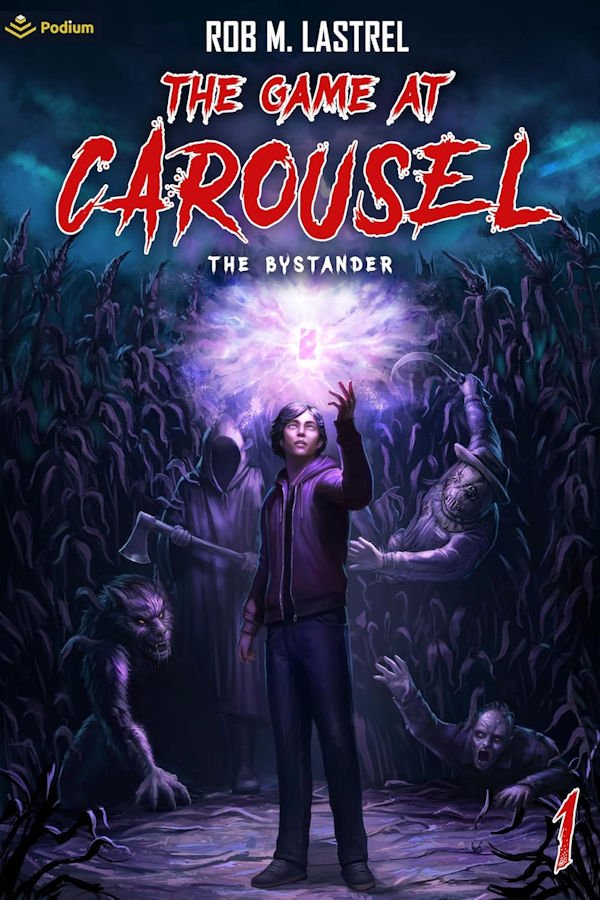
When horror-obsessed Riley Lawrence and his group of college friends arrive in the small town of Carousel for their Centennial Celebration, the few decrepit cars parked in the street don’t scare them. But when they enter a locked building, an animatronic usher hands them each a ticket, and the lights dim, Riley realizes they’ve entered the inescapable patchwork of a horror movie set. And they’ve each been assigned an archetype—Scholar, Athlete, Eye Candy, Final Girl—to play out as the curtains rise.
Assigned the Film Buff archetype, Riley’s doomed to repeat knowing exactly who the killer is but never surviving the attacks himself. After all, film buffs may know what’s coming, but they’re always the first to be hunted down. Until, that is, Riley learns he can avoid a death or two by exploiting the Oblivious Bystander trope. It seems monsters and killers won’t harm him as long as he can convincingly pretend he hasn’t noticed them.
To make it through this deadly game, Riley and his friends will need to leverage their tropes effectively to determine what’s trapping them there in the first place. But as the rounds continue and escape seems farther and farther out of reach, they’ll be forced to ask: Would they survive in a horror movie?
I’ve been dipping my toes into the GameLit/LitRPG genre for decades now, enjoying all its mechanics and tropes, and even wrote a few books when it was in its infancy, but this book is something else. Is The Bystander game-like? Sure. But it’s not limited to gaming conventions. The tropes (abilities in this book are called “tropes”) come out of a cinephile’s lexicon, and as a big film buff, I got a kick out of the hundreds of abilities named from lines in classic horror, science fiction, and fantasy movies.
The story focuses on a group of college-aged men and women who end up trapped in (I want to say is another dimension) a place called Carousel, where they are forced to participate in horror-film simulations, going through every classic horror story plot formula you can think of. The main character, Riley, is given the film buff role, which gives him the ability to see the stats and abilities of other characters and NPCs, allowing him to speculate and sometimes predict how the story of these horror-simulated games are going to go, making for some excellent self-aware, meta moments where he uses the above “tropes” belonging to him and his friends to get out of sticky situations.
The book’s scenarios, or stories, work for the same reason horror-themed mechanic board games like Betrayal of House on the Hill and Trouble Brewing work, where you are given different stages that adhere to horror formulas with an omen stage, a party stage, a first blood stage, etc. If you’ve ever seen the movie Cabin in the Woods, then you know the more aware the characters are of these tropes and plot structures, the funnier it is when they try to defy them. This serves double duty for the book, as it allows Lastrel to put a lampshade on anything that might’ve taken readers out of the story. It’s incredibly hard to call out something in a story when the main character has literally called it before you could even think of it. This allows even the more contrived scenes to feel natural, since much of the reason characters have to act a certain way is the nature of the game.
In the individual stories the characters find themselves in, they end up fulfilling certain roles you would usually find in a horror movie or game. These include the athlete, the last girl, the scholar, etc., and each role comes with associated skills and flaws. For example, although the character who plays the athlete is actually relatively clever and is studying to become a lawyer, the role he plays in the stories has a low Savvy stat, which compels him to play the dumb jock stereotype. These categories include everything from monster hunter to hysteric (which actually has useful abilities tied to it), and how the characters respond to the roles they are given indirectly offers incredible insight into their feelings and personalities. For instance, you can really tell the book’s badass veteran character, Arthur, loves playing out his monster-hunter role, despite the cynical, hopeless real-life persona he puts on whenever he’s outside a story.
As someone who has played a fair share of TTRPGs (table-top role playing games), I noticed a similarity between these scenarios and how characters are made to play out their individual stories, particularly in that players cannot act on information the characters they are playing do not know. For instance, it can be very important to make sure certain plot points are mentioned in-scene, a lot like the difference between players talking about the game and their characters talking about the game during actual roleplaying.
The characters playing their roles accurately is one of the many rules of Carousel, and there are dire consequences for players who refuse to play by them. These rules, like many aspects of this world, are intuited by most of the characters, and those who don’t, don’t last long, akin to a player being kicked out of a campaign. This lack of knowledge is one of the many aspects we readers share with the characters: we just don’t know what’s going on half the time, but we learn with them.
This connection with the characters comes with its downsides. Along with their lack of knowledge, it’s difficult to get a clear sense of progression in their attempts to escape this world, feeling like a one-step-forward, two-steps-back approach with every major clue they’re given. I understand the desire to go through as many stories and horror film formulations using the Carousel framing device as possible, but as even the characters point out, the new abilities and stat increases often feel like a distraction from the true conflict at hand. Much of the best conflict is driven by the characters’ attitudes toward the world and their lack of progress in escaping it.
Regardless, I’m going to keep reading this series and see where it goes, and if that’s not a recommendation, I don’t know what is.

