

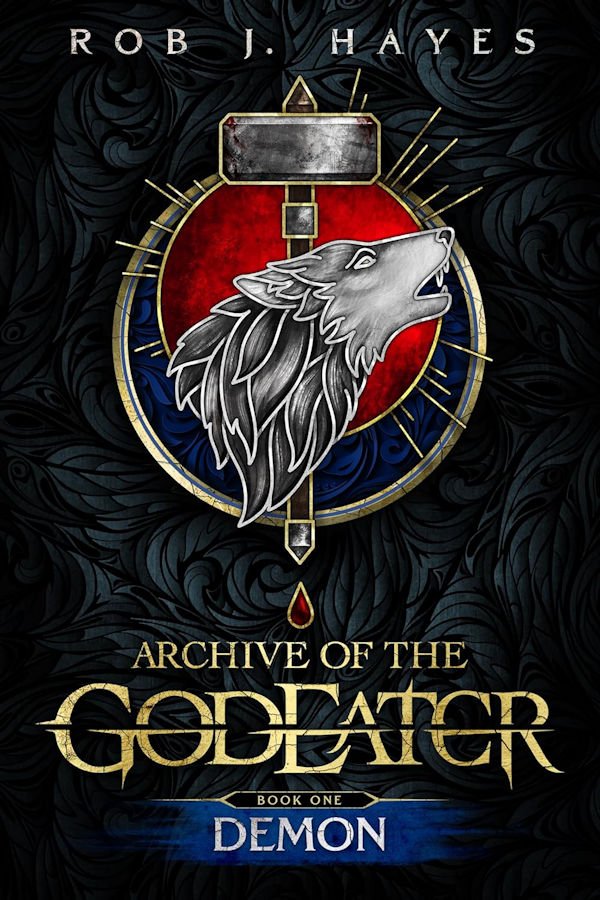
Dien Hostain was never meant to lead. She wasn’t meant to survive.
Kind of heart and quick in temper, Dien expects to lead a simple life, learning her father’s trade. But unbeknown to her, he was not always a carpenter. He’s an exile, a traitor once known as the Peace Breaker.
When nightmarish demons attack the village of Berrywhistle, her father is murdered. Dien and the survivors are taken as thralls to live out the rest of their days in squaller and back-breaking labour. But Dien’s blood boils with the need to escape and take her revenge.
They try to break her body. They try to break her spirit.
Will Dien take up her father’s hammer and unite her people?
On wings of vengeance, a Saint shall rise.
Demon (Archive of the God Eater #1) by Rob J. Hayes goes even further back than Deathless (Annals of the God Eater, #1), which is set before Herald (Age of the God Eater, #1).
This whole series is a trilogy of trilogies, each set in the same world, but before the other one.
Demon once again it reshapes what I thought I knew about this world. At this point, that feels like a defining feature of the series. Every step back in time pulls the rug out from under earlier assumptions and reframes characters, factions, and histories that once felt solid.
This book digs deep into the roots of demons and humans alike, and nothing is presented in simple terms. There are no clean lines between monster and victim, faith and manipulation, truth and myth. Instead, everything feels messy, brutal, and deeply uncomfortable in a way that feels intentional. The further back we go, the more stripped down and raw this world becomes.
Tonally, this is very dark. Darker than Deathless, and certainly not a book to go into lightly. The violence and suffering are not decorative, they sit at the core of the story, and there are moments that are genuinely hard to read. This is grimdark that earns the label, and checking content warnings is absolutely recommended.
What worked especially well for me was how the book balances answers with new questions. You do learn more, about the demons, about humanity, about how things came to be the way they are, but every revelation opens up another layer of uncertainty. It never feels frustrating, though. It feels like standing in front of a vast, half-buried ruin, seeing just enough to know there is far more beneath the surface.
Once again, Hayes plays with history itself. Who tells the story matters. What survives matters. And what is remembered as truth may be anything but. By the end, my understanding had shifted yet again, and I was left both unsettled and eager to keep going.
Demon is not a comfortable read, nor is it meant to be. It is harsh, bloody, and morally thorny, but if you are already invested in this world, it is also deeply compelling. Each step backward makes the present more complicated, more tragic, and far more interesting.

