

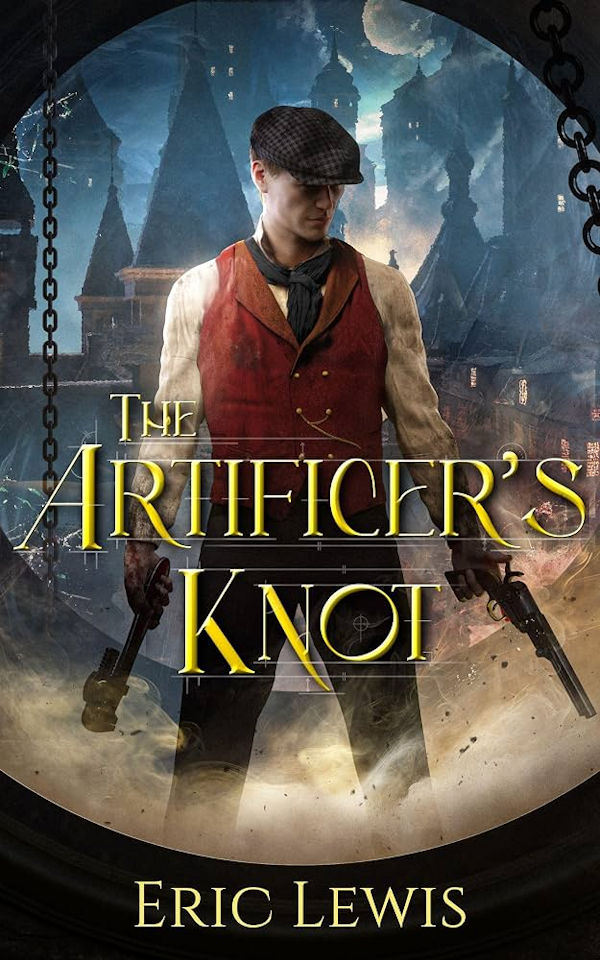
Randyll Tephius should’ve known he’d get in trouble. The mystical, energetic substance Vril has ushered in an industrial age monopolized by the elite Alchemists. Ran’s University thesis on newly-discovered oil deposits threatens them enough to see the student Artificer expelled in disgrace. He survives on the streets until being rescued by an unlikely benefactor: aging mob boss Gouger Nebb.
Ran seizes the chance to rebuild his career, using mob money to fund ingenious inventions and allow Nebb to retire as a ‘legitimate businessman.’ But while struggling not to become a gangster himself, Ran’s efforts meet with sabotage, and he maneuvers among rival gangs, aristocrats and sadistic police to expose the perpetrators.
The Alchemists who ruined his life emerge from the shadows, now offering wealth and redemption if he’ll switch sides and help them expand their deadly monopoly worldwide. It’s a tempting proposal that means betraying the very man who saved him.
Not every book makes it to the semi-finals, but The Artificer’s Knot earned its place. A gaslamp crime story built around energy monopolies, gang warfare, and a brilliantly misplaced artificer, this one pulled our judges in with its sharp prose, distinctive characters, and a world that feels uncomfortably relevant. It is not a straightforward fantasy, and that is exactly what makes it interesting. Read on for our full reviews.
EG
Upon starting The Artificer’s Knot, I was immediately intrigued. The world seems to be a steampunk-esque adventure and I will admit I am a sucker for a steampunk adventure. However, the further I got into the story, the less enthralled I was.
This book follows Ran, an Artificer who got expelled from university just before getting his papers. Desperate for a job, he falls in with gangster boss Nebbs, who decides to use him and his knowledge of things like petroleum oil (a potentially new power source in this world) to make money and escape the life. Only, nothing is ever so simple as it seems.
The prose in this book is excellent. The writing is smooth and draws you along so you almost don’t feel like you’re reading. The dialogue is unique to each character and there is that sort of je ne sais quoi I love to see in a book. I noticed no typos (excepting those that were intentional) and had no problems with the prose.
Likewise, the characters were interesting and uniquely crafted so that they jumped off the page. Ran in particular was fascinating to read. He had such an unsuitable background for being a gangster, yet he seemed to thrive there, which made the story feel more twisty and fascinating. Nebbs was snarky and dangerous and yet somehow one of the most intelligent characters in the book, despite his lack of education. Everyone had their own motivations and desires and it came through really well.
My problem, however, lies with the plot. This book reads less like a steampunk novel and more like a historical fiction about a gang war in Chicago or something. It has the potential to be interesting, but with each chapter there was an escalation in the drama. It got to the point where I was so bored because the drama just kept increasing and I could almost predict things would go wrong in catastrophic ways and the characters would have to regroup to solve the next catastrophe. It wasn’t so much overwhelming as underwhelming and a bit predictable. It got to the point that at about 60% of the way through the book, I started skimming the chapters to get the main gist and still understood enough to figure out how the book was going to end.
I never thought I would have an issue with a book for being too dramatic, but I think this book managed it. Which is a shame, because the prose and characters are so well crafted.
Adawia
Having judged by the cover and title I thought I’d love this one, but I’m just not sure. Nebb feels a bit like a try-hard version of Brick Top (Snatch) but there are some interesting elements to the story.
Then I came back to the story after putting it aside for a bit, and ended up enjoying it. I still have some reservations about Nebb (a few too many threats in the vein of “men have stopped breathing for saying less”, kind of put me off) but his overall sharpness and—sometimes brutal—common sense eventually won me over—mostly. This is a gritty world, and it’s hard to be a nice person and be successful—it’s basically one or the other as corruption and gang rivalry are rampant. I mean, you need the support and backing of either one of the gangs, or a wealthy person just to survive.
The story developed in complexity and cleverness as it went on which kept me intrigued even though some of the characters’ actions or responses seemed occasionally a little ‘off’ or a little too convenient. The writing is solid, the flow and pacing are really good, and I had no trouble following the tale as it grew and threads and characters were added.
Maureen
Reading this book was like riding a zip line above the crowds on a fairground midway. Everywhere you looked, something was happening. Danger, love, plotting, plots foiled, steam trains, steam boats, a charming underworld mob boss, a tough old harridan as a rival, an inside seat to the machinations, dreams of growing rich(er), and dreams of creating something that will change the world.
Randyll, a young journeyman artificer, through circumstances arranged by a rich classmate, is denied his final papers, which affects his position in well-to-do society; bringing him so low that no one even half-respectable will hire him. Enter Nebb, a minor organized-crime gang leader, who sees the value of having an artificer on payroll. He takes advantage of Randyll, but soon comes to appreciate his unique set of skills. The book covers a lot of Ran’s escapades learning the biz, while trying to keep himself basically honest.
There’s no lack of ups and downs, edge of-your-seat moments, and treachery. He and Nebb fall into a good thing no one else is doing, and the competition becomes ruthless as the city’s rich artificers figure out what’s going on; which is—Ran will make their businesses obsolete. Other mob bosses move against Nebb at the same time Ran’s plans are destroyed. As if it’s not been exciting up to this point (and I assure you, it has been), new players come out of the woodwork like keystone cops, all intent of keeping Ran down and out of the game. But they haven’t planned on Ran being able to outthink and outwit them.
The game is afoot, and it’s a lively one.
Julia
The Artificer’s Knot pulled me in much more than I expected. It is fast, clever, and confident in its blend of gaslamp fantasy, crime story, and political intrigue, and I found myself consistently entertained as the story unfolded.
At its core is Ran, an artificer whose brilliance is both the engine of the plot and its biggest weakness. He is undeniably over-competent, able to solve almost any technical problem, adapt seamlessly to gang life, and navigate increasingly dangerous situations with impressive ease. This does drain some tension from the story, because failure rarely feels like a real possibility. Still, I was able to look past that more often than not. What mattered to me was not whether Ran could succeed, but what success demanded of him. Watching him test his own limits, compromise his values, and slowly reshape his sense of right and wrong gave the story its emotional weight. His voice felt grounded, and his flaws felt human, even when his abilities stretched credibility.
I am usually not drawn to gang or mafia narratives, which made this book a pleasant surprise. Like the War for the Rose Throne series, it managed to engage me despite my general resistance to the genre. The cast in The Artificer’s Knot might not be just as stellar, and not all stand out individually, but they are written with enough clarity and purpose to keep the story sharp and forward-moving.
Nebb, in particular, is not a flashy or charismatic figure, but was written in a way that made me care about his fate. He is ruthless when he needs to be, but not senselessly so. There is a sense of rough fairness to him, a practical code that includes protecting people in his territory and taking responsibility for the consequences of his power. That balance made him more interesting than I expected, especially given my usual lack of interest in criminal power structures.
Despite dealing with gang wars and political sabotage, the book isn’t overly dark. Yes, there is plenty of violence, people are shot, blown up, and killed without ceremony, but the story does not linger on brutality. Death is treated as a consequence of the world these characters inhabit, something that happens because it must, and then the narrative moves on. That restraint keeps the focus on power, choices, and momentum rather than shock value.
Where the novel really shines is in its political and scientific underpinnings. The struggle over energy, monopolies, and control feels sharply relevant, with entrenched powers willing to sabotage any threat to their dominance. I especially liked the uncomfortable framing of oil as a relative improvement over existing systems, while still clearly carrying its own moral and environmental cost. The story is not interested in easy answers. Its characters are focused on survival, leverage, and control, and that refusal to offer clean solutions gives the world real bite.
In the end, The Artificer’s Knot is an engaging and thoughtful standalone that balances invention, ambition, and corruption with a steady hand. It may stumble at times in how easily its protagonist succeeds, but it more than compensates by asking sharp questions about what success costs, how power reshapes values, and who ultimately pays the price for progress.
Kerry
The Artificer’s Knot is a well polished and structurally sound novel and while it’s an engaging (I did read it in one sitting) read, it didn’t really excite me. The characters all fell a tad heavy on the tropes; the brilliant and ambitious student who gets kicked out of an institute of learning who ends up working for the amiable looking but vicious and violent gangster just so he can survive. Our young MC (main character) Ran, manages to work his way up the gangster ladder due to his skills and in doing so exposes the greed and corruption in the world of energy production and shows how hard it is when trying to bring new products into a tightly controlled market. The fact that this product is petroleum, does and should sit uncomfortably on the reader especially in light of what is happening in the real world at present. I did like the ending where we are left questioning our MC’s morals and how he now views the world.
And that’s it! Our four semi-finalists in Round One for this year’s Self-Published Fantasy Blog-Off (SPFBO)!
- The Artificer’s Knot by Eric Lewis
- City of Stone by K. T. Holder
- Of Mages and Makers by Rel Carroll
- Physical Magic by William C. Tracy
This Friday (June 26th) we reveal our finalist pick who will move on to Round Two!
A sincere thank you to every author who entered. Putting your work forward for a competition takes real courage, and we appreciate each and every one of you for it. Two more to go!
You can keep up with round one of the contest on the official SPFBO website. And if you have no idea what I’m talking about, you can learn more here.
Our judges this year Adawia Asad, Eva Geraghty, Evelyn Grimald “E.G.” Stone, Julia Kitvaria Sarene, Karen Lucia, Kerry Smith, Kit Caelsto, Maureen Neuman, Robert Max Freeman, Sara Rosevear, Sherry Cammer, Stacey Markle, Tianna Twyman, and Yaniv Rosenfeld Cohen. If you’d like to learn more about us, including our likes and dislikes, you can read about them here. And again, you can learn more about the contest here.
Any queries should be directed to the editor, Jennie Ivins, via DM (Bluesky/Threads).

