

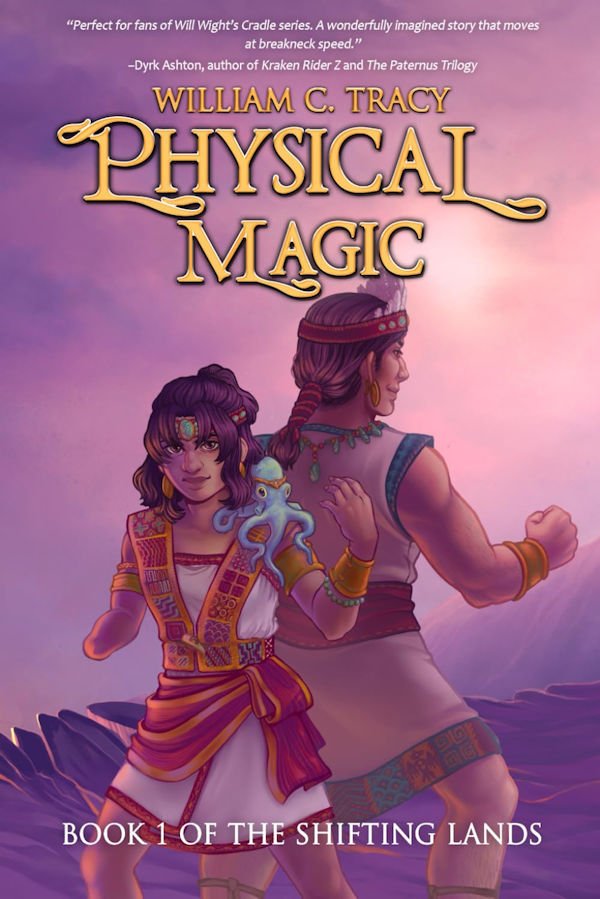
Silluka was born with only one arm and could never practice the exacting motions to summon the favor of the gods. Caught stealing, she is forced to test her powers or be branded an outcast. She fails, and loses citizenship to her village.
In a fit of desperation, Silluka tries to steal a badge of citizenship from a mysterious elder, but instead, Elder Quilqi shows Silluka a different path to gain the powers of the gods, aided by an octopus-like technological wizard who worships their own eldritch divinities. Time is short for training however, because a new island is speeding toward the coastal town, throwing deadly hurricanes and tidal waves before it and threatening all who live there.
Only the gods and godlike storm warriors protect the village from destruction, but all of them fail when a mysterious creature bursts through the wall. It’s only one forerunner for a species of terrifying fast, deadly, and ready to invade the larger island. The village must flee inland before the invasion, while Silluka is weighed down by her outcast status and her brother’s failing abilities.
To save herself, her family, and her village, Silluka must overcome stigma and self-doubt. She must learn the scope of the world outside her village. She must learn Physical Magic.
Physical Magic stood out from the very first chapters. Drawing on Pacific Island-inspired cultures rather than the usual Western medieval fantasy template, it brings a fresh and distinctive world to the page, alongside a protagonist whose struggle with self-worth feels honest and carefully handled. Thoughtful, inclusive, and quietly ambitious, this one stayed with our judges long after they finished. Read on to find out why.
Eva
Silluka is a young woman who’s about to learn a whole lot about how the world around her works and I’m here for her story and growth. I was absolutely cackling in chapter four when Silluka meets a small creature who uses their own translation invention (a translation circlet) to attempt to communicate with her. This machinery hasn’t had all its kinks worked out and the creature smacks the invention to get it to translate correctly: ‘“Excuse! This is my workshop! Translation circlet is rotten kelp.” They took it off again. Smack. “Still under torture.” Smack. “Construction.”‘ Also, when they referred to a wake up call as a “wake attack.”
Julia
This story immediately stood out to me because of its setting. It is clearly not drawing from the usual Western medieval fantasy toolbox. Instead, the world feels inspired by island-based cultures of the Pacific, with gods tied to storms and survival, and communities that must eventually move on when their land can no longer sustain them. That sense of impermanence, and the harsh rules built around it, give the book a distinct atmosphere that feels both fresh and unsettling.
At the heart of the story is Silluka, a disabled protagonist who has grown up internalizing the belief that she is useless. I really appreciated how much space the book gives to this mindset. Her journey is not framed as suddenly becoming capable or exceptional, but as slowly questioning the story she has been told about herself. What resonated most for me was that she needs to prove her worth to herself first. The change does not come easily, and it does not come all at once.
The society around her is deeply flawed, built on the idea that only the strong and magically capable deserve to survive and move on. I liked that the book does not fully excuse this belief, but also does not resolve it too neatly. Some characters begin to question it, some do not, and the shifts in thinking feel tentative rather than magically fixed. A few ideas and changes are handled lightly, but not to the point of feeling unearned.
The magic system itself is familiar in concept, but I enjoyed how it is presented. It does not get lost in pages of technical explanation. Instead of hyper-detailed descriptions of every movement, the focus is on balance, stance, dexterity, and intention. It is easy to grasp without feeling shallow. I also liked that the book gently suggests physically perfect movement might not be the only way to access the power of the gods, which ties in well with its broader themes.
There is an element later on that functions as an assistive tool for magic use. I am generally wary of anything that risks turning into a magical cure for disability, and I would not have minded if there had been no such solution at all. That said, this felt more like an aid than a miracle fix, especially because it opens possibilities for people with many different kinds of bodies and conditions, not just one. Framed that way, I was mostly comfortable with it.
Inclusion is another quiet strength of this book. Silluka’s brother is openly bi and moves naturally between relationships with different genders, and no one treats this as remarkable. Silluka herself is also described as being attracted to more than one gender, though her lack of relationships feels closely tied to her internalized belief that she is not worthy, rather than a lack of interest. There is the faintest hint of something possibly developing for her, but it never takes over the story. The casual, matter-of-fact queerness of the world felt natural and meaningful. The author openly identifies as bi/pan as well, which probably helped this aspect being written so organically and well.
One of my favorite additions to the story were the octopus-like artificers. Their dialogue and banter are genuinely fun, and their enthusiasm for inventing all the things adds humor and a slightly strange, inventive edge to the world.
There is one small worldbuilding hiccup early on involving how citizenship tokens are handled, which briefly pulled me out of the story, but it never becomes a real plot issue and was easy to move past.
I listened to this as an audiobook. The narration took a little getting used to at first, as the pauses at commas felt almost as long as full stops, which made the rhythm feel slightly disjointed early on. After a while, though, I adjusted and stopped noticing it. The narrator is queer, uses they/them pronouns, and is Native Hawaiian, which felt like thoughtful and fitting casting for this story.
This book clearly sets up a larger series, with much more to come, but it still felt satisfying on its own. Overall, this is a thoughtful, inclusive fantasy with a strong emotional core, a distinctive setting, and a protagonist whose struggle with self-worth feels honest and earned.
EG
This story is a fun adventure that is great for those who love a technical system of magic with lots of rules. The story follows Silluka, a young woman in the Huaca society who can’t channel their magic because of a limb difference. Until she learns that maybe she can channel, and must help her people as they migrate away from a looming disaster. The story was a fairly standard journey with danger along the way, but the world was unique enough that I found the familiar story quite entertaining. I will say I’m not hugely fond of highly technical magic systems, and this one went into lots of detail. But the story was entertaining, the characters were likable, and I had a good time reading it.
Maureen
Easily the most delightful part of this book is the worldbuilding. Tracy has done a great job on this, both in terms of martial arts forms and their elemental affinities, and the societies of the islands. The culture and roles, right from village elder to lowly undesirable, play into the bigger picture, as do the various personalities interacting with each other.
The plot (even at the end of the book, I don’t think we’ve yet seen where this is headed) seems to be various archipelago islands are crashing up against each other occasionally, and at the start of this book, we’re seeing this in real time. The Huaca (the people or tribe [although we’re advised later on this is incorrect]) are running from a much stronger group they call Turtlemen as twisters and volcanoes hamper the village’s getaway. The capable perform chayus (you might know them as forms, sets, kata) that appeal to the various gods, who lend them and elemental power according to the chayu.
In their voyage to get away, others are drawn into the villagers’ orbit, and in this manner, we discover love for both Silluka and her brother Ichu, orphans looking out for each other. Silluka and Ichu are the protagonists of this story; this book has more to do with her development because she’s at a disadvantage trying to perform perfect chayus with only the one forearm.
The characters are okay, but ‘just.’ They’re easily likeable, and we follow their ups and downs, but I was missing that little something. Pacing was okay, although the whole start/stop parts of the voyage felt a bit clunky. Immersion was terrific. I was in a hurry to get back to the story when I’d set it aside. There were only two typos I caught and both were minor, easily missed.
I am quite sure there are more surprises in subsequent books and I believe I’ll be picking them up to see if I’m right.
Adawia
I do like this story, but a few niggling issues prevented me from becoming completely immersed. One issue being that we are often told how clever the FMC (female main character) is, but I honestly can’t recall any instances of her displaying profound cleverness (not really, anyway). It feels a bit like the author did this to compensate for the character’s disability. I do, however, recall a number of instances of her extraordinary courage—even ‘under fire’. I think it would have been better if that quality was played up a little more.
We are nearing the end of Round One for this year’s Self-Published Fantasy Blog-Off (SPFBO)! One more semi-finalists to review, then this Friday (June 26th) we reveal our finalist pick who will move on to Round Two!
A quick reminder: Our semi-finalist reviews will not be done in any particular order. All the scores will be announced after all four reviews are posted.
As always: Reading is subjective. What didn’t click for us might be exactly your kind of story. If anything here sounds appealing, please do give it a look!
And a sincere thank you to every author who entered. Putting your work forward for a competition takes real courage, and we appreciate each and every one of you for it. One more to go!
You can keep up with round one of the contest on the official SPFBO website. And if you have no idea what I’m talking about, you can learn more here.
Our judges this year Adawia Asad, Eva Geraghty, Evelyn Grimald “E.G.” Stone, Julia Kitvaria Sarene, Karen Lucia, Kerry Smith, Kit Caelsto, Maureen Neuman, Robert Max Freeman, Sara Rosevear, Sherry Cammer, Stacey Markle, Tianna Twyman, and Yaniv Rosenfeld Cohen. If you’d like to learn more about us, including our likes and dislikes, you can read about them here. And again, you can learn more about the contest here.
Any queries should be directed to the editor, Jennie Ivins, via DM (Bluesky/Threads).

