

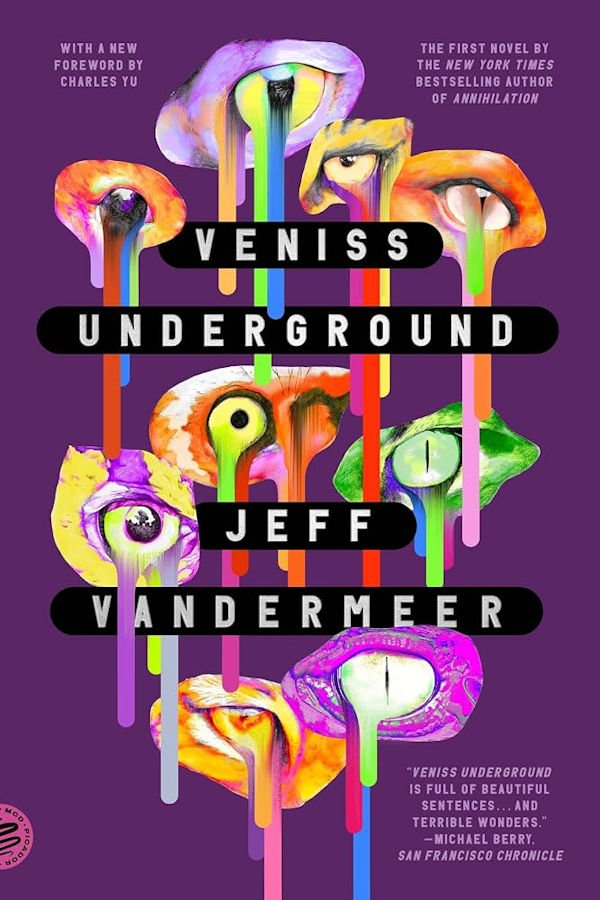
Witness an unforgettable journey that reveals the magical and mysterious city of Veniss through three intertwined voices.
First, Nicholas, a would-be Living Artist, seeks to escape his demons in the shadowy underground—but in doing so makes a deal with the devil himself.
In her fevered search for him, his twin sister, Nicola, spins her own unusual and hypnotic tale as she discovers the hidden secrets of the city.
And finally, haunted by Nicola’s sudden, mysterious disappearance and gripped by despair, Shadrach, Nicola’s lover, embarks on a mythic journey to the nightmarish levels deep beneath the surface of the city to bring his love back to light. There he will find wonders beyond imagining, and horrors greater than the heart can bear.
A journey into a dark and surreal existence, Veniss Underground is an experimental fusion of body horror, biotechnology, and urban dystopia. Often regarded as an early landmark of the New Weird, the novel sees Jeff VanderMeer weave a haunting tale of science, crime, and human transformation through poetic prose, vivid worldbuilding, and deeply flawed characters.
Rather than focusing solely on the plot, I want to explore why this book held me fascinated from its first page to its last.
The atmosphere and living world VanderMeer creates are extraordinary. They surround what is, at its core, a relatively simple story, yet it is the richly detailed, eerie, and relentlessly grim environment that makes the novel so compelling. VanderMeer’s worldbuilding draws the reader deeper and deeper into the city, constantly provoking curiosity and almost forcing us—often against our better judgement—to continue exploring the ruined and horrifying place he has created.
Central to this world is the use of genetic manipulation to create human-animal hybrids, some of which are regarded as living works of art. The concept is as fascinating as it is deeply disturbing, blurring the boundaries between beauty and cruelty, creation, and exploitation.
Over the course of the novel, we are introduced to three central characters: Nicholas, a struggling artist; Nicola, his twin sister, who lives in a more decadent part of the city; and Shadrach, Nicola’s former lover and a previous associate of the maniacal creator Quin.
After Nicholas and Nicola are drawn into Quin’s grotesque experiments and subjected to horrific transformations, Shadrach descends into the city’s underworld to confront him. The plot is deliberately simple, echoing a dystopian reimagining of the ancient Greek myth of Orpheus and Eurydice. This familiar structure provides a strong foundation for VanderMeer’s far stranger ideas.
What makes the characters convincing is not that they are heroic or especially admirable, but that they are recognisably human. Through their relationships, mistakes, and contradictions, VanderMeer reveals the small traits and imperfections that make them feel real. Their emotional flaws provide an important contrast to the grotesque and often nightmarish world around them.
Their stories are delivered through three different perspectives. Nicholas speaks through a distinct and intimate first-person voice. Nicola’s story is told in the rarely used second person, drawing the reader deeper into her experience, while Shadrach concludes the nightmare in the third person, giving his descent the quality of a mythic and deeply personal trial. I found this structure fascinating. It gives each section a distinct identity and each character a unique voice, helping to elevate them beyond mere literary devices. The shifting perspectives also make the novel feel increasingly expansive, as though the reader is moving outward from individual experience into something larger, darker, and more universal.
VanderMeer is clearly exploring themes that fascinate him and continue to resonate throughout society. One of the most prominent is the exploitation of others in the name of scientific progress. The creation of genetically spliced human-animal hybrids, including meerkat assassins, is both wildly imaginative and deeply disturbing. Whether intentional or not, the choice of meerkats also creates an amusing echo of VanderMeer’s own name.
I have seen criticism that the book borders on being weird for the sake of it, but I never felt that. Its strangeness always seemed purposeful, connected to the wider story, and designed to disturb, challenge, or provoke. The horror is not simply decorative. It reveals the consequences of unchecked ambition and the reduction of living beings to experiments, commodities, or art.
At the same time, the novel is also a story about love and sacrifice. How else can you define and demonstrate true love than through a tireless descent into a degenerate underworld, digging through piles of discarded and mutilated bodies in search of the person you love? The gore and emotional intensity of this sequence create an image I cannot fully do justice to, nor praise highly enough. It is horrific, but it is also deeply moving.
The idea that something exists just beyond our reach, or that there is a hidden world we choose to ignore, is ever-present. We remain safe in our ignorance but terrified by discovery. In Veniss Underground, this hidden reality lies beneath the city, where the full extent of Quin’s tampering and experimentation is revealed.
This creates a sharp parallel with the real world and the price of self-interested progress in the hands of those without restraint. It is an all-too-relevant subject: the pursuit of advancement without responsibility, compassion, or concern for who must suffer as a result.
Ultimately, Veniss Underground earns its place as an important early work of the New Weird. It blends imaginative storytelling, haunting atmosphere, and distinct characterisation, but its greatest strength lies in its themes, sometimes subtle and at other times screaming for attention. It explores the darkness of the human mind, the selfish desire for progress, and the urge to play god. Yet it also examines the power of love, the depths of human courage, and the lengths to which one person will go to save another.
This was my first experience of VanderMeer’s work outside the popular Southern Reach series, and it quickly became one of my favourites in the genre. It also led me to seek out and devour more of his writing.
In summary, VanderMeer has created something unusual, thought-provoking, and profoundly memorable. Veniss Underground leaves a lasting impression as the reader navigates its surreal brilliance against a horrifying backdrop of human experimentation, exploitation, and transformation.

