

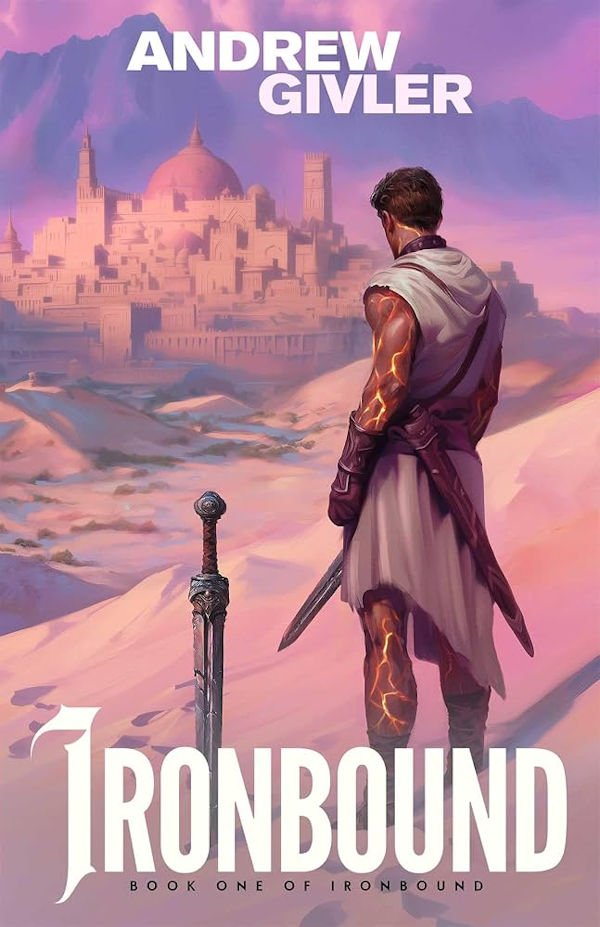
As long as he can remember, Castor has wanted nothing more than to fuse with a Cor Heart. Made from an otherworldly metal, it would give him the ability to bind a Symbol and manipulate the elements.
The day of trial has finally arrived—a chance for Castor to prove his worth. Only after winning the Empress’ blessing can he begin his life of adventure.
When his chance is interrupted by a vicious attack, he finds his home in ruins and his family in mortal peril.
Conscripted into the Legions, bound to a Symbol he never wanted, Castor must survive the Iron City, his enemies in the frozen North, and clandestine traitors within the rusting Empire itself.
But more than anything, he wants revenge against those who took everything from him.
Andrew Givler’s Ironbound sits in quite a crowded space of dark progression fantasy with a focus on Roman-inspired military fiction, but quickly establishes its own distinct identity. While the early chapters evoke familiar staples of the genre, the story explodes into a tense, character-driven narrative that balances brilliant worldbuilding with high-stakes combat.
At the centre of the story is Castor, who initially comes across a bit too clever for his own good, and those familiar with Ruocchio’s Hadrian Marlowe or Islington’s Vis will spot many parallels in his sharp mind, high-born confidence, dedication to training, and obsession with letting us know all about it at every opportunity. However, Givler subverts this masterfully in such unexpected terms by throwing Castor’s life into utter turmoil as things spiral out of our protagonist’s control. The rest of the novel is a deconstruction of that early over-confidence, forcing him to adapt to circumstances way beyond the preparation grounds of Segesta, and it makes his survival and strategic choices feel genuinely earned and organic.
The supporting cast lend the story a strong emotional grounding, particularly through the camaraderie and sense of shared survival forged within Castor’s legion. In this, the novel felt very close to The Stormlight Archive—companions to the protagonist bringing necessary warmth to a bleak military world, with several side characters’ personalities offering an interesting dynamic. That said, the roster is not without its flaws. At times, they almost strayed into peripheral ‘cookie-cutter’ characters with no real function other than to act as narrative tools to push Castor’s own journey forward. Their own motivations (with a few exceptions) remain light throughout, making them feel like archetypes reacting to the protagonist rather than being independent agents with their own needs and goals.
Beyond character similarities, Ironbound shares some thematic DNA with Pierce Brown’s Red Rising series through its cutthroat imperial setting, rigid hierarchies, and legion dynamics. The worldbuilding is top tier, although it is possible the aforementioned Brown, Ruocchio, and Islington have already laid the groundwork, helping us keep our footing when navigating this world. Regardless, Ironbound takes turn after surprising turn to shift the focus to the brutal realities of conscription and military survival. At the one-third mark, Givler sheds the influences and forges his own path—much like our protagonist.
From this point on, Givler moves nimbly between different narrative modes; he keeps it character-driven when emotional weight is required, action-packed during the combat, and broad enough when exploring the world and history. Most pleasing of all was no single element overstays its welcome, and he somehow manages to juggle this whilst moving the plot forward without sacrificing depth.
Like many, I love a good magic system, and Ironbound doesn’t disappoint. Centred on the elemental congruencies and Cor Hearts, this is a system that allows space for its characters to use it effectively based on who they are, rather than leaning on simple power levels or arbitrary rules. In fact, it’s a rare example of a magic system that lives and dies by its characters’ dispositions, personalities, intelligence, or physical strength; a wily character will utilise congruencies entirely differently than someone who is physically dominant. This focus on resourcefulness and nuance gives the action sequences and duels a genuine tension and a sense of unpredictability.
Ironbound stands comfortably alongside some of SFF’s undisputed heavyweights, bridging the gap between familiar genre tropes and a distinct, action-packed story of its own. By battering Castor through brutal trials and turmoil, grounding its world with a brilliant character-driven magic system, and shifting to a tense military narrative, Givler delivers a novel that succeeds on nearly every front. If the sequels, Cold Wind and Bloody Sands, can maintain this standard, the series will undoubtedly cement itself as one of the most impressive of recent years.

