

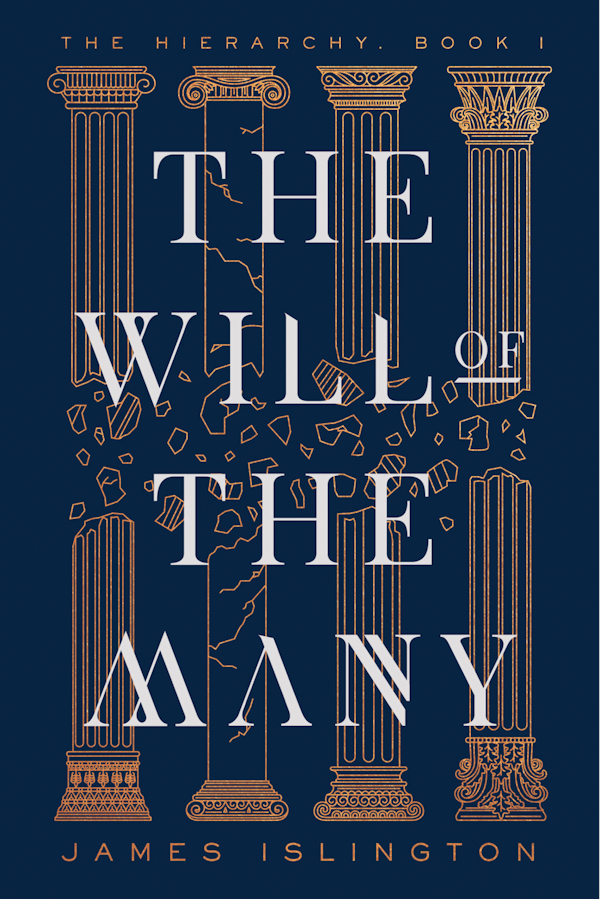
AUDI. VIDE. TACE.
The Catenan Republic—the Hierarchy—may rule the world now, but they do not know everything.
I tell them my name is Vis Telimus. I tell them I was orphaned after a tragic accident three years ago, and that good fortune alone has led to my acceptance into their most prestigious school. I tell them that once I graduate, I will gladly join the rest of civilised society in allowing my strength, my drive and my focus—what they call Will—to be leeched away and added to the power of those above me, as millions already do. As all must eventually do.
I tell them that I belong, and they believe me.
But the truth is that I have been sent to the Academy to find answers. To solve a murder. To search for an ancient weapon. To uncover secrets that may tear the Republic apart.
And that I will never, ever cede my Will to the empire that executed my family.
To survive, though, I will still have to rise through the Academy’s ranks. I will have to smile, and make friends, and pretend to be one of them and win. Because if I cannot, then those who want to control me, who know my real name, will no longer have any use for me.
And if the Hierarchy finds out who I truly am, they will kill me.
The Will of the Many and The Strength of the Few are close contenders for the best books I have read this year. In short, Islington takes a classic young adult fantasy academy formula, sets it in a classical Romanesque fantasy world, and pulls you along with several compelling mysteries and exciting confrontations.
In long… Vis, our late-teen main character, starts as an orphan at quite a nasty orphanage (the scars on his back can attest to that), but over the series of events leading to him climbing the ladder of this world’s hierarchical class system, we are let in on his secret: he’s actually a lost prince of a nation overthrown by the Hierarchy. Due to his twelve years of privileged upbringing and lessons, he’s gained major advantages, giving all not-in-the-know the illusion that he is merely an incredibly quick learner, picking up things no orphan should know. He impresses politician Magnus Quintus Ulciscor, who adopts him for his own goal to uncover the secrets behind the prestigious Catenan Academy, including the mysterious death of his brother, Caeror.
So, we have dense worldbuilding, mystery, and a semi-revenge motive within a brutally strict political system; that’s a lot, and it barely covers the premise. A major appeal of these books for me comes from the nature of Vis’s identity. There’s something cool about the main character having to pretend to be less than what he is. Reading his story is like being in on a secret and having the satisfaction of seeing him use it against the many smug, well-to-do antagonists. Vis, like Batman, goes into all his confrontations well-prepared, well-trained, and well-educated, which commonly leads him to victory. But it’s the times when he’s forced to improvise that are the most interesting. In several instances, when the stakes and circumstances are sudden and dire, Vis is forced to break the rules or resort to crueler tactics to win. This reveals his true ability: his resourcefulness. And boy, does he win a lot because of it, but at a great cost most of the time.
The magic system is more on the periphery than in most fantasy books, and it is rarely used in book one. Will is a catch-all term for both superhuman strength and telekinesis granted to those in the Hierarchy, from Will “seeded” by those lower down the Hierarchy’s three somewhat adversarial pyramids (government, military, and religion). It’s used to explain much of the technology and magical superpowers of the few important characters who use it. Because it’s against the rules to use Will at the academy, it is usually only a tool to raise the stakes against Vis in more climactic moments.
Until book two, that is.
At the academy, Vis must rise through the ranks to the highest class, class three, to gain access to areas crucial for uncovering the mystery of Caeror’s death, all while avoiding the suspicion of the head of the school, Principalis Veridius. This would be fine if not for Ulciscor overburdening expectations and the creepy, tomb-torture secrets Veridius is up to, which are connected to another important aspect of this world: the Cataclysm.
Three hundred years ago, the world was nearly destroyed, one in twenty people died, and technology regressed to the point that everything considered high technology is “pre-cataclysm.” Like all good world-ending tropes, what caused the cataclysm is unknown, and there is a good risk of it happening again. Yay.
To summarize my feelings on book one, it follows all the beats of a young adult mystery fantasy set at an academy with a Roman-style flavor. It’s a tight read and better written than many books with that formula. However, what makes it even more worth recommending is its sequel, The Strength of a Few, which I loved, and I can’t really go into it too deeply without giving away major spoilers for the end of book one.
So, let it be known that from this line down, there will be spoilers for the end of book one.
[Spoiler Warning: The rest of the review has spoilers for the end of book one, The Will of the Many. Read with caution if you have yet to finish the book.]
Spoilers for The Will of the Many
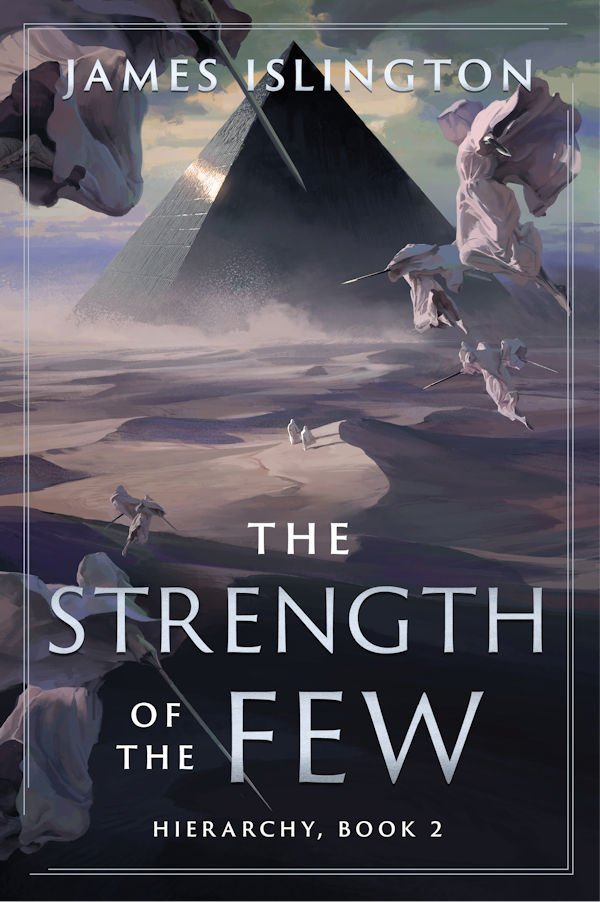
Omne trium perfectum.
The Hierarchy still call me Vis Telimus. Still hail me as Catenicus. They still, as one, believe they know who I am.
But with all that has happened—with what I fear is coming—I am not sure it matters anymore.
I am no longer one. I won the Iudicium and lost everything—and now, impossibly, the ancient device beyond the Labyrinth has replicated me across three separate worlds. A different version of myself in each of Obiteum, Luceum, and Res. Three different bodies, three different lives. I have to hide; fight; play politics. I have to train; trust; lie. I have to kill; heal; prove myself again, and again, and again.
I am loved, and hated, and entirely alone.
Above all, though, I need to find answers before it’s too late. To understand the nature of what has happened to me and why.
I need to find a way to stop the coming Cataclysm, because if all I have learned is true, I may be the only one who can.
The Strength of a Few takes off directly after book one with the reveal that Caeror is alive in another world, one of three worlds studied by Veridius’s attempts to prevent a second cataclysm, and which Vis has been copied into. That’s right, all three of them. There are now three Vis, three stories running in parallel, and their settings are all vastly different.
I won’t lie. At first, I was overwhelmed by this twist, as the book starts the reader in neither the world we knew from book one, nor the world Vis woke up in at the end of it, but a third world. Here, there are shamans and barbarian warlords, all with their own culture and language, which Vis has to learn. It’s a lot. But by about the halfway point, I kind of started to get it. The intense fights, reveals, and cliffhangers fit together quite well, creating a rhythm that synchronizes them. Fittingly, the abilities Vis is given as a result of being copied are called synchronicity. These abilities involve him being aware of Will users around him, being able to adopt others’ Will into himself, quick healing, and even a level of Jedi mind trickery in the later parts.
I want to say these abilities make Vis quite powerful in the second book, but given he doesn’t fully understand how to use them until the last third of the book, they’re barely enough to keep him alive at times. Their activation at certain points in the story could be considered deus ex machina, if not for the fact that the different versions of Vis learn about them and discover how to use them at different times. Now, as a fantasy writer myself, I thought this was a clever loophole. By having one Vis lampshade the magic by learning it earlier, it doesn’t feel so out of place when another Vis uses that magic to, say, kick some ass in a desperate situation.
If I were being a stickler, I might say some of the uses stretch the reader’s knowledge of the magic somewhat, and the formula whereby Vis gets into a tough situation only to miraculously win by pulling a rabbit out of his hat can get a little repetitive. However, if anyone’s enjoyed JoJo’s Bizarre Adventure, one has to admit there is a level of shenanigans you have to accept for some badass Uno Reverse card wins, particularly on villains as cruel as the ones we’re offered in this series. That’s not to say these scenes don’t make sense. They just feel, for lack of a better word, convenient. But what’s the alternative? The main character dies in three different worlds? Not the best idea when your entire story is written in the first person.
Another aspect I must cover is the revenge plot. Through flashbacks, we are given good reason for why revenge isn’t the driving motive for Vis. So when, in book two, he’s given a chance to enact that revenge, he knows, and we know, this will not end with the satisfaction one might assume it would. In fact, one could say because of the consequences of that scene, obtaining his revenge was the worst-case scenario. Rarely does a book so easily convince me of the negative side of revenge without being too preachy and actually show why, particularly with how commonly revenge is used as an ultimate motivation for characters.
In the end, I enjoyed book two immensely, and I am eagerly anticipating the next installment in this series. The twists throughout have kept me coming back, and none so much as the ones at the end of this book. Yet, like with most mystery series, it’s all about the landing, and I am holding my breath for the next installment in this series.

