

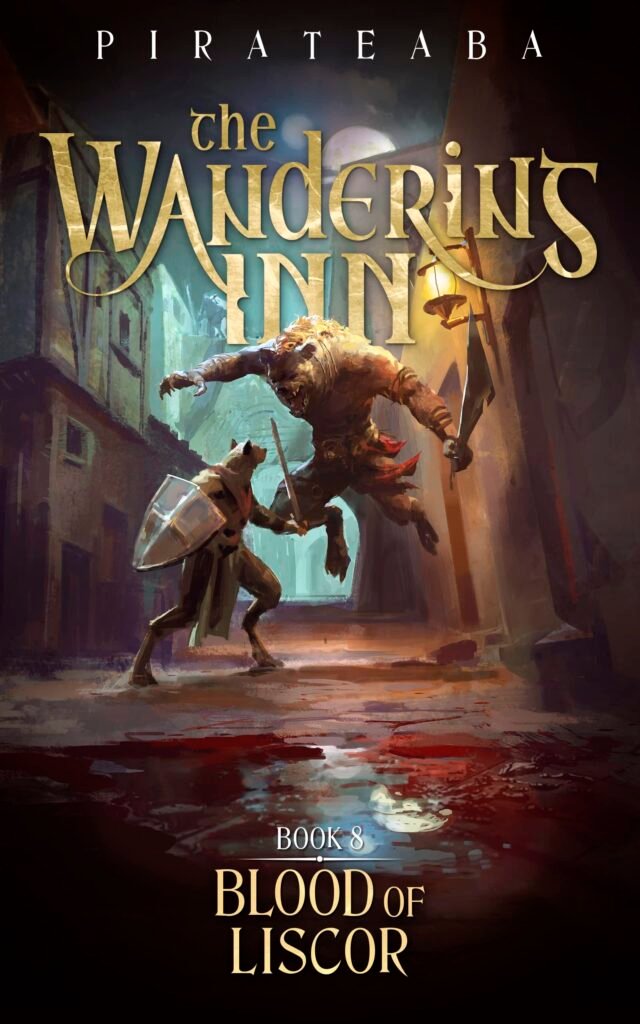
Something is buried underneath Liscor. And it’s hungry.
Of course, if there were only one thing under Liscor, there would be far less to fear. However, the dungeon continues to be a threat. At the same time, Goblins continue to roam northern Izril, but not all of them are as hostile to people as Tremborag or the Goblin Lord. Will the Unseen Emperor of Riverfarm make that distinction, however?
A reckoning is coming as old faces and new reemerge. And all the while, The Wandering Inn is still serving food and respite and even plays to adventurers and Antinium alike. But something is coming from the dungeons. And it—they—are hungry.
If you have made it this far into The Wandering Inn, you already know why you keep coming back. It is not the magic system or the world building, though both are excellent. It is the people. All of them, regardless of species, class or how many legs they have.
Blood of Liscor is one of the stronger entries in the series, and it earns that almost entirely on the back of its character work.
Erin really gets to shine here in a way that feels genuinely satisfying. She is often underestimated, and this book lets her use that.
Lyonette continues a growth arc that has been building for a while, and it finally clicks into place. She has been a spoiled princess, then someone who bent herself entirely to what others needed. Here she starts to find out who she actually is when those two things meet. It feels earned. There’s another plotline of hers I don’t like as much, but that’s probably down to taste, and I won’t spoil it for you.
The Redfang five get real room to breathe for maybe the first time, developing personalities beyond pure survival mode, and they are an absolute joy to follow.
Bird is a delight as always, an Antinium who is somehow broken, and yet a favorite. He’s neurodiverse coded in ways that will resonate with a lot of readers, and surrounded by characters who take him seriously without making a fuss of it.
The dungeon crawl at the heart of this book is tense, atmospheric and genuinely gripping. There is a long-lost character whose fate has been shaped by isolation and madness in ways that are not perfectly written, but the core idea lands hard. A hero twisted into something else entirely. Watching another character navigate old loyalties against a new and painful reality is handled with real nuance, refusing easy answers in either direction.
Not everything lands. The play subplot builds and builds and then resolves so fast it barely registers, which makes all that build-up feel a bit pointless. Laken also feels oddly diminished here compared to previous books, in a way that does not quite track as a natural continuation of his arc.
But honestly? When a series makes you care this much about this many characters, a few weaker threads are easy to forgive. Blood of Liscor is exactly why this series is so addictive.


 Angela Boord
 Tom Joyce