

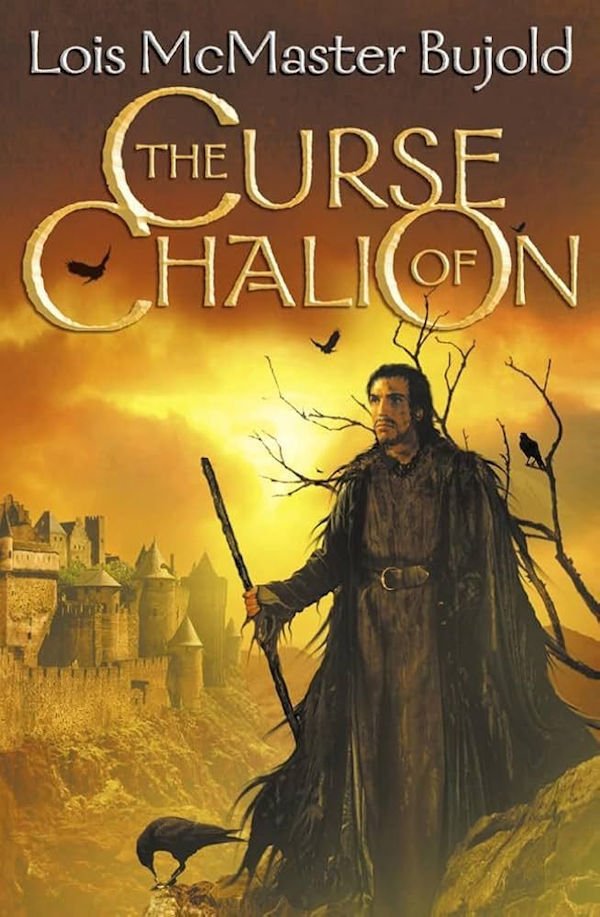
A man broken in body and spirit, Cazaril, has returned to the noble household he once served as page, and is named, to his great surprise, as the secretary-tutor to the beautiful, strong-willed sister of the impetuous boy who is next in line to rule.
It is an assignment Cazaril dreads, for it will ultimately lead him to the place he fears most, the royal court of Cardegoss, where the powerful enemies, who once placed him in chains, now occupy lofty positions. In addition to the traitorous intrigues of villains, Cazaril and the Royesse Iselle, are faced with a sinister curse that hangs like a sword over the entire blighted House of Chalion and all who stand in their circle.
Only by employing the darkest, most forbidden of magics, can Cazaril hope to protect his royal charge—an act that will mark the loyal, damaged servant as a tool of the miraculous, and trap him, flesh and soul, in a maze of demonic paradox, damnation, and death.
I first read The Curse of Chalion many years ago. In fact, so many years ago I initially remembered reading it a year or two before it actually came out (2001). I picked it up randomly at a market stall, mostly because it had a castle on the front. I was an experienced fantasy reader (so I thought) at the time, but mostly loved older, classic, heroic/antiheroic fantasy like Tolkien, Moorcock, and Gemmell. Having grown out of Eddings and Jordan, I hadn’t found what I wanted in proto-grimdark, though I was searching within quite narrow parameters (so much so that I started writing my own to fill the void).
But I also barely read women authors, mostly as a conscious (if subconsciously influenced) choice, sadly.
So it was very fortuitous that I picked up this book. Both that I actually chose it, and for my future fantasy reading, fandom, and writing.
The Curse of Chalion tells the story of Cazaril, a former warrior and agent, now approaching middle age (he seems less old now!) and recovering from years spent as a galley slave, following treachery. Instead of some Inigo Montoya revenge quest, however, he becomes the advisor to two young noblewomen, just trying to get a warm bed and food. But all is not well in Chalion, as he soon finds out—and when he tries to do something desperate (and heroic, just not in the way I was used to) he starts to uncover the mystery of the curse, and finds himself at the middle of both theological/mystical and political challenges. And he doesn’t fight them with a sword, or wizardry, or a clash of armies, but with brains and the pen, aided by the bravery of women.
Reader, it blew my mind.
Turns out heroes didn’t have to be invincible warriors, or solve everything with a big battle. Women could have major roles without just being love interests* or damsels in distress. Politics could be nuanced and perilous without being grim and impossible. Faith could be real and important with gods that acted tangibly on the world.
The book opened up new worlds of fantasy to me (albeit slowly): new authors, new types of stories, magic systems, characters, and heroes. It hugely influenced not only my reading, but my writing, and also my advocacy (sadly needed) for women fantasy writers.
Twenty-some years later and I had the chance to read it again on audiobook, and, slightly apprehensive—I almost never reread, and it was so precious to me—I went for it, hoping I hadn’t built it up too much in the memory and…
…it was even better the second time!
I remembered very little of the story, it turns out, and even though I had read the sequel (also excellent), had forgotten how the ending came together. My memory of the main character was also a little off, in that he’s more physically active despite his injuries and afflictions, but also has a slightly gratuitous, if platonic, romance with a younger ward.* (These days he probably wouldn’t.)
What was better was the detail, the realism, the twists and turns, the plots, mysteries, and solutions. I’d thought of it as a book without action—a revelation—but it’s not that at all; it’s just a book with different sorts of action and intrigue, the sorts I’ve grown to love.
So I’m very glad I didn’t leave this book to my younger self, even though it had a huge influence on him. It’s been one of my favourite books for years largely for the impact it had than for any clear memory of the events (obviously); but now I can say it’s one of my favourite ever books because it changed my life AND because it’s exactly the sort of book I now look for, and cherish. I don’t know if it set me on some inevitable path to this point, imprinting itself as my future ideal book, but I’m so very glad I read it—twice!

