

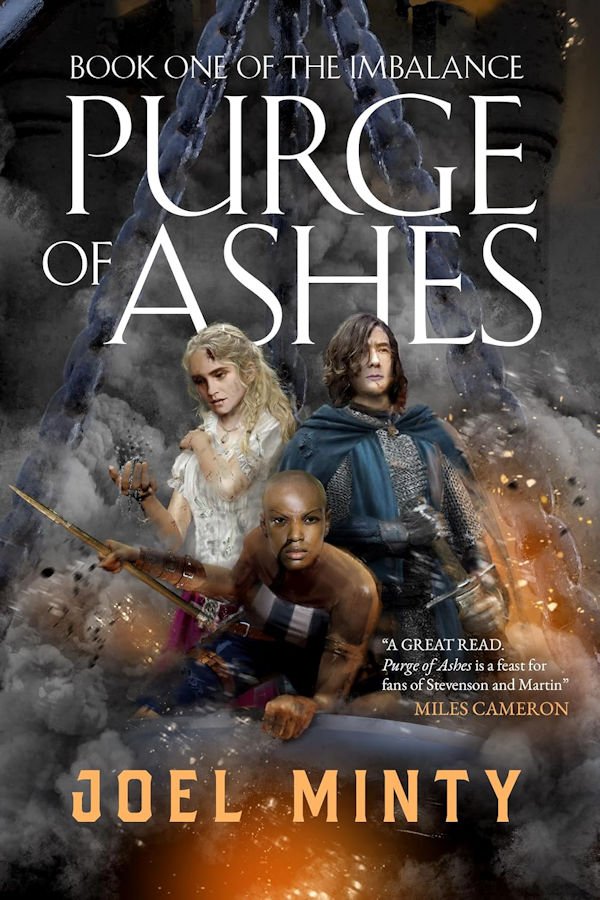
Zealots of the Scalion Legion arrive in a maelstrom of fire and blood, their ambitions as mystifying as their body count is explicit.
They rush at Orenzo Madleej, once eager conscript now crestfallen mercenary, suffocating his wide-eyed notions about historied combat. They fall on Aronan Kloss, once worthy heir now embattled harbinger, uprooting his duelling responsibilities of national security and human decency. They howl above Asma Madrejingo, once a resolute head now a fragile heart, leaving her for dead amid those who promised shelter—and they come with a sole cabalistic objective: to hunt a single immortal betrayer harbored by Aronan’s powerful father.
Now obligated by contract to escort half a city of refugees to the distant capital, Orenzo and his division are Aronan’s only hope to protect his people from a massacre of crude magic and relentless iron. The road is long as a spear, trust as fleeting as reprieve, and the trials of confidence without as exacting as the worms of misgiving within—for as the harrowing march cripples morale and civil war bleeds out the toughest of the crown’s retainers, the capital seems less and less likely to provide sanctuary.
Yet sanctuary they will need, for among them walks one with smoldering temples in his wake: a god’s bastard purposed with fraying the bonds between man and providence.
What chance, asylum, against the birth of imbalance?
From page one, this story grabs you and holds you in its grip, drawing you into knife-edged politics, relentless conflict, and deeply human relationships. Joel Minty’s exceptional debut immerses you in an expansive new world. But it’s more than that. It’s the beginning of what could become an epic tale wrestling with humanity’s capacity to create, destroy, and survive.
The book unfolds in three distinct parts. The first depicts a city being crushed beneath an invading enemy: the Scalion Legion. An army of rodent-like creatures, filthy, vicious, and devoid of compassion, they are hellbent on a singular purpose and willing to bathe the streets in blood to realise it. This opening act introduces some of the main protagonists while thrusting you straight into the action. Brutal slaughter and simmering malice make the downfall of a once-great city a grim spectacle.
The second part of the story centres on the refugees from the city. Having fled the burning ruins of their former home, they must journey through unknown and potentially hostile lands in search of shelter. Led by mercenaries and nobles, they face an uncertain future, their survival far from assured. For me, this section slowed the pace but allowed the characters more room to develop. Inner dialogues, heated exchanges, and rising stakes strip back bravado and pretence to reveal the naked truth of humanity. Joel does this exceptionally well, giving his characters depth by exposing their flaws.
And the final part of this book… the siege. This is where everything comes together in a potent mix of betrayal and sacrifice. By this point, the pace quickens as the story’s threads draw together. It’s bloody, emotional, and at times frantic, building to a satisfying crescendo that leaves you wanting more.
Status versus competence. This tension runs throughout the book, deepening the sense of despair. Does noble birth confer the ability to lead, to inspire, to conquer? No, and the story lays that assumption bare. It’s experience that matters. Leaders aren’t born; they’re crafted, chiselled. Yet leadership depends on more than experience alone. It requires trust, earned through relationships and tested in the adversity of war and the face of betrayal. Joel uses that friction between inherited authority and earned loyalty to weave intrigue and guile into an otherwise unforgiving landscape.
The combat feels true and, more importantly, grimy. Exactly as it should. There is no grandeur in shedding blood for conquest or survival. Joel captures this perfectly, making the scenes raw and visceral. War is not pretty.
The magic in Purge of Ashes offers another dimension to the conflict. Elemental forces bubble below the surface, lending support in battle without ever feeling overpowered. Just necessary. There’s a sense that far more is still to come in future books, and that we’ve only scratched the surface of what these forces can do.
This is a book that rewards close attention. Its intricate worldbuilding asks you to hold details in mind until their connections become clear. It takes some investment, but for me, that gradual unfolding is part of the pleasure. Joel’s prose flows elegantly, then shifts into a blunt, hard-hitting rhythm when the narrative demands it.
Perhaps the standout element of this story for me was the character progression. I’ve mentioned this in previous reviews because it matters to me: characters need flaws that make them feel human. Infallibility is not relatable. Here, we witness characters become heroes through their actions as they confront self-doubt, arrogance, and hurt. Their histories unfold, their secrets are laid bare, and their experiences shape the relationships that help them rise.
Orenzo deserves particular mention.
He’s introduced as a relative nobody serving in the Locian Freelancers. Simply performing a duty. For me, he embodies the idea that where you come from and what you’ve accomplished need not define what you’re capable of. His lack of self-confidence makes his actions all the more compelling: he doesn’t have to be free of doubt to prove his worth, and he does so time and time again. Oh, and there’s something more about him I’m desperate to understand—but that will have to wait.
But our connection with words goes beyond a good story well told. For me, a book becomes something special when it strikes a certain chord, gets under your skin and crawls awhile. That’s exactly what Purge of Ashes did. It embedded itself and stayed with me long after I put it down. I could imagine the world and feel the characters’ vulnerabilities. The atmosphere Joel creates is electric, threaded with the sense that safety is always fragile and conflict never far away. That sustained tension kept me hooked.
I have huge praise for what Joel has created in Purge of Ashes. I know, by his own admission, that bringing this book to fruition has been a long journey. For me, that care and commitment come through on the page. It feels like a book into which he has poured his heart and soul.
If you enjoy fantasy steeped in brutal conflict, fraught politics, and flawed characters who give you a reason to care, I’d encourage you to read this. It’s an ambitious beginning, and I’m eager to see where Joel takes the story next.
Lastly, a big thanks to Joel for getting a physical ARC into my hands. From Canada to Denmark! We made it happen, and I’m damn glad we did.

