
Sixteen-year-old Jun dreams of proving his worth as a warrior in the elite Guardian’s Tournament, held every six years to entrust the magical Scroll of Earth to a new protector. Eager to prove his skills, Jun hopes that a win will restore his father’s honor—righting a horrible mistake that caused their banishment from his home, mother, and twin brother.
But Jun’s father strictly forbids him from participating. There is no future in honing his skills as a warrior, especially considering Jun is not breathmarked, born with a patch of dragon scales and blessed with special abilities like his twin. Determined to be the next Guardian, Jun stows away in the wagon of Chang and his daughter, Ren, performers on their way to the capital where the tournament will take place.
As Jun competes, he quickly realizes he may be fighting for not just a better life, but the fate of the country itself.
Before launching into this review, I must make a confession. It’s terrible of me, but when I see a celebrity book, I cannot help but wonder if said book is only on the shelves because of that celebrity connection. Which is unfair. Obviously, someone can be related to Bruce Lee and help to write a good book. There is absolutely no logical reason for these two facts to be mutually exclusive.
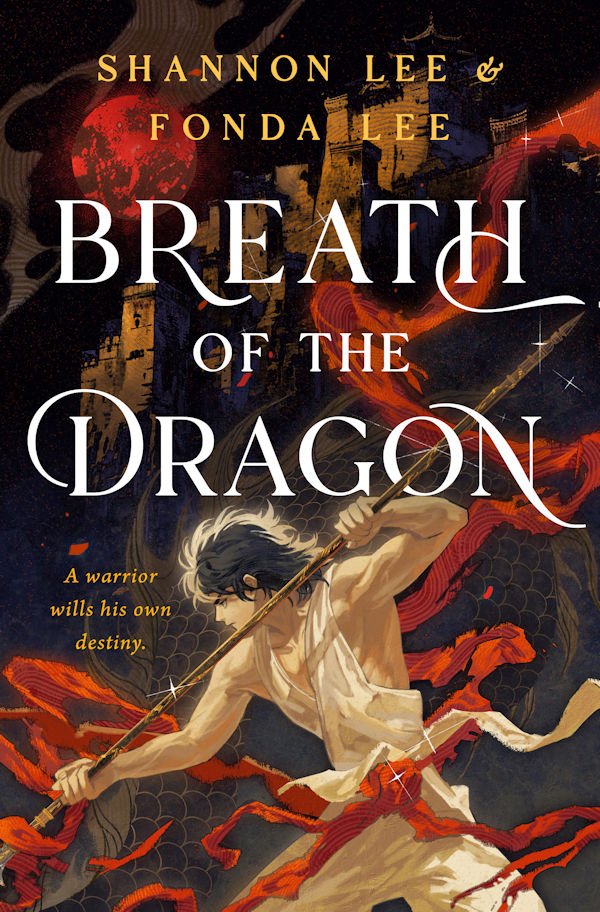
So, intrigued by the cover art (try not to judge me for judging a book by its cover) and the description (I love a good Coming of Age story), I overcame my biases and picked up a copy. Breath of the Dragon, book one of the Breathmarked Duology, was released in January of 2025. This YA (Young Adult) epic Coming of Age story is co-written by Shannon Lee, who is Bruce Lee’s daughter and CEO of the Bruce Lee Family Companies, as well as chairperson of the Bruce Lee Foundation. And by Fonda Lee, celebrated author of Jade City, the winner of the 2018 World Fantasy Award and the first book in the Green Bone Saga.
First, let us examine the prose, one of the great unknowns when selecting a new book by a new-to-you author. Now, anyone who’s read my review of The Last Unicorn knows I love flowery prose. Getting lost in a description of a sunrise brings me joy. Sentences that take up the space of an entire paragraph delight me. Breath of the Dragon is not that, and there’s a lot to be said for ‘not that’ as well.
The writing is crisp, clean, and beautifully to the point. This suits the YA genre well, combining with the Coming of Age trope to make Breath of the Dragon a wonderful novel to introduce young readers to the realm of fantasy literature. As I observed in my review of The Last Unicorn, I gave up on reading it when I was young. I couldn’t follow the story amidst the glowing, poetic prose I now enjoy. Young readers will find the writing in Breath of the Dragon much more approachable.
Another highlight of Breath of the Dragon is the window offered into a non-European based fantasy world. Don’t get me wrong, I love a good medieval European setting, but it’s also great to stretch your wings (after all, dragons have wings and surely stretch them… so as not to get wing cramps while flying). Having never before read a fantasy novel set in a realm inspired by Ancient China, this opportunity to delve into such a world was another reason to pick up Breath of the Dragon.
Which brings me to my one complaint. For much of the book’s beginning, I lacked a strong sense of where and when the story takes place. There are undoubtedly clues in the text. Likely they include furnishings, weapons, clothing, and more. For example, were the book set in a medieval Europe based realm, mention would be made of corsets, towers, breastplates, and hunting harts and hinds. Having grown up with those references, they make getting oriented in a world easy. Not having grown up with any of the references in Breath of the Dragon, coupled with the slightly modern tone of the language (which is applaudable for its accessibility, as discussed above) left me uncertain about the world in which our characters live. None of which detracts from the Coming of Age story contained therein.
A classic tale of youthful rebellion, Breath of the Dragon follows Jun Li, a youth whose twin brother, Sai Li, seems destined for greatness, while Jun’s desire for the same is thwarted and rebuked at every turn, and even results in hardship for him and for his family. Without spoiling anything, we are treated to opposing political sects, organized crime, temptations of wealth, and the evils of corruption. Readers also get a glimpse into the lives of traveling performers moving through both rural regions and cities of various sizes, and into martial arts training and tournaments. Specifically, into the Guardian’s Tournament, a pivotal event around which much of the story is focused and which is of great importance in the Breath of the Dragon world. A full, rich world that is, as is often the case in Coming of Age stories, far more complex than our main character, Jun, initially knows.
A world that also contains magic, gifted by the realm’s god, Dragon, in the form of Breath Marks. Such marks manifest as dragon scales somewhere on the recipient’s skin, and grant a myriad of abilities, from psychological to physical. One such Breath Marked individual is our hero’s twin brother, Sai Li, though our hero is not. Jun Li must learn to master his inner strength through mental and physical training, and strict discipline. No magical power conferred by Dragon aids him.
On a deeper level, however, Breath of the Dragon is about Bruce Lee’s philosophies, the authors making specific mention of consulting his writings and on wishing to share his legacy. Breath of the Dragon highlights Bruce Lee’s views on physical and mental discipline, on unity, and on honor. There is an emphasis on the idea that taking ownership and control of your body, mind, and spirit is the way to become the best version of yourself. Two wonderful quotes, both spoken by Jun’s companion Ren, exemplify this.
“Marked or not, every one of us has Breath enough to will our own destiny into being.”
And,
“The gifts we work for are greater than the ones we’re given.”
Throughout, readers will find an emphasis on respecting others, especially those from whom we learn, on the need for a disciplined and clear mind, and on the importance of physical fitness.
You will also discover themes on how fostering division and mistrust is a root of evil, and a strong rejection of making choices for self-serving reasons. Bruce Lee’s philosophy of unity is best expressed in Breath of the Dragon by Jun’s thoughts:
The people on the other side of the wall were not so different from those here; they’d merely been born elsewhere. It didn’t make them inherently weak or evil.
And his views on being self-serving with,
…people were happy for the tournament to continue under Cobu’s new rules even if it ruined the integrity of the Guardianship and threatened the stability of the country. There was money to be made, and bloodshed entertained the masses.
Readers are provided with many examples of Jun’s honor, and of the growth of his character. While far from perfect, especially at the start of the story, and rather given to short-sightedness (excusable at sixteen), Jun is a sympathetic character who offers many traits to emulate. A character you will enjoy accompanying on his journey.
As for an age group, the book is recommended for fourteen and up, because there is a considerable amount of fighting and some cursing. The cursing is rare and usually mild, but in a few instances on the stronger side. For my part, I would have preferred world-specific curses be invented, because then the book could easily be recommended to even younger readers. Still, due to the strong morality of the themes and the lack of anything overly romance-related, the age at which someone can enjoy this book is dictated mostly by reading comprehension.
Can you pick up this book and read it without reading the second book in the duology, Mark of the Warrior, the release date of which is October 27th of 2026? Yes. Most definitely. While the epic quest in which Jun Li becomes embroiled is not over, you do get a satisfying end to Breath of the Dragon. One where goals have been addressed and where Jun Li’s character has shown considerable growth. So yes, you can definitely read Breath of the Dragon without reading Mark of the Warrior, but will you want to? Probably not.
Finally, as an aside, this is my first book in a long time with sprayed edges, and I forgot how they stick together slightly when a book is new. Each page has to be separated from the others when turned, something that brings an amazing sense of satisfaction. Plus, the crackly sound they make when you squeeze them is soothingly ASMR.
I leave you with this, my favorite quote from Breath of the Dragon, both for its profound and prescient feel, and the poetry of the words, spoken by Jun’s mentor Chang.
“These are dangerous times. I can sense the Breath in this city turning bad, like a winter wind. Win or lose, we’re about to be caught in it.”

