

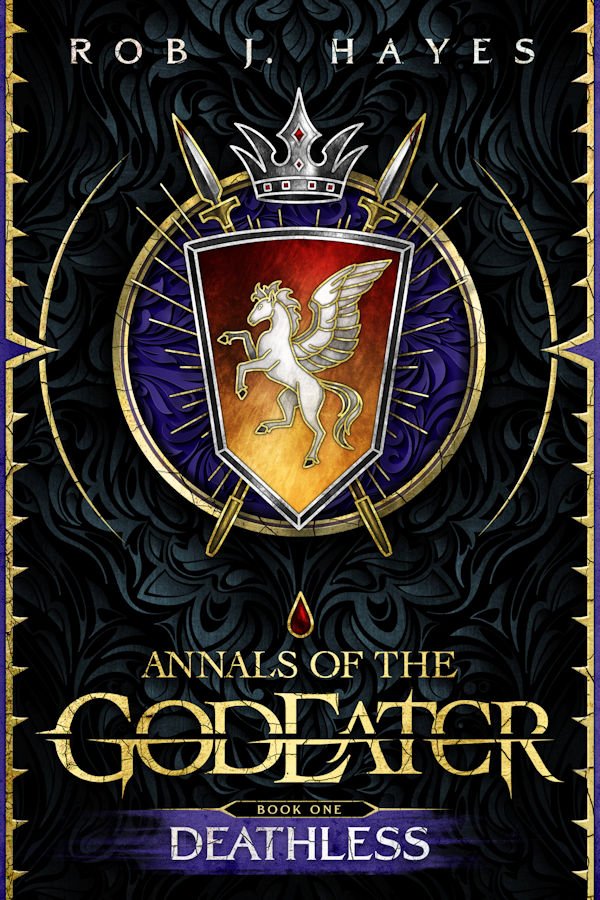
Seven were the Godless Kings who took their war to Heaven.
King Ertide Hostain was once known as the Crimson Prince. He fought side by side with angels and pegasi and defended the Sant Dien Empire against monsters. But his pact with Heaven has become strained. He has grown old, his body rots, and he has yet to choose which squabbling prince will be his heir.
The Hostain dynasty has ruled over the empire for millennia, but when Ertide finds cryptic notes from his dead father, he realises not all is as it seems. Has history been rewritten? And if so, what is heaven hiding?
Immortality has a price, and it is paid in blood.
This series is built around a wild concept. It is a trilogy of trilogies, with three books released together for each arc. I started with Herald, then read Deathless, and moved almost straight on to Demon. What surprised me most is how well this structure works. With every book, my understanding of characters I thought I already knew keeps shifting.
Deathless is set around a thousand years before Herald, with Demon reaching even further back. Reading them in this order has already changed my view of several characters quite dramatically, and Deathless plays a big role in that shift.
This is a dark and often bloody story, which I expected, especially knowing where King Ertide Hostain would eventually end up. What I did not expect was how human this book makes him feel. You see him struggling to keep his empire alive under the often impossible demands of the angels, questioning his faith, and being caught between what he believes to be true and what he is slowly uncovering instead. He is ancient, worn down, and painfully aware that he is nearing the end, while not being ready to let go yet.
The family dynamics in this book are excellent, and they add real emotional weight to the larger political and religious conflicts. Combined with the sheer scope of the world, this might appeal especially to readers who enjoy big dynastic stories, with shifting loyalties, long memories, and power that spans generations, very much in the vein of epic fantasy dynasties like those found in ASOIAF.
I really enjoyed the side characters and the political elements throughout. There is a lot going on for such a short book, but having read Herald first made it feel natural rather than overwhelming. Already knowing the wider world meant the politics slotted into place instead of weighing the story down, and I am not sure I would have eased into it quite as smoothly if this had been my first entry into the series.
One of the most intriguing aspects of Deathless is how it plays with history itself. What is real history, what is a lie, and what has simply been forgotten over time? As a reader, I know I can just continue with Demon and uncover more answers, but the king has no such luxury. He has to make decisions based only on the information available to him, incomplete, biased, and often manipulated, which adds a constant undercurrent of tension.
What I loved most was how much this book expanded and reshaped my understanding of characters I already knew. Expectations shifted again, sometimes in ways I never saw coming. I did not think this kind of backwards storytelling would work as well as it does, but by now I have learned to trust Rob’s instincts. He has taken me from skeptical to fully convinced more than once, and Deathless does it yet again. Knowing there is still more to uncover only makes me more eager to see just how much everything will change next.

