

This is the second article in our Creatures in the Shadows series. You can read the first one on West African creatures here.
South and South-East Africa is a land of mighty warriors. The Zulu, the Maasai, the Kikuyu, the Ngoni…the names that put fear in the heart of anyone who hears them. The sagas of their terrible wars, of the Great Scattering, or the Desolation of the Kuavi make for a haunting read, and a compelling setting for an exciting novel of epic, Game-of-Thrones proportions. What, then, does a fierce warrior fear? What creatures populate his imagination? What monsters can you encounter in an Eastern African setting?
The Wraiths of Satan
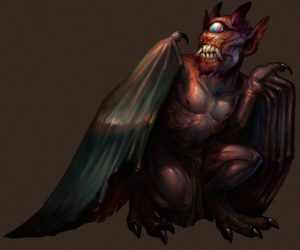 The Swahili-speaking people of Kenya, Tanzania and Mozambique have a word for malevolent spirits: the Shetani – a borrow from the Arabic “Shaitan”, the Devil. The Shetani resemble crooked, distorted humanoids, with one arm or one eye, haunting and possessing humans and animals alike. They come in various forms, their ways always depraved and terrifying: the Ukunduka, feeding off sexual energies, or the infamous, bat-like Popobawa, violating its victims in their bed.
The jungles of Madagascar are inhabited by the equally evil spirits, the angry ghosts of the forgotten dead, the Angatra, haunting in the vicinity of the graves. A long-neglected and un-placated Angatra turns into the dreaded Kinoly wraith, who will roam the rice fields and village roads, with its fiery red eyes, and razor-sharp dagger-like claws with which it disembowels men alive.
The people of Uganda were also familiar with the less terrifying spirits and ghosts: the Mizimu, haunting their family village, or the grand Balubaale, the guardian saints, great men who protected their tribe even after death. In the forests of Uganda lived the ancient dryads, Kakua Kambuzi, tall, slender and smelling of incense.
The Heart Takers
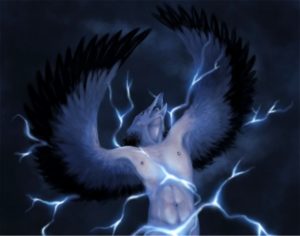 But a more corporeal evil lurked in the fields and forests as well; the ever-present vampire race had settled in the South, and took on the novel form of the Lightning Bird, Impundulu. This man-sized black-and-white bird is able to summon thunder and lightning, and is often found in employ of the powerful wizards. In human form it is a beautiful, seductive man, with insatiable appetite for fresh blood, preferably of virgins.
If Impundulu doesn’t get your blood, the Tikoloshe will; these shape-shifting vampires, also often serving the witches and wizards, can appear as a small teddy-bear-shaped dwarf, or a bear-sized humanoid, always hairy and stocky; they can also show as human males. The Mantindane’s natural form is a ochre-colored dwarf, with beard and moustache, but it can sometimes grow to monster-size, capture and torment humans for its pleasure; its name means, simply, “The Tormentor”.
Madagascar isn’t safe from the blood drinkers, either. The more common variety is known as Mpakafo or Mpakara – literally, the Heart Taker and the Blood Drinker, tall, pale-skinned, long-legged. The Vazimba are smaller than humans, also pale, with elongated faces and large lips, behind which hide long fangs. But the chief of the Madagascar vampires is the princely Ramanga, whose task it was to slurp the blood spilled (by accident or war injury) by the members of the royal family. Originally human servants of the kings, their custom eventually transforms them into powerful wizards.
Almost Human
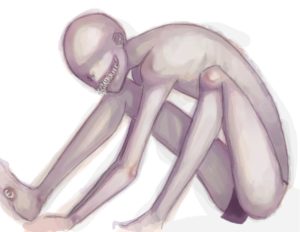 Not in the same league of creatures as ghost or vampires, the dwarves and fairy folk of South Africa have some of the most imaginary forms of all the legendary humanoids. There’s the Aigamucha, a race of man-eating creatures who seem almost human, except they have eyes on the soles of their feet. When hunting, they run blind; when spotting prey, they have to stand on their hands. Another man-eating race of humanoid creatures, the Hai-uri, have only one leg and one arm, and travel by jumping. The Kalonoro of Madagascar are ape-like, hairy, telepathic dwarves, less than three feet tall; their feet point backwards, so they are impossible to track.
The tiny Abatwa – originally the name of a tribe living in the Central Africa – deserve a book of their own; they are an ant-riding fair folk, living among the blades of grass, largely benevolent, unless you step on one – it will then curse you with its dying breath.
The Hero’s Hunt
The plains and forests of the region are not lacking in the giant beasts; the monsters are the woe of the commoners, but a quarry of heroes. In the rivers, a warrior seeking glory could hunt the Mamlambo, a giant, 60-feet long creature with the body of a fish, short legs, and neck of a snake, glowing green in the night; or the Inkanyamba, a serpent with the head of a horse, living in the shadows of the great waterfalls of South Africa. Hunting the Ilomba might be more tricky – this great sea snake of Zambia can bind its life force with that of its owner, and can only be destroyed by the witch doctor. Lastly, in the waters of Tanganyika lives a giant perch Pamba, so big it can swallow an entire canoe of fishermen.
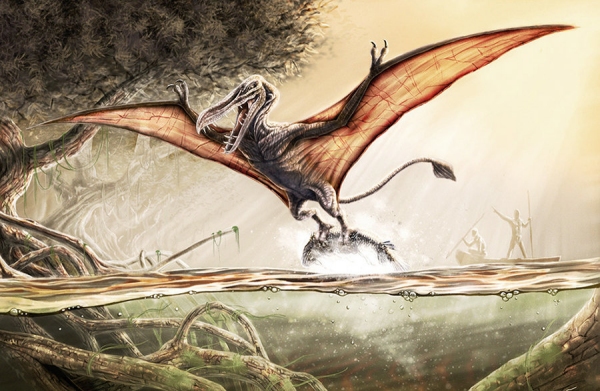 Facing the Kongamato could prove a real challenge: the great flying monster of Angola and Zambia, similar to a red pterodactyl, is known as “the breaker of boats”, and its leathery wings span up to 7 feet. In the deserts of Namibia lives its opposite: the Ga-gorib, a pit-dwelling, underground beast, reaching towards passers-by with its leopard-spotted limbs. On the plains of Zimbabwe lives the Ogo, an 8-feet high humanoid creature, whose body is covered with thick, dark-brown fur, an African Yeti; while on the savannah, you could, if you’re very lucky, spot the elusive Ndzoondzoo, the zebra-unicorn. Just be careful not to kill the Nyarvirazi: this were-lioness is actually the cursed daughter of an unfortunate local chieftain, and she will turn human as soon as she eats fresh meat.
After slaying all these monsters, our hero could do well to travel back to Madagascar, to meet the Tompandrano: the huge crocodile with its head glowing in the dark. With a shield made of its great scales, he would be ready to stand against the final prey: the Grootslang.
The Grootslang is a dragon of South Africa; a 50-foot-long ancient serpent, green and metallic, known to devour elephants whole. It gathers diamonds, for which this region is famous, into its cave, and guards it jealously. He who slays the Grootslang and gains its hoard, will be the true hero!
In the next episode, we will jump from East Africa across the Indian Ocean, onto the islands and peninsulas of Malaya, Indonesia, and Philippines.
Title image by damie-m.

