

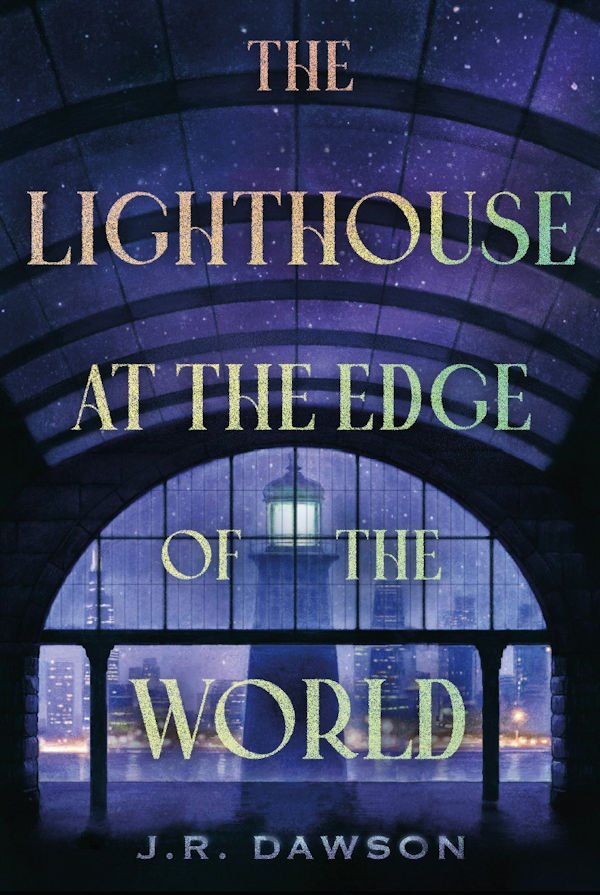
At the edge of Chicago, nestled on the shores of Lake Michigan, there is a waystation for the dead. Every night, the newly-departed travel through the city to the Station, guided by its lighthouse. There, they reckon with their lives, before stepping aboard a boat to go beyond.
Nera has spent decades watching her father—the ferryman of the dead—sail across the lake, each night just like the last.
But tonight, something is wrong.
The Station’s lighthouse has started to flicker out. The terrifying, ghostly Haunts have multiplied in the city. And now a person—a living person has found her way onto the boat.
Her name is Charlie. She followed a song. And she is searching for someone she lost.
[Content Warning: This book contains an active shooter situation, death, self–harm, suicidal ideation and suicide, endangerment of an animal, and estrangement from a parent.]
I won’t lie; I feared this book. One look at the cover, deep purple, the world viewed through a tunnel and glass, and you can tell it’s a serious book. The writeup does nothing to expel that impression. The Lighthouse at the Edge of the World by J. R. Dawson, acclaimed author of The First Bright Thing, is a book about death.
But I’ve undertaken a quest to read all the fantasy novels in my local bookstore, and I will not be defeated only a few books in. So, afraid or not, I brought the book home, after about four trips to stare balefully at it on the bookshop shelf.
Besides, it cannot be all about death, can it? To have death, life is required. So, there must also be life, and since this is a good book, hope as well. But I’m getting ahead of myself. Let us begin with the mundane.
The obvious qualities of the book.
The Lighthouse at the Edge of the World is told in the first person, from two points of view. Those of Nera and Charlie, two young women from vastly different worlds who are both questing, though only one knows she is questing when the book begins. On the surface, this novel is about where souls go when someone’s life comes to an end in Chicago, Illinois, how the lighthouse at the center of the story came to be involved in that process, and what the lighthouse does.
There are also Remnants. Snippets at the start of each chapter that arise from various points of view or even take the form of visual information. They, along with some passages in the text, acquaint us with bits of tangential information, and with the nominal villains of the story: the Haunts and the Demon at their center.
While the format of the book is organized and precise, the writing is a bit choppy and raw. There is a roughness to it, particularly in Charlie’s point of view, that seems quite deliberate. A stylistic choice fitting the subject matter.
And what a weighty subject matter it is. I was right to be afraid. With the character of Charlie, we experience not only grief, but survivor’s guilt, post–traumatic stress, depression, and all the spiraling, weighty thoughts that come along with them. The Lighthouse at the Edge of the World takes a deep dive into trauma and suffering, and looks at how a person can, possibly, claw their way back out. At the support they may or may not receive, at the effects on their relationships, and on their families.
And something hit me in between my throat and my heart, like a shot of adrenaline. That feeling came a lot in the last year—grief and nerves. Grief, getting stuck on the way from your gut to your eyes. I swallowed it back, but it was the sort of sadness that had roots in more than one place. ~ Charlie
The Lighthouse at the Edge of the World is the kind of book you wish we didn’t need, but know that we do. One of those books that makes you a better, more understanding person, even though you didn’t want to know, and didn’t want to understand. But let’s face it, if our world refuses to change for the better, we must strive to understand the damage being done to people, or not only can they not hope for normalcy, none of us can.
To have thousands of days . . . To be completely cocooned in the illusion of routine. What a privilege, to believe this would last forever. ~ Nera
To drive home her points, Dawson gives us not only Charlie and her struggle through trauma, but Nera. A sort of blank slate. The assistant to the keeper of the lighthouse, Nera aids in shepherding the dead from the lighthouse out onto the lake, where they cross over to whatever comes after this life. Nera provides us with a window into a multitude of ways to view death, from mad grief, to fear, to being at peace, and the whole gambit in between and around each. At first, she is simply that, a foil to Charlie’s quest for answers.
Until Nera begins a quest as well. One to understand life.
Between the two, the author examines several age-old quandaries: If we’re all going to die anyways, why trouble to live? Should we live like we might die tomorrow? Is anyone ever ready to die? Should we fight, or go peacefully?
Not to spoil the book, but there are no hard answers. How can there be? Instead, many different examples are provided as both characters learn and grow and come to their own conclusions.
All things disappear eventually. But wouldn’t they cheapen if they didn’t? The suddenness, the temporary flash of life, that’s what made it special. ~ Nera
There is a fantasy storyline in this book. There is magic, and dogs are magical. However, that all takes a backseat to unraveling life and death. As is sometimes the case with magical realism, the fantasy aspect feels secondary to the main points of the book. The sapient dogs, the Haunts and the Demon, even the giant magical lighthouse at the center of the story, all exist as vehicles by which to deliver those points. Which is one of the real–life magic powers of fantasy; making difficult topics more palatable.
So, what did I like best?
I mean, aside from the impeccable formatting, I like that it delves into important topics and that the social commentary is skillfully and realistically incorporated. We need to communicate more about difficult ideas. I would even go so far as to say we need to take the time to examine such ideas more deeply, as The Lighthouse at the Edge of the World does, rather than viewing the world as a series of memes and soundbites.
Other positives are the large roles of music and religion. Music, because music is a wonderful element and a great allegory. Religion, because it’s educational to delve into people’s faiths and points of view. Also, The Lighthouse at the Edge of the World is LGBTQIA+ friendly, which is always a plus.
We are not what I expected for my life, this is not who my father wanted me to be, but it is who I am. And we are full of joy. ~ The Journal of David Stein, The Lighthouse at the Edge of the World
Additionally, there is a theme of learning to give yourself space and care. Especially the space and care you need to heal and to grow and to change. To become the person you are meant to be next.
Change, and fear of change, are also strong themes. Frankly, I’m a fan of asking people to examine any fear of change they might have, and to take an honest look at the alternatives. This book does so.
Lastly, The Lighthouse at the Edge of the World contains some of the most beautiful descriptions of love I’ve ever seen.
I wanted to know her, to really know her. To be ten years down the road from now, having her memorized as if our bodies were a house where we’d grown old together. Her smile, her heart, her hands. Our minds holding all the treasure and souvenirs we’d collected over the decade, all the places we’d seen, all the times we’d made each other laugh with something silly that no one else would understand…I didn’t just want to hold her. I wanted to see all the people she would become. So I brought my lips to hers. – Charlie
What didn’t work for me?
I wouldn’t go so far as to say, ‘didn’t work,’ but this book is heavy. It will most likely make you cry. So, please know whether you are a person who finds a dip in the waters of misery cathartic or illuminating, or a person who, at this moment, needs to safeguard the peace and calm they have. Sometimes the communion of shared trauma brings us a sense of closeness and peace. Other times, it can tip someone over the edge. Before you read, consider where you fall on that spectrum.
It’s also a slow build. By necessity, the weighty topics take up a lot of space, leaving less room for the action of the plot. Insofar as the sort of action you might associate with a fantasy novel, not much happens until about sixty percent of the way through the book.
What am I on the fence about?
The use of dogs. I couldn’t decide if it was a brilliant gambit to drive home and heighten emotions, or an easy way to add stress and high stakes to various situations.
Also, the use of rats. Not because I’m disturbed by rats being portrayed as evil (even though I love rats and they aren’t at all evil), but because they are occasionally plot-hole rats. Sometimes they appear to add drama to high stake moments, but disappear as soon as focus shifts. Yet, does it truly matter where they went? Can we not just make assumptions about their fate?
Trigger warnings.
Not every book needs trigger warnings, but this one does. In the author’s own words:
While this book holds many hopes, it also comes with some difficult passages, including an active shooter situation, death, self–harm, suicidal ideation and suicide, endangerment of an animal, and estrangement from a parent ~ J. R. Dawson
I would add to that, foul language and sexual situations. Not as a trigger warning. Simply a forewarning.
Conclusion
So, while you should double-check you are ready to read this book before doing so, you should read this book. Just about everyone should. The topics are universal and important, and the social commentary well woven in and heartfelt. The Lighthouse at the Edge of the World is a book worth reading, and the topics therein worthy of consideration.
. . . grief never ends. It spills into the next day, into the next year, the next story. ~ Nera

