

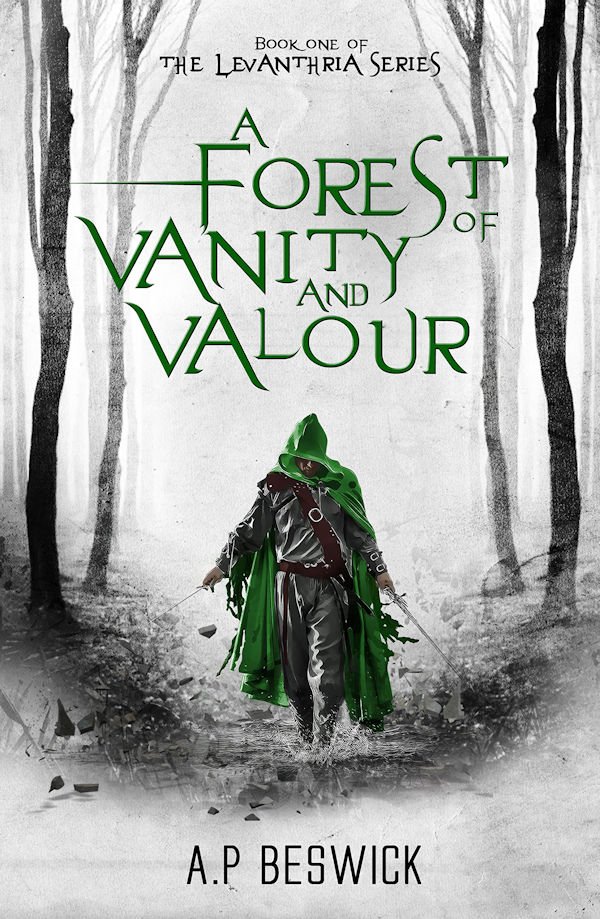
Vireo Reinhold relishes collecting his monarch’s proper dues. Working hard to prolong and fund the king’s never-ending war, the self-centered official revels in the perks of luxury that come with his unorthodox role. But his world upends when he unearths an ancient spellbook that promises to unlock a shadowy, forgotten magic.
Embroiled in a secret affair with a fellow noble’s wife, Vireo is mortified when he’s forced to commit an unthinkable act. Driven into exile, no longer able to coerce the vulnerable, and with the powerful tome in his enemy’s hands, the fallen agent’s only shot at survival hangs on his skills at saving others.
Can Vireo redeem himself as the people’s champion before they all fall to a sinister fate?
A Forest of Vanity and Valour is a fresh, dark take on the Robin Hood legend that immediately grabbed my attention with such an inventive premise. Rather than relying on familiar characters, predictable themes, and plot points, the book uses the myth as a foundation to tell a gripping story that feels both recognisable and surprisingly original.
Vireo is a brutal and self-motivated tax collector, raising money for the perpetually absent king who has placed the city in the reliable hands of Jareb, himself in an impossible situation caused by his monarch’s expensive love of warfare. Set predominantly in the city of Askela and the dangerous Forest of Opiya, the story follows two protagonists whose lives are irrevocably altered by a single event, forcing them to question everything they believe about justice and power.
The premise itself is one of the book’s greatest strengths, and the main reason I picked it up in the first place. Without venturing into spoiler territory, the fantasy-retelling is a genuinely fascinating concept that hooked me straight away, and it was executed with real confidence. The inciting incident dramatically alters the trajectory of both protagonists and binds their arcs together. Watching their roles, motivations and perspectives evolve from that point became one of the elements I enjoyed most. Both character journeys felt satisfying, and I really appreciated how their shifting positions continually reshaped the story’s exploration of its themes.
The book’s willingness to embrace moral ambiguity means there are very few clear-cut heroes or villains here. Instead, Beswick presents characters whose decisions are shaped by perceived duty and survival, allowing us to sympathise with people on opposing sides of the escalating conflict. That approach felt particularly fitting for a Robin Hood retelling, where questions of justice often depend on a character’s perspective rather than objective notions of right and wrong. It gave the decisions and conflicts additional weight, making the story’s exploration of power and responsibility feel far more nuanced than a straightforward battle between good and evil.
The first-person present tense is not something I tend to read much, but it works well in creating a momentum which gives the narrative a real sense of immediacy, placing you firmly in the protagonists’ shoes, and makes the action feel urgent and consequential. That said, I did feel there was a bit of a trade-off; the focus on the POV characters meant that many of the supporting cast (I’m looking at you Lek and Gillam!) didn’t receive the same level of development, and the wider world, while intriguing, occasionally feels as though it’s just out of reach – especially as we’re grounded in largely the same two locations. There were several moments where I found myself wanting to spend a little more time exploring the setting and learning more about the people inhabiting it.
At first, I’ll admit I struggled to engage with the prose, and wondered whether it would be engaging enough. I need not have worried, because as it progressed, I found the style was just very readable. It doesn’t try to draw attention to itself with elaborate description or overly lyrical passages, but just prioritised clarity and momentum. That style suits the novel well, allowing the action and character dynamics to take centre stage. When the story does slow down, it’s usually in service of developing relationships or reinforcing the emotional consequences of earlier events, helping those quieter scenes land without disrupting the pace.
A Forest of Vanity and Valour also has a wonderfully dark streak running through it, and there were several inventive moments that genuinely caught me off guard but also felt so well rooted in Robin Hood myth; the sort of scenes that make you pause for a second before smiling because of how unexpected or cleverly realised they are. Those touches gave the book its own clear identity and helped distinguish it from more conventional fantasy adventures.
I particularly appreciated the pacing and length. Even when the story paused for a character moment around a fire, or a noble staring out across his city, it never felt like it lost momentum. In a longer novel, I think some of the plot decisions may have needed additional development or justification, but at this length everything feels purposeful. Rather than rushing, the novel simply knows what story it wants to tell and gets on with telling it.
The fantasy and magic elements are woven naturally. Beswick includes monsters, magic, and arcane texts to add a sense of wonder without ever overshadowing the heart of the story. Rather than simply retelling one familiar legend, the novel feels as though it’s laying the foundations for something much bigger. The closing tease of another iconic piece of British folklore was handled lightly enough to spark my curiosity without stealing the spotlight, and it left me excited to see how these characters will navigate the next chapter of their journey.
Overall, I had a great time with A Forest of Vanity and Valour. It’s imaginative, fast-paced and full of memorable ideas, with character arcs that kept me invested from beginning to end. While I would have happily spent more time with the supporting cast and the wider world, those are largely the result of wanting more rather than feeling dissatisfied. I’m looking forward to continuing the series and seeing where these characters go next.

