

This is it for the cut posts in this year’s Self-Published Fantasy Blog-Off (SPFBO)! Today we say goodbye to the last two books in our Seventh and Final Fall. Next up: our four semi-finalists, each getting their own dedicated review!
A quick reminder: We don’t read in any particular order, and we don’t cut from worst to best either. We work through the books a few at a time, and now we have finally reached the end of that road.
As always: Reading is subjective. What didn’t click for us might be exactly your kind of story. If anything here sounds appealing, please do give it a look!
And a sincere thank you to every author who entered. Putting your work forward for a competition takes real courage, and we appreciate each and every one of you for it.
You can keep up with round one of the contest on the official SPFBO website. And if you have no idea what I’m talking about, you can learn more here.
The Non-Magical Declan Moore by Nathan Taylor
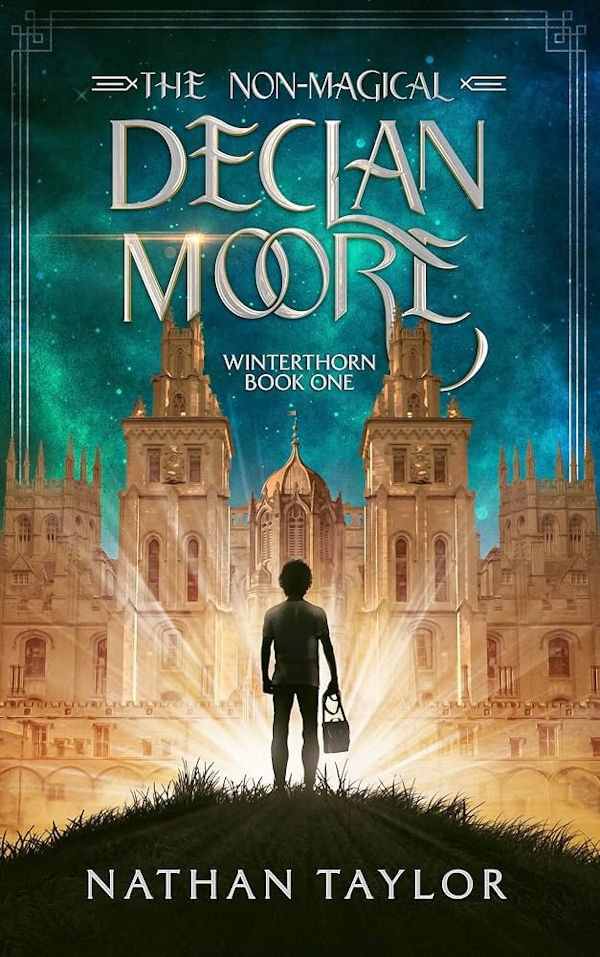
In the modern nation of Euryma, magic is as common as bottled water. Witches and wizards lead normal lives, using extraordinary powers to do ordinary things. Here, everyone can do magic.
Almost everyone.
Seventeen-year-old Declan Moore knows he’s not the chosen one. While his friends apply to magical colleges and promising futures, Declan is left to be the school groundsman’s apprentice. His only wish is an inkling of power to escape the disappointment of being a LAMP—one Lacking All Magical Potential.
Then the world falls apart.
Overnight, thousands of witches and wizards vanish from their homes, leaving the non-magical populace to pick up the pieces. But as Declan searches for his parents, he discovers something he does not dare to believe.
Declan isn’t helpless, he is dangerously powerful.
And using that power to save his parents could kill them all.
The Non-Magical Declan Moore split the team more sharply than almost anything else we read this year. Ratings ranged from very high to very low, making this a true marmite book. Here are the positive reviews first.
– – –
Stacey
I really enjoyed this story of Declan, his lack of magic and the discovery of what he can really do. Declan is a typical 16-year-old teen, although in a world where magic comes easy and those who don’t have it (LAMPS) are shunned, he’s keeping a dark secret from those around him. When things get a little crazy around him, he needs to level up his game in order to save his parents, friends, and possibly, the world as he knows it. He can’t trust anyone and everyone lies to get what they want from him.
Fun worldbuilding, characters that seem to take the crazy events in stride (maybe too much?). My only true negative would be some characters we think are important simply disappear for a while and Declan barely registers their loss. I’d like to see more relationships in the following books in the series. It would definitely make me want to root for them a little more!
– – –
Sarah
This one kept me absolutely glued to the page from the very first chapter. Declan was a very relatable character, and I also loved the characters of Horace and Ava as well. Hope we’ll see more of them in book two!
I was a little confused about the likability of a few characters later on, but it makes total sense at the end. The theme of finding the mole in the Directive was particularly thrilling. Nothing like a little betrayal to keep all the characters on their toes! Honestly, by the end I wasn’t quite sure what to believe, but I’m sure that’s what book two is for, and hope I can get my hands on it soon!
– – –
Now follows what reflects the lower end of that spectrum:
The premise is familiar but appealing: a teenager born powerless to magical parents, navigating a magic school in a modern world where having powers is everything. For some judges that setup worked immediately, with the easy prose and quick pacing pulling them through without much resistance.
For others, the central problem was Declan himself. His emotional reactions felt consistently off, with big moments getting shrugged off and genuine distress snapping back to normal almost immediately. One judge found the whiplash between apparent suffering and carefree action made it impossible to believe in his interactions at all. The supporting cast drew similar criticism, feeling more like plot functions than people, with one or two notable exceptions. Ace in particular was singled out as the strongest character in the book, grounded and real in a way the wider cast wasn’t. One judge noted the severity of the violence occasionally felt at odds with the otherwise YA tone of the story.
If the positive reviews resonate more with you than the critical ones, this is very much a book worth trying. Clearly it has the ability to completely win readers over, and for the right audience it delivers exactly what it promises.
Hunter’s Apprentice by Simon Shugar
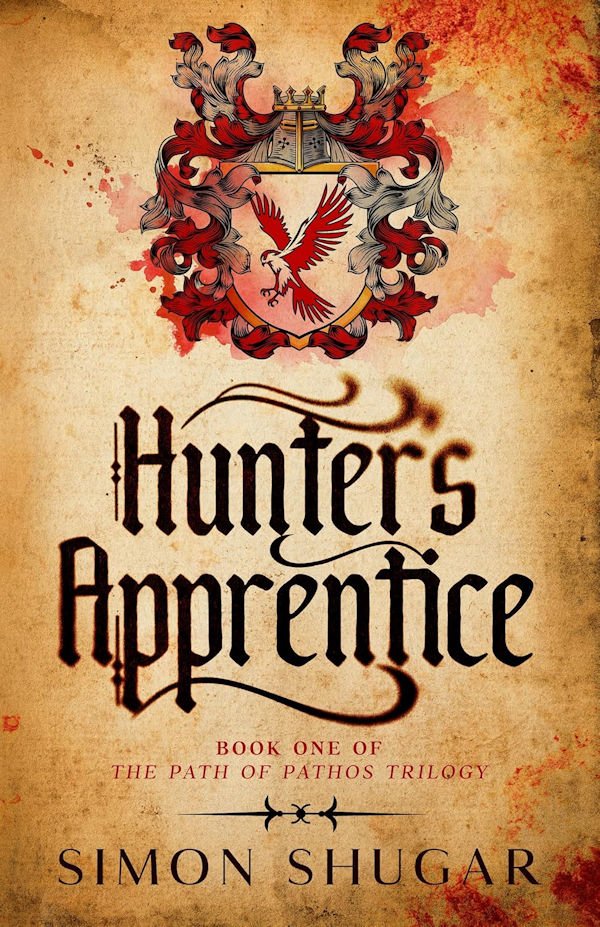
In a village struggling to survive while kings clash, Tomi grows up surrounded by hard work, fierce loyalty, and hope for better days.
But hope alone won’t keep danger away.
When the power of Pathos awakens within him and the peaceful life he knows begins to crumble, Tomi is thrust onto a path that will demand courage, strength, and sacrifice.
If Tomi wants a future, he must forge it as a hunter’s apprentice.
Hunter’s Apprentice divided the team in ways that map fairly neatly onto how much the narrative voice worked for each judge.
Those who engaged with the story found it a compelling and readable dark fantasy built around family, loyalty, and survival in a harsh world. The nature and wilderness elements drew particular praise, grounding the journey in practical day-to-day reality rather than treating survival as background noise.
– – –
Julia
This ended up being a really engaging read for me. It leans heavily into classic fantasy territory with a lot of familiar tropes, but what really carried it for me was the narrative voice. It is very easy to read and has a strong pull that made it hard to put down. Even when I noticed flaws, I still kept turning pages because I wanted to know what would happen next.
This is a darker world than many classic fantasy stories, please check trigger warnings if you need them!
The world itself is harsh and unforgiving, but the main character is not. If you are used to grimdark where characters struggle with their own darkness, this is very different. The darkness here comes from what happens around the characters, not from who they are. The core family and community dynamics are built on unconditional love, loyalty, and people trying to do the right thing even in awful circumstances. The contrast between a brutal world and genuinely good people worked very well for me.
One thing that stretched my suspension of disbelief quite a bit was the main character’s age versus how he thinks and acts. He often feels much older than he is written to be. I ended up just mentally aging him up in my head and then it worked fine, but if I had taken the stated ages very literally it would have pulled me out of the story. The voice also felt very consistent across the years, rather than changing much as he grows up.
There are also a few moments where things work out a little too conveniently. Not enough to ruin the story for me, but noticeable. The same goes for some skill progression moments that felt a bit fast or lucky. I could accept most of it because the book is clearly going for a classic fantasy storytelling style rather than strict realism.
The nature and survival elements were one of the strongest parts of the book for me. The foraging, preparing for winter, tracking, hiding tracks, building shelter, living lean when supplies are low, all of that gave the story a strong sense of place and day-to-day reality. It made the world feel lived in rather than just travelled through. I especially liked that survival was not treated as a montage skill, but as an ongoing part of life. Food has to be found, winters have to be prepared for, mistakes have consequences, and small practical knowledge matters. Those sections added weight to the journey and made the quieter moments feel just as important as the bigger plot beats.
The handling of trauma was a bit mixed. The initial depiction of long-term impact and withdrawal from daily life, chores, and the world around a main character was handled well. However, I would have liked to see a bit more lingering effects or small relapses after the turning point, but overall it did not feel careless or dismissive, just a bit too clean once the healing begins.
Emotionally, I was more invested in the story momentum than deeply attached to specific characters, partly because they felt just a little too perfect and flawless to feel fully real to me. That is not necessarily a negative. It was noticeable, but not enough to hurt my enjoyment, because the voice and overall flow kept me hooked even when the story got very dark.
Overall, this is a flawed but very readable fantasy with a darker edge and a strong narrative pull.
If you want a story with real heroes, strong family and community bonds, and a harsh world where terrible things can happen without the characters themselves becoming morally grey or cynical, this is a solid pick. It is the kind of story that pulls you along like a cold wind through the trees, harsh at times, but steady, clear, and hard to stop following once you step onto the path.
– – –
The main sticking point for several judges was the narrative voice. The story follows Tomi from age four onward, but the narration consistently feels far older than the character is supposed to be. For some, this was easy enough to mentally adjust for; for others it was a persistent immersion breaker. One judge also flagged some editorial issues, including repeated paragraphs and phrases that suggested the self-editing hadn’t been fully cleaned up. Another stepped away early, finding the opening chapters too focused on minute domestic detail to sustain momentum.
– – –
EG
The Hunter’s Apprentice was an interesting tale of childhood and war, and not at all what I expected from this fantasy story. It follows Tomi, a child of four (at the start of the book) whose father has just left to go to war, leaving him at home with his mother. Then begins the struggle of the women and older men left behind to tend to the village, manage the harvest, and so on. Soldiers arrive and Tomi’s pleasant world is turned upside down by the realities of war and the cruelties of men. When his mother falls ill, he goes with her to a larger town to stay with her sister, and the realities of war encroach even further.
Honestly, I am not entirely sure what to think of this book. Barring a few formatting errors and a few typos, the writing was fairly fluid and easy to follow. The narration was meant to be coming from Tomi, but it did not ever feel like a child was narrating the book, even though the story spans the years of four through ten. Yes, some of his actions were childish/childlike, but never did I actually get the impression that this was a coming of age story. The narration felt far too adult for that.
The story also turned quite a bit darker than I had initially expected from the first chapter of the book. Yes, that does make sense in hindsight, given this book is a story about war and its effect on Tomi, but the initial start of the story feels much more slice-of-life, edging towards cozy. The rest of the story is most definitely not cozy fantasy.
The ending, too, was not at all what I thought it would be. It does make sense for character x to have his untimely end, but the way Tomi reacted again felt too adult for his age.
I think the characters are well crafted and the story well plotted. It’s a story about family and war and being good when everyone else is not. I enjoyed it in some parts and did not in others, and ultimately was left confused about my feelings regarding this book. Not one I would pick up again, even if I did generally enjoy the initial read.
– – –
A secondary concern was a minor character introduced as a threat who felt cartoonishly villainous without enough backstory to make him believable as anything more than a plot device.
For readers who can settle into the voice and accept the occasional convenience in plotting, this is clearly a story with genuine pull and warmth at its core.
And that is it for our cut posts! Thank you once more to every author who entered and had the courage to put their work in front of us. We genuinely appreciate each and every one of you.
Now the exciting part: congratulations to our four semi-finalists, whom have each earned their own dedicated review! We look forward to giving them the full attention they deserve in the posts to come. Stay tuned!
- The Artificer’s Knot by Eric Lewis
- City of Stone by K. T. Holder
- Of Mages and Makers by Rel Carroll
- Physical Magic by William C. Tracy
Our judges this year Adawia Asad, Eva Geraghty, Evelyn Grimald “E.G.” Stone, Julia Kitvaria Sarene, Karen Lucia, Kerry Smith, Kit Caelsto, Maureen Neuman, Robert Max Freeman, Sara Rosevear, Sherry Cammer, Stacey Markle, Tianna Twyman, and Yaniv Rosenfeld Cohen. If you’d like to learn more about us, including our likes and dislikes, you can read about them here. And again, you can learn more about the contest here.
Any queries should be directed to the editor, Jennie Ivins, via DM (Bluesky/Threads).
Featured image by Sinziana Susa.

