

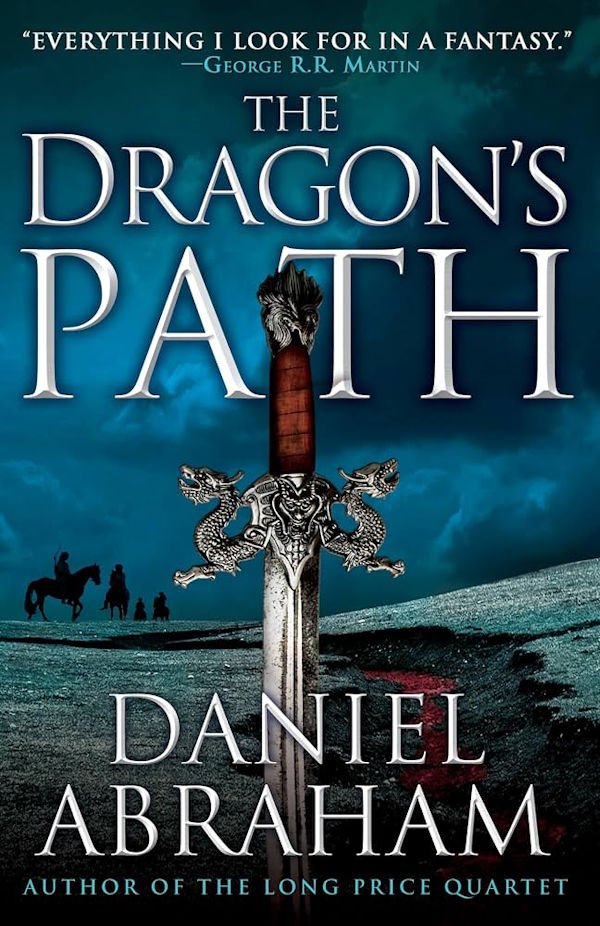
Among my convention book haul was The Dragon’s Path. It looked interesting and promised to be a novel of journeys and politics and other things that I usually find interesting in books.
It was at least partially true.
The book centers around the political troubles of the kingdom of Antea. They take over the city of Venai and machinations ensue. The sack is not as lucrative as hoped since the Medean Bank snuck all of the portable riches of the noble houses out before the city fell, minded by Cithrin and Marcus. Of course, things go horribly wrong.
I might as well get my big gripe out of the way. Geder was the most boring character I’ve read in a while he didn’t seem to have much of personality, he was manipulated by nearly everyone except the castle cats (and I wouldn’t put it past the kitties to have done so). He was very much a creature of reaction and overreaction through the course of the book. While some of the machinations pushing at him are seen through the sections focusing on Dawson, I can see how Geder was being used narratively, but it would have been nice for him to grow in a way that wasn’t to further someone else’s goals. Get a few close friends, work the scholar angle into something more than an one dimensional side note, or even explore his relationship with his father a little bit (who shows up briefly). Right now, Geder is so all over the place motivation-wise, that he reads as little more than a walking plot device.
As mentioned before, Dawson is one of the movers and shakers on the political side of the book. He’s pretty much a stalwart supporter of straight monarchy and doesn’t like the emerging merchant class or the idea of farmers having a legal say in government. Naturally, the opposition isn’t thrilled with this and for that matter neither is the King since violent division between the nobles aren’t good for his blood pressure. Dawson’s “I know best attitude” grated on me and it seemed like his wife Clara actually was the better politician. It was a pity that she didn’t play a bigger part for all of Dawson’s efforts to “shield” her from the more unpleasant side of Anean politics. It rather seemed to me that the wives of all the political factions would have managed to arrange a more mutually beneficial agreement for everyone in far less time than it took to screw everything up…assuming their husbands had given them leave to visit various cousins and friends more freely.
Branching off of that, there seemed to be an undercurrent of, “Oh you’re a girl? Well, a guy could have done better,” running through the novel. While it looked like female merchants were okay, I found it irritating that fighting smarter or figuring out how not to have a conflict was considered less viable than fighting stronger simply because it was associated with “female equals weak does not equal SMASH ALL THE THINGS” in the context of the narrative. Cithrin dealing with those exterior limitations was somewhat addressed, particularly when she starts to set up and run her own bank branch. Marcus’s past and how it affected him also made for a decent alternative to the gender politics although his was considerably more muted due to previous bad-assery. In any case, I kind of wanted to slap more than a few characters about it repeatedly.
The section of the story that centered on Marcus and Cithrin was much more cohesive with itself even though there were only three points of intersection with the political side of the book. Cithrin clearly has the most amount of character growth with all the ups and downs associated with such things. It was really nice to read about how she goes from scared and nervous ward of the bank to confident banker. On this side of the tale, Marcus simultaneously acts as a grounding force and protector, and a clever one at that. Convincing the acting troupe to act as guards under his direction was a pretty awesome solution to a rather pressing problem and one that continued to have predominately positive side effects for Cithrin (as it gave her people to talk to) and Marcus (getting him and his partner out of Vanai, before its takeover). It was fun and interesting to watch Cithrin gain confidence within the merchanting society she knew after such upheaval in her life. I liked watching the ghosts of Marcus’s past and being able to see how it affected his disposition towards Cithrin as he changed from protector to something almost like an equal partner.
It seems counterintuitive that I wouldn’t gripe about how vastly disconnected the heavily political side of the book was with the tale of displacement and renewal, but since I really wasn’t particularly thrilled with the political side in any way, shape or form, it suited me just fine that they had very little to do with each other. It will certainly make rereading the book easier.
I am interested in some of the characters (as explained earlier) and I do realize that this is the first book in a trilogy and that there does exist the possibility for the more intrigue oriented side of the tale to get better. But considering that I really, really enjoyed at least half of the book, I probably will continue to see what new challenges they face and put up with “side B” for the far better “side A.”

