
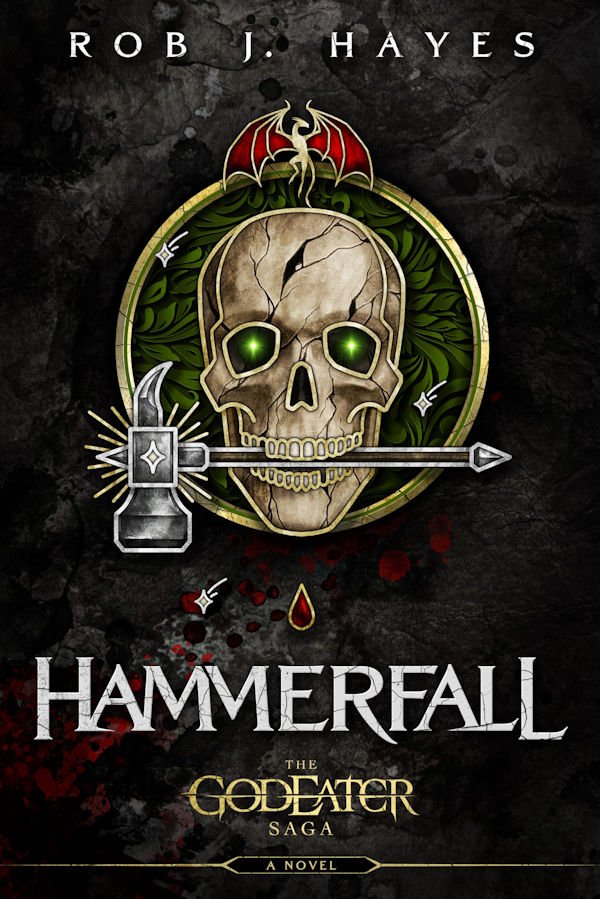
They named her the Starhammer once. Hero to some, monster to many more. First into the breach at the Shattering, anointed in the blood of a thousand demons. The last of the legendary Valkyr.
But the Starhammer is dead. Or so all the stories tell.
Amidst the soaring trees and haunted slopes of the Primals, Selitha relies on the forest to provide, and cares for her family. Nothing is more precious to her than her daughter.
It is a simple life. It is a peaceful life. It is a lie.
When bandits raid the Primals, burning towns and stealing children from their beds, Selitha has no choice but to lend her axe to the rescue.
Volcanic giants spew ash into the sky, demonic bears claw the forest to splinters, and there are even rumours the kin, half-men half-beasts, serve the raiders. All the Terrors of the old world stand against her.
With a severed head as guide, to rescue the children, Selitha may need to bring the Starhammer back from the dead.
But will it be the hero who rises from the grave, or the monster?
Hammerfall is another utterly brilliant book that works both as a deeply entertaining read and as something with far more depth underneath the surface.
Yes, there is a quest and plenty of action, but what really stood out to me were the layers of humanity, morality, and self-discovery running through the entire story. This is very much a character driven story set against a backdrop of danger, history, and violence, rather than a story that is only about the events themselves.
At the center of it all is Selitha, an angel created for violence who has stepped away from the fate she was made for. She has lost her wings, her armour, and her immortality shield, and now lives a quiet life in the mountains with her husband, children, and grandchildren. To the outside world she can seem gruff, ancient, and terrifyingly good at what she was created to do, and part of her still answers the literal Battle Song without hesitation. But she is never cruel. With her family she is warm, deeply loving, and grounded in a way she never was before. She carries scars everywhere, not just across her body, but in the way she moves through the world and the choices she makes. Violence is what she was made for, but it is not all she is. What makes her so compelling is how fiercely she loves and how hard she tries, over and over, to be more than the weapon she was meant to be. The choices she faces are brutal and not always predictable, but they always feel emotionally real and deeply human.
As they moved towards the village square, people trailed after them, ragged survivors with despair in their eyes and hope in their hearts. It was a burden she knew would be heaped on her shoulders. Hope was such a strange thing; as weightless as the wind, it could bear you up as though on wings. Yet the hope of others had a terrible weight, like chains of cold iron crushing you into the dirt.
One of the most fascinating parts of the book for me was the arc of the severed head, simply called Head. He begins as a truly horrific, hateful person, and the story never excuses the choices he made. What it does instead is show how someone can become that way without removing responsibility from them. You see the damage, the history, the things that shaped him, and it becomes one of those deeply uncomfortable explorations of how people might have been different if they had made different choices, or had the strength or support to let go of what was done to them. It never asks you to forgive him. It just makes you understand why someone might become that person. Some of the most powerful moments come from the way Selitha reflects on him and what he represents. At the same time, he brings surprising comic relief in some scenes, while in others he becomes a vehicle for some of the book’s deeper moral questions, which makes him incredibly memorable.
Selitha’s daughter adds a completely different kind of energy to the story. She is chaotic, curious, and charming, with a mix of innocence and surprising wisdom. The mysteries around her are handled beautifully. The foreshadowing is there, but never heavy handed, and when things are revealed they feel natural and satisfying rather than shocking for the sake of it. She brings lightness and playfulness into a very dark story, while never feeling helpless or simple. There is a slightly chaotic, mischievous energy to her that made her incredibly fun to read.
“I do not think they will follow us,” her daughter said, smiling in the bronze light of the moon. “They have bigger problems to deal with.”
Selitha looked at what her daughter was clutching to her chest. “Are those cage pins, Daughter?”
Her daughter nodded. “I found them. No one had touched them in a long time, I promise.”
The small group traveling together works extremely well. It is large enough to allow for different perspectives, moral clashes, and emotional reactions to what is happening, but small enough that the story can really focus on who these people are. Watching how they change each other over time was one of the strongest parts of the book. Some move from decent to morally compromised in the name of survival. Some move from monstrous to experiencing empathy for the first time. Others are forced to confront who they really are beyond what fate, trauma, or other people told them they had to be. There are also powerful moments around entitlement, survival, and what anyone has the right to ask from another person, especially when that request comes from desperation rather than cruelty. By the end, they all feel like very different people from where they started, and it feels earned.
“Death is never about what a man deserves. Nor how they have lived their life nor the deeds they have done. Death can come for us all at any time, and the only thing we can do is live our lives with courage and hope. All we can do is make the time we have mean something instead of trying to steal more time from others.”
I also continue to love this world. It is very dark, not in a decorative way, but in a way that feels woven into how this world survives. This is a world built on violence, sacrifice, and things that are meant to make you uncomfortable, from monsters and demons to the ways power is taken and used. But it is also deep and layered. Each story feels like looking at it from a new angle, revealing new pieces without overwhelming you with information. It always feels intriguing and fresh, never like an info dump, and never like it slows the story down.
Compared to the trilogy starting books, this one feels less like it is reshaping everything you thought you knew, and more like it is broadening your understanding of the world and the people inside it. It adds emotional depth and perspective rather than massive historical shifts, which worked really well for me in a standalone story.
Hammerfall is a story about family, about what shapes us, and about who we might have been under different circumstances. It is dark, emotional, sometimes brutal, but also full of heart. It is the kind of story that reminds you that people are rarely just one thing, and that sometimes understanding is not the same as forgiveness. It left me both satisfied with this story and even more invested in this world.

