

The Rampart Trilogy took me a little while to fully sink into, but once it did, it had me completely. The longer I lived in this world, the more real and unsettling it became, until it felt less like reading a story and more like walking beside the characters through it.
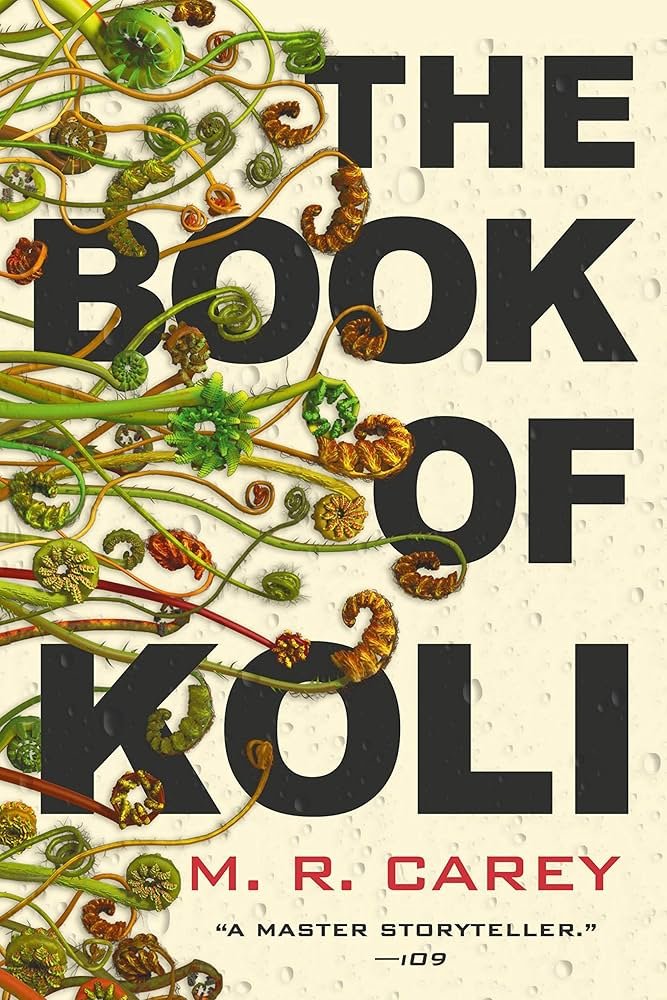
Beyond the walls of the small village of Mythen Rood lies an unrecognizable world. A world where overgrown forests are filled with choker trees and deadly vines and seeds that will kill you where you stand. And if they don’t get you, one of the dangerous shunned men will.
Koli has lived in Mythen Rood his entire life. He knows the first rule of survival is that you don’t venture beyond the walls.
What he doesn’t know is – what happens when you aren’t given a choice?
At its core, this is a series about people. Big ideas are everywhere, about society, power, technology, belief, and survival, but they are always filtered through small, human perspectives. Carey has a rare gift for making characters feel deeply real. They are flawed, thoughtful, sometimes frustrating, and always shaped by the world they live in. You never feel guided toward neat conclusions. Instead, you are invited to sit with uncomfortable questions and draw your own.
One of the things that stood out to me across all three books is the voice. The slightly altered grammar in dialogue could easily have felt gimmicky, but here it works beautifully. After a short adjustment period, it becomes invisible, a natural extension of the setting. It adds texture and depth, making the world feel lived in rather than constructed.

The Trials of Koli is the second novel in M R. Carey’s breathtakingly original Rampart trilogy, set in a strange and deadly world of our own making.
Beyond the walls of Koli’s small village lies a fearsome landscape filled with choker trees, vicious beasts and shunned men. As an exile, Koli’s been forced to journey out into this mysterious, hostile world. But he heard a story, once. A story about lost London, and the mysterious tech of the Old Times that may still be there. If Koli can find it, there may still be a way for him to redeem himself – by saving what’s left of humankind.
The series grows in scope without losing intimacy. What starts as a fairly contained story slowly opens up, revealing wider systems and deeper consequences. Yet it never loses that small scale lens. You see the world through limited eyes, while feeling the weight of much larger forces pressing in from all sides. That contrast is one of my favourite things about Carey’s writing.
The middle book deepens everything, removing any remaining sense of safety and forcing the characters to confront hard truths. By the time you reach the final book, the emotional and thematic groundwork has been laid so carefully that the ending feels both inevitable and satisfying. It leaves space for uncertainty, but it also brings real closure where it matters.

Koli has come a long way since being exiled from his small village of Mythen Rood. In his search for the fabled tech of the old times, he knew he’d be battling strange, terrible beasts and trees that move as fast as whips. But he has already encountered so much more than he bargained for.
Now that Koli and his companions have found the source of the signal they’ve been following – the mysterious “Sword of Albion” – there is hope that their perilous journey will finally be worth something.
Until they unearth terrifying truths about an ancient war . . . and realise that it may have never ended.
The Rampart Trilogy is thoughtful without being preachy, emotional without being manipulative, and intelligent without ever feeling cold. It is a series that lingers, not because of shock or spectacle, but because it quietly asks you to rethink what you believe about progress, community, and what it really means to survive.
This is one of those rare trilogies where each book strengthens the others. Taken together, they form something layered and resonant, a story that stays with you long after the final page, like a half remembered warning, or a truth you are not quite ready to let go of.

