

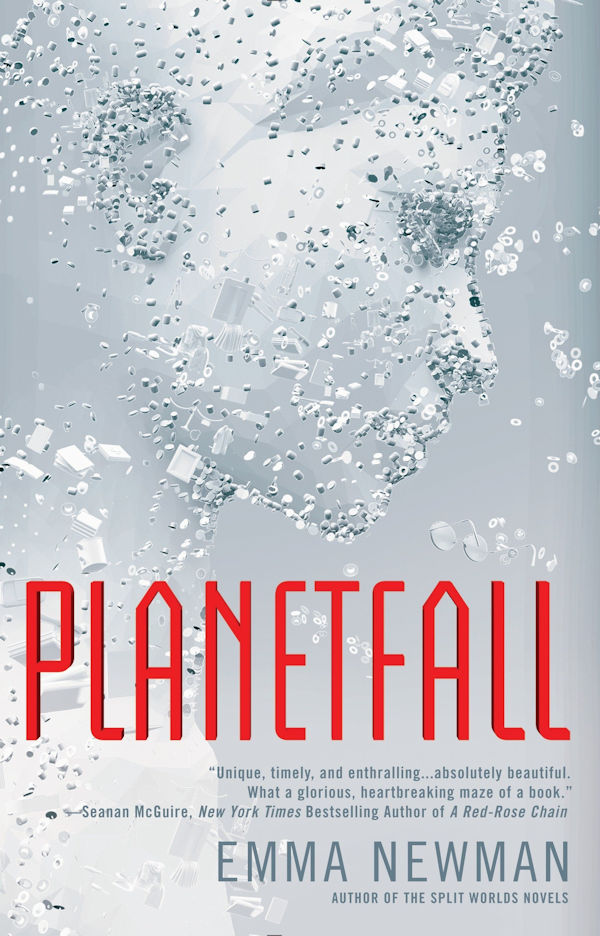
Renata Ghali believed in Lee Suh-Mi’s vision of a world far beyond Earth, calling to humanity. A planet promising to reveal the truth about our place in the cosmos, untainted by overpopulation, pollution, and war. Ren believed in that vision enough to give up everything to follow Suh-Mi into the unknown.
More than twenty-two years have passed since Ren and the rest of the faithful braved the starry abyss and established a colony at the base of an enigmatic alien structure where Suh-Mi has since resided, alone. All that time, Ren has worked hard as the colony’s 3D printer engineer, creating the tools necessary for human survival in an alien environment, and harboring a devastating secret.
Ren continues to perpetuate the lie forming the foundation of the colony for the good of her fellow colonists, despite the personal cost. Then a stranger appears, far too young to have been part of the first planetfall, a man who bears a remarkable resemblance to Suh-Mi.
The truth Ren has concealed since planetfall can no longer be hidden. And its revelation might tear the colony apart.
Planetfall and After Atlas by Emma Newman are linked books set in the same universe, but they are very different in tone and can both be read as standalones. I read them in order, which I think added some extra layers, but either one works on its own.
Planetfall surprised me right from the start. I went in completely blind, with no expectations at all, and what I found was nothing like what I would have guessed from the cover. It blends so many elements seamlessly:
- A Colonisation story
- A close-knit society and the relationships between its people
- A murder (?) mystery
- Anxiety and other mental health challenges
- A mysterious past that slowly unfolds
- An intriguing new world and concepts to explore
- Engineering and science woven into the plot
Each of these aspects is handled with care and feels integral to the story. I was hooked from the very first chapter and tore through it in no time. The prose flows smoothly, and I loved the voice of the main character. I have a soft spot for protagonists who do not easily blend in with the masses, and she was exactly that. Her place in the colony and her relationships felt deep, real, and full of unspoken history. When I reached the end, I felt both satisfied and sad to leave the world behind.
Govcorp detective Carlos Moreno was only a baby when Atlas left Earth to seek truth among the stars. But in that moment, the course of Carlos’s entire life changed. Atlas is what took his mother away; what made his father lose hope; what led Alejandro Casales, leader of the religious cult known as the Circle, to his door. And now, on the eve of the fortieth anniversary of Atlas’ departure, it’s got something to do why Casales was found dead in his hotel room—and why Carlos is the man in charge of the investigation.
To figure out who killed one of the most powerful men on Earth, Carlos is supposed to put aside his personal history. But the deeper he delves into the case, the more he realizes that escaping the past is not so easy. There’s more to Casales’ death than meets the eye, and something much more sinister to the legacy of Atlas than anyone realizes.
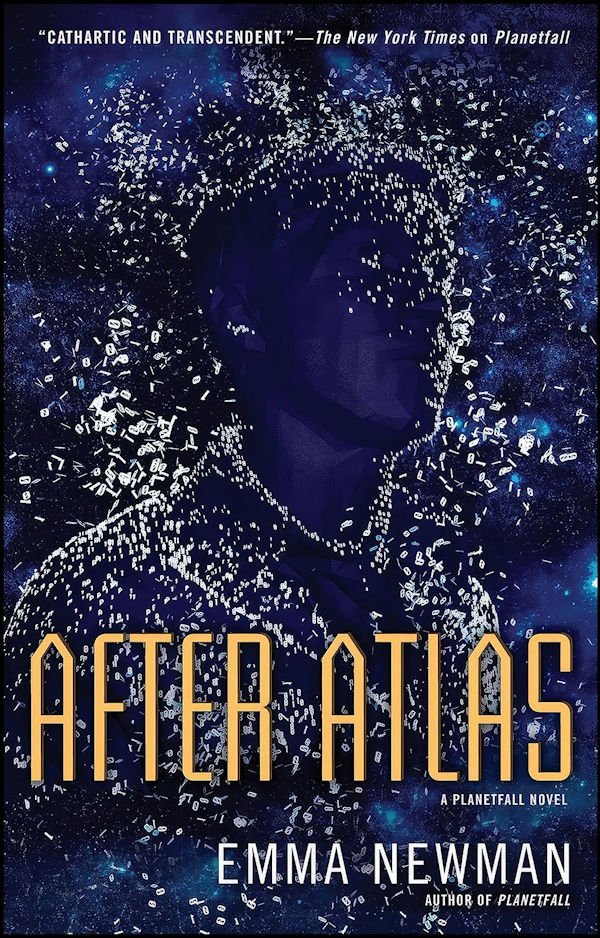
After Atlas, while set in the same universe, is a completely different kind of story from Planetfall. This time it is a murder mystery set in our future, laced with sharp social commentary. The themes are never forced; the criticism comes through naturally as part of the main character’s life and experiences. The worldbuilding balances modern high tech with the eerie, closed-off atmosphere of sect-like low tech communities, creating striking contrasts.
For me, the biggest strength of After Atlas is the main character himself. He is clearly neurodivergent in some way, which made it incredibly easy for me to empathise with him. He struggles with certain foods and with some social interactions, but he has a keen, analytical mind that shines in investigative work. This is done with empathy and authenticity, never as a gimmick or stereotype, and it adds real emotional depth to both stories.
While After Atlas was not the easiest read, it was gripping from start to finish, with twists that kept me alert and invested. Together, these two books show how richly varied storytelling can be within the same universe. One offers an intimate, emotional look at a small, isolated colony on another world, while the other delivers a tense, thought-provoking investigation in a near-future Earth. Both are well worth reading, whether separately or in sequence.
Two very different books, one unforgettable universe. Planetfall is intimate, emotional sci-fi with secrets at its heart. After Atlas is a sharp, tense mystery that keeps you guessing. Both deliver rich worlds, gripping plots, and exceptional neurodivergent representation.

