

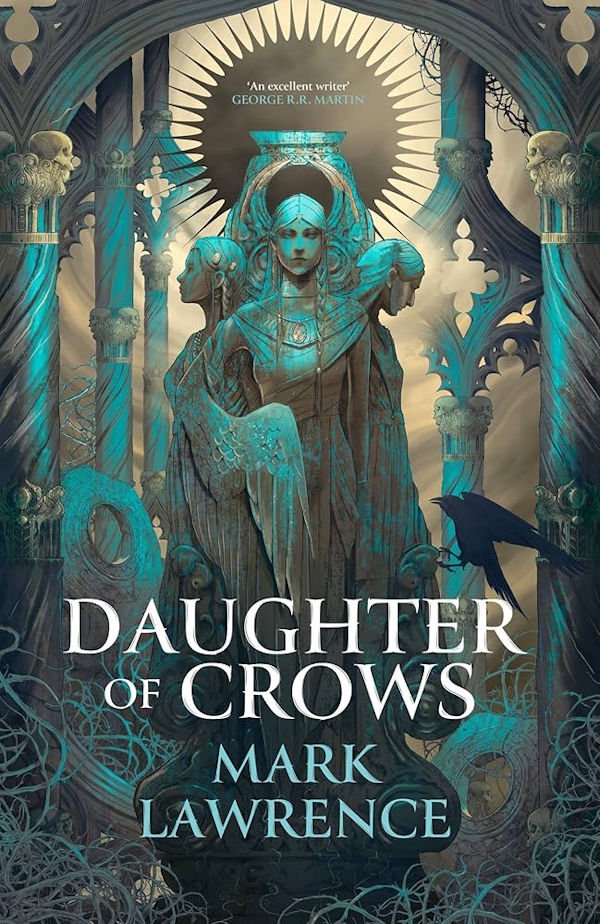
The Academy of Kindness exists to create agents of retribution, cast in the image of the Furies—known as the kindly ones—against whom even the gods hesitate to stand. Each year a hundred girls are sold to the Academy. Ten years later only three will emerge.
The Academy’s halls run with blood. The few that survive its decade-long nightmare have been forged on the sands of the Wound Garden. They have learned ancient secrets amid the necrotic fumes of the Bone Garden. They leave its gates as avatars of vengeance, bound to uphold the oldest of laws.
Only the most desperate would sell their child to the Kindnesses. But Rue… she sold herself. And now, a lifetime later, a long and bloody lifetime later, just as she has discovered peace, war has been brought to an old woman’s doorstep.
That was a mistake.
Innocence stolen, innocence sold, and innocence lost. Only three of the hundred will “graduate” from the Academy of Kindness: a brutal institution where violence and alliances are the only real chances of survival.
This is the first book in a new dark trilogy from Mark Lawrence, one that promises to be gritty, rage-fuelled, and conceptually different.
Let’s start with the main protagonist, Rue, as we first encounter her: an old, bitter, twisted woman trying to forge a life while forgetting another. She is dragged back into a tale of blood and vengeance after witnessing the massacre of her peaceful village. Early on, we discover exactly what she is capable of, and it is not for the faint-hearted. It is visceral, raw, and explosive, instantly showing us there is far more to her character than first appears.
Rue is fascinating, and through her, Lawrence explores a less common approach. Usually, we read as young characters grow through their experiences and the challenges they face. Here, Lawrence flips that expectation, giving us someone who has already lived a life. We see her frustration at growing old and how it limits her abilities. Her mind remains sharp and capable, but her body is beginning to fail her. This creates something different. Rue’s age and experience give her instant depth, while also introducing a relatable and quietly brutal theme. Put simply, Lawrence proves an old lady can still be a force to be reckoned with.
We are introduced to a second narrative that slowly reveals the earlier part of Rue’s life. We discover her time as a student, although indoctrination may be a more apt term, at the Academy of Kindness where she is known as Mollandra. This is the most gripping of the narratives and perhaps the most obvious. We follow 100 girls plunged into trials and challenges, pitted against each other with only the chance of three surviving to ascend to the position of kindnesses. Sculpted to deal a violent justice upon the world. It doesn’t hold back. Scenes of physical and emotional trauma and unrelenting brutality are aplenty, but Lawrence’s prose elevates the material beyond standard grimdark fantasy. Always eloquent, but with a unique brand of bluntness that is revealing and refreshing in equal measure.
Despite the darkness, there is a light that burns bright. The theme of friendship or perhaps it’s more companionship. Unbreakable bonds are formed against the backdrop of survival. Whether these are mutually beneficial acquaintances or something far deeper, you’ll have to decide for yourself but for me this added to the depth of the characters.
Later in the book, we are introduced to the third narrative. This one took me longer to piece together and for me was possibly the most intriguing and darkest one of all. It introduces us to grim and depraved setting. Children. Prisoners in a twisted home, abused and tormented by a mother and father who assume supernatural qualities. Abominations in body and mind. We learn of Rue/Mollandra’s role as the Eldest. Her role to keep the other children safe. Lawrence is at his finest when leaning into the darker themes and this for me was it. It’s emotionally unsettling and at times hard to read. Even her escape is shrouded in a grimdark blanket. Re-united with her real family to enjoy some sense of normality and hope. Only to be betrayed and forced to sell herself to the academy. The worst traits of humanity are exposed and it feels real.
The theme of memory plays a large part in the story. How those memories shape who we are today, what memories we choose to suppress and remember and ultimately how they affect our actions and interactions. Rue is a primary example of someone shaped by her past, trying to forge a new future only to be dragged back and haunted by that inescapable history. It’s relatable on all levels and I think that’s what hooks you the most about this story. However abstract or fantastical it might appear, our past shapes our future. Our suffering, our successes, and more importantly, our relationships. That’s what drives us.
I want to talk about the pacing of the book. I’ve read books where multiple PoVs can create a jarring and hazardous pace. I never felt this happen, and actually the occasional lull in action and tempo gave me a chance to breath and soak up the story, which is a good thing. I don’t want to be fatigued by constant pressure. That said, there is a moment in this story where there is deliberate acceleration to bring us as the reader to a point of climax. That effect left me wanting more, needing more of the story.
In conclusion, Daughter of Crows is an unrelenting, naked depiction of humanity at its worst, but also a fierce reminder of what survives it. It is a story of stolen innocence, brutal endurance, friendship, memory, and the terrible cost of becoming who you are. Lawrence makes you grit your teeth at the violence, ache at the cruelty, and still find beauty in the smallest acts of love and kindness.
This is grimdark fantasy with a pulse. Bloody, intimate, and emotionally ruthless.
My only real criticism is simple: I finished it, and now I have to wait.
After my reading I was able to interview Mark Lawrence about the book and the future of the series.
You’ve created what can only be described as a unique protagonist in Rue. Where did the inspiration for her come from?
I’m rarely able to name inspiration—it all goes into the mixing machine, and the ideas come out without labels. The idea to show her old came from forums/social media where the desire to see older female main characters is frequently voiced. I was either meeting that desire or calling their bluff.
Fantasy often gives us younger characters learning, growing, and discovering their power. Rue is different: she’s already lived a life. Did that allow you to explore something different through her?
Yup. Primarily what the difference between young people and old people is. On the face of it, that’s obvious. But as you look more closely at many individual parts of the answer, the certainty starts to evaporate. Growing old, physically, mentally, and in terms of acquiring experience and memories, is a complex thing with many subtleties.
We follow multiple timelines for a single character. How did that concept develop? Did you start with one period of Rue’s life and add the others to build depth, or was it always the plan to have all three?
I don’t plan my books. They just happen as I write them. I tend to write single point of view books and have provided the illusion of multiple points of view by using different ages for the character before, but they’ve always been relatively close together in years—here I span many decades.
Memory and identity seem central to the book. I felt I was constantly reevaluating Rue across the different stages of her life. Were you exploring how people can seem entirely different at different points in their lives while still being fundamentally the same person?
I was. Memory and identity are inextricably woven together, and the process of aging builds us as it goes. We can only remember a tiny fraction of our life. Much of our experience is concentrated into lessons or attitudes. Quite how our unconscious chooses what to hold onto and what to let slip is, to me, a fascinating and fundamental thing.
I felt the book carried a real psychological weight on many different levels. One of the most fascinating elements was, even in the face of cruelty, friendship, trust and loyalty can still blossom. Was that something you were consciously exploring?
I was certainly looking at the randomness of the friends process along with the hugely consequential nature of those early friendships. Friendships and relationships are a big part of being human, being both a strength and a weakness. I’ve always been interested in how those early chance encounters help form our foundations. And as those friendships fray and fall apart, or are pared more terminally by time’s knife, it’s fascinating how this impacts us. The loss of that network is part of aging, as much as dimming sight and lost vitality.
The Academy of Kindness is such a chilling name for such a brutal institution. The contrast between kindness and violence works incredibly well. How early did you arrive at that name?
I guess wherever it appears in the book—somewhere very early on. I had the Morrigan in the prologue and talked about different aspects of a triple-goddess. It wasn’t much of a jump to decide to use the Furies, and since they were referred to as The Kindly Ones in antiquity, the Academy’s name suggested itself.
There are scenes that feel like fantasy, and others that feel intimate, claustrophobic, and almost horror-like. How conscious were you of moving between epic fantasy, grimdark, and horror?
I just write the story. I never worry about where it fits into any categorisation. I’ll veer from fantasy to sci-fi, and trample over any lesser sub-genre boundaries without a care.
Your books often challenge readers to care about people who have done terrible things. What makes a morally compromised character worth following for you?
They just have to be interesting. That can be as simple as being entertaining—a sense of humour, outrageous behaviour, a dedicated focus on murder… anything like that can be simple fun. We don’t worry too much that John Wick kills a hundred gunmen because someone killed his dog.
They can be interesting in far more sophisticated manners—they might contain fascinating contradictions or be a microcosm of struggles that many of us have.
Or they could have some from column A and some from column B.
Book one leaves us feeling that we understand Rue better, but perhaps not completely. Is the trilogy more about uncovering what happened to her, or what she chooses to become next?
Yes.
And “next” is a tricky concept when you’re pushing back the horizon on one person in three or more time periods… but yes.
And finally, is there a question you hope readers are asking themselves when they finish Daughter of Crows?
I mean… I hope they’re asking how to get hold of every other book I’ve ever written, and where to send the bucket of cash they benevolently want to give me…
But as a direct consequence of the read, I guess I would hope they were thinking about their own experience of growing up or growing old, and were perhaps more conscious of how a variety of processes including choice and chance have shaped them.
Thank you to Mark Lawrence for taking the time to speak with us today! You can learn more about Daughter of Crows and the The Academy of Kindness series on his website, or follow him on Bluesky, Facebook, Instagram, and Threads!

